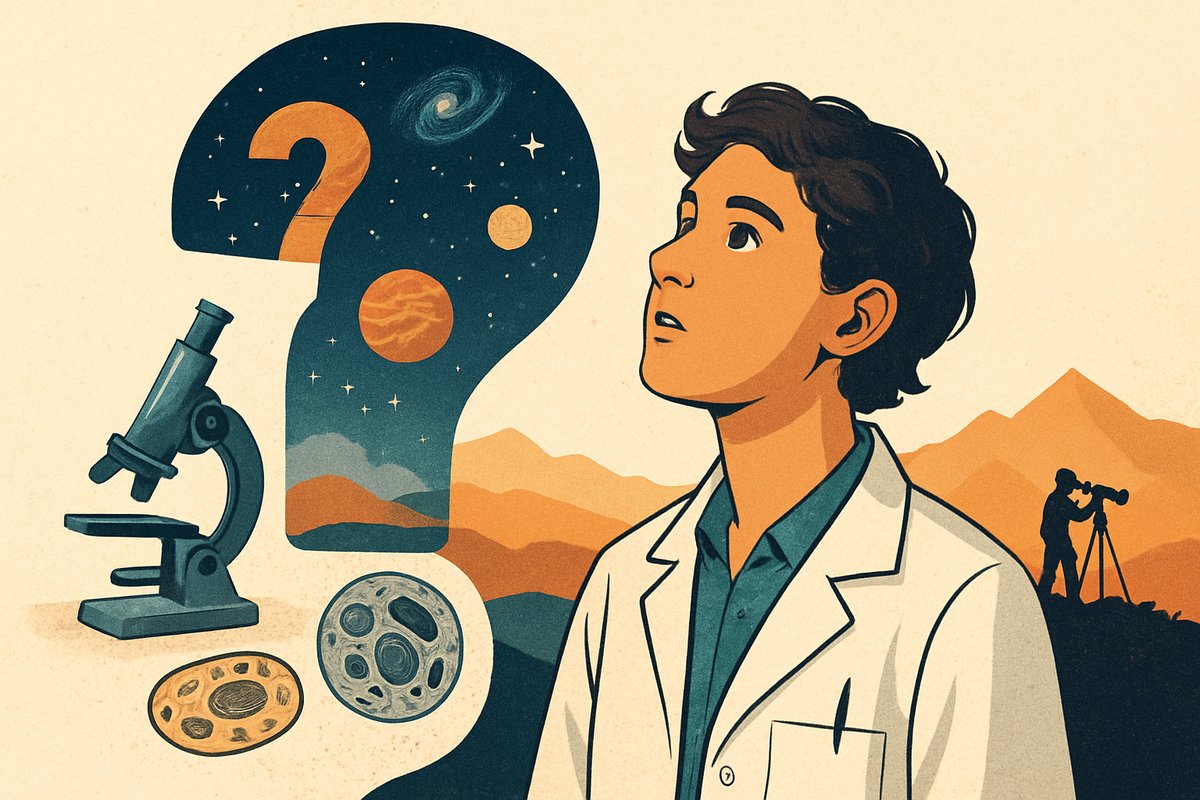

Every great scientific advance once started as a spark of curiosity. A child peering through a glass jar at wriggling insects, an amateur astronomer gazing at the band of the Milky Way, or an observer noting patterns in climate data-all these moments are invitations to ask “Why?” and “How?” Curiosity is the portal through which knowledge enters our world, and as we venture through this portal, we build the bridges that carry us from wonder to understanding.
In a basement laboratory a century ago, a biologist trained his eyes on droplets of pond water with a simple microscope. That tool revealed a hidden universe of microbes, transforming our view of disease, ecology, and the origins of life. Today, entry-level microscope kits allow students and hobbyists to explore the same wonders with greater clarity. Whether examining pond scum or pollen grains, these instruments remind us that a single lens can focus the path to countless discoveries.
Turn your gaze skyward and you enter another realm of exploration. The first telescopes revealed that the faint glow above us was more than just points of light-it was a tapestry of planets, galaxies, and stellar nurseries. Amateur telescopes designed for backyard observers now bring Saturn’s rings and Jupiter’s moons within reach. Each night of stargazing is a collaboration across time, building on centuries of curiosity that reshaped our picture of the cosmos.
Back down on Earth, science turns its attention to the air we breathe, the water we drink, and the soil beneath our feet. Environmental sensors-compact modules that measure temperature, humidity, particulate matter, and more-have democratized monitoring. With these tools, citizen scientists can track local pollution levels, map microclimates in their neighborhoods, or document shifts in seasonal patterns. Data collected by passionate volunteers contribute to larger models, turning community efforts into global action.
Behind every experiment lies a framework of models and simulations. From the mathematical equations that describe quantum particles to the complex climate models that predict tomorrow’s weather, computational tools allow researchers to explore scenarios too vast or too precise for simple observation. Open-source platforms and powerful laptops put these capabilities in the hands of many, encouraging everyone to test hypotheses, visualize outcomes, and refine theories before ever stepping into a traditional lab.
Science thrives at the intersections. Biologists collaborate with computer scientists to decode genomes, chemists team up with engineers to design sustainable materials, and social scientists work alongside data analysts to understand how communities react to technological change. These collaborations cross disciplinary borders and bring fresh perspectives to old problems. Interdisciplinary research centers and online collaboration networks serve as digital crossroads where ideas spark and merge.
In recent years, the rise of remote laboratories has transformed how we learn and conduct experiments. Virtual platforms connect students to real lab equipment housed miles away, allowing anyone with an internet connection to run experiments, collect data, and hone practical skills. This shift not only expands access but also fosters a global community of learners who share results, troubleshoot challenges, and celebrate breakthroughs together.
Citizen science projects have become powerful engines of participation. From monitoring bird migrations through smartphone apps to mapping the night sky using personal telescopes, enthusiasts across the globe contribute to large-scale studies that would be impossible for any single institution to carry out alone. This inclusive approach not only accelerates progress but also deepens public engagement, reminding us that science is a collective enterprise rather than an isolated pursuit.
Beyond tools and infrastructure, the human side of science is defined by perseverance, resilience, and empathy. Lab notebooks are filled with failed trials and unexpected results. Yet each setback carries a lesson, guiding researchers closer to the truth. Sharing those stories-of experiments that went awry, of late-night breakthroughs, of mentors who offered encouragement-builds a culture of openness and support. Emotional intelligence becomes as critical as technical skill in steering teams through complex challenges.
Values-driven science places sustainability and ethical responsibility at its core. Researchers now design experiments with environmental impact in mind, choosing biodegradable materials, reducing energy consumption, and minimizing waste. Projects in renewable energy, circular chemistry, and conservation biology are guided by the principle that discovery should not come at the expense of future generations. This shift towards mindful innovation ensures that scientific progress aligns with the health of our planet.
Democratizing science also means making knowledge accessible. Open-access journals, preprint servers, and science communication platforms ensure that findings reach everyone-from traditional researchers and policy makers to curious readers and DIY tinkerers. Podcasts, interactive websites, and community workshops break down complex concepts into engaging narratives, encouraging lifelong learning and informed decision-making.
Emerging trends continue to redefine what’s possible. Artificial intelligence speeds up data analysis, identifying patterns and anomalies that might escape human eyes. Collaborative robots automate repetitive tasks in laboratories, freeing researchers to focus on creative problem-solving. Portable DNA sequencers and field-ready analytic tools bring cutting-edge techniques to remote locations, enabling real-time insights into ecosystems, disease outbreaks, and cultural heritage preservation.
Science is more than a set of disciplines-it’s a mindset that nurtures curiosity, embraces failure, and celebrates collaboration. Whether you’re a student peering through lenses for the first time or a professional researcher navigating complex systems, the spirit of inquiry remains constant. Each question you ask, each data point you collect, and each theory you refine builds on a vast tapestry of collective effort.
So where do you begin? Embrace the questions that intrigue you. Set up a workspace with the tools that inspire you, from simple notebooks and sensor modules to telescopes and microscopes. Seek out mentors, peers, and online communities. Share your findings, celebrate your breakthroughs, and learn from each obstacle. In every experiment lies the potential for discovery-an opportunity to reshape our understanding of the world.
Beyond the lab bench lies a universe waiting to be explored, from the cells that compose our bodies to the galaxies that stretch across space. Let curiosity be your guide, patience your ally, and community your compass. As you embark on your own journey of discovery, remember that every great advance starts with a single question-and the courage to pursue the answer.
No affiliate links found for this post.