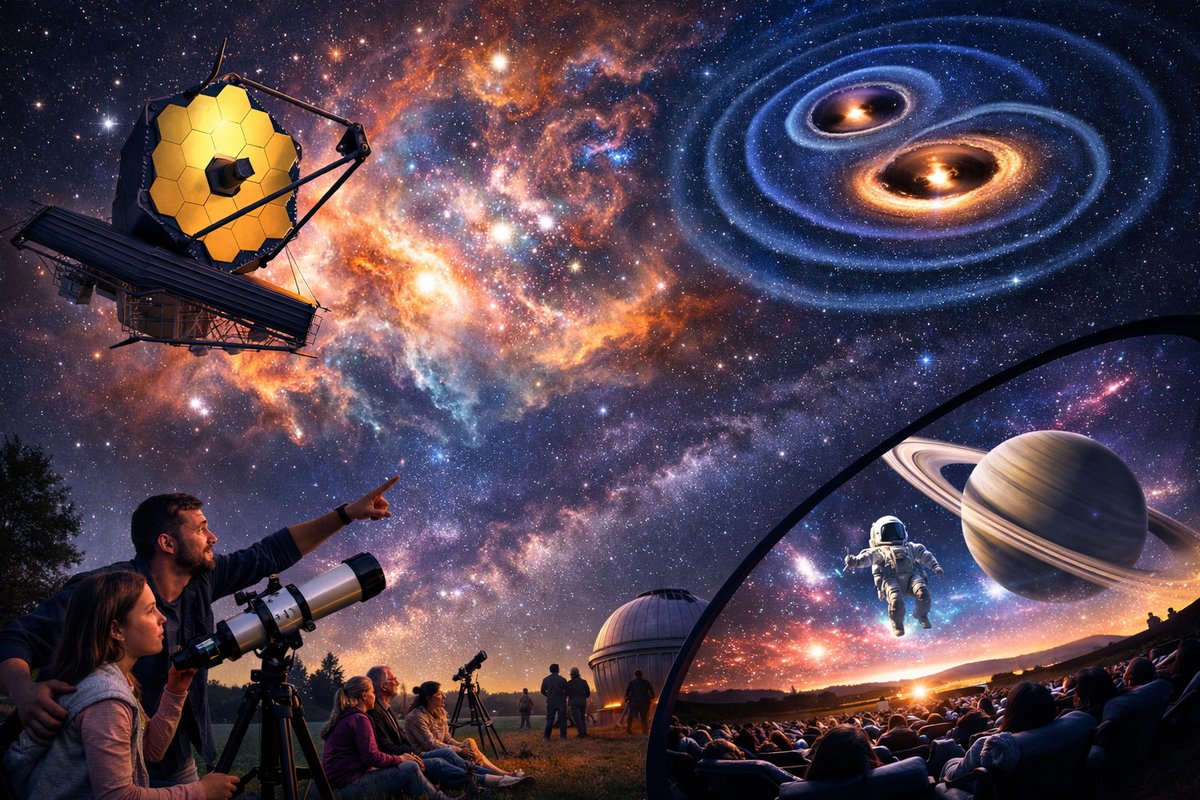

On a clear evening, the faint band of the Milky Way arches overhead like spilled paint across a canvas of velvet. That moment-when the human eye first picks out glowing clusters of stars-has captivated minds since our ancestors watched the sky from riverbanks and hearthsides. Today, a fresh surge of discoveries is rekindling that ancient spark in a broader public than ever before. High-resolution infrared reveals hidden star nurseries, gravitational wave detectors whisper the final convulsions of merging black holes, and citizen scientists armed with smartphones are spotting comets on their morning commutes. Together, these threads weave a modern tapestry of cosmic curiosity.
Only a few years ago, astronomers hailed the James Webb Space Telescope’s debut images as a revolution in seeing. Spiral arms glow with infant stars; dusty pillars shelter protostars on the brink of ignition. Such revelations carry more than scientific value-they prompt existential questions about origins and endings. That sense of awe doesn’t stay confined to university labs. Art installations across city parks now project Webb’s nebulae onto pathways, inviting walkers to trace the outlines of distant worlds beneath their feet.
Meanwhile, on the other side of the spectrum, observatories listening for ripples in spacetime have transformed imperceptible jolts into headlines. Gravitational waves-once theoretical whispers-are today registered as triumphant roars when neutron stars collide. These cataclysmic dances, happening hundreds of millions of light-years away, arrive at Earth as minuscule shifts in laser beams. Yet they resonate deeply, reminding us that we’re participants in a dynamic cosmos woven by gravity and time.
Beyond professional facilities, amateur astronomers are riding the wave of this newfound openness. Online platforms now host thousands of raw telescope images, ripe for community analysis. Anyone with a modest backyard setup can flag anomalies, cross-check catalogs, and sometimes even help confirm exoplanet transits. The thrill of discovery has expanded out of ivory towers and into living rooms. Science centers host monthly ”star parties” where visitors trade tips on polar alignment and share freshly developed astrophotographs over hot chocolate.
It’s not just the night sky that’s sparking wonder but the way these cosmic stories reshape our everyday perspective. Psychologists note that moments of transcendence-often triggered by exposure to vast scales-can foster humility, empathy, and more sustainable worldviews. When we glimpse the swirl of lights in a galaxy, we’re reminded of our shared home on a small, fragile planet. Environmentalists are beginning to harness this ”overview effect” by partnering with observatories to pair stargazing events with ecosystem preservation talks.
If you feel drawn to join this chorus of cosmic explorers, a few simple steps will get you started. First, take a night to escape city lights and reacquaint yourself with constellations: Orion’s belt, the Big Dipper, Cassiopeia’s W. Online sky-mapping tools and smartphone apps can overlay real-time charts on your screen, guiding you from one bright star to the next. Soon, you’ll peer through binoculars at the fuzzy patches of Andromeda or glimpse Jupiter’s moons as pinpoint jewels.
Helpful as smartphones are, nothing beats a pair of dedicated astronomy binoculars when it comes to field portability. A lightweight model with 7x to 10x magnification brings open clusters and lunar craters into view, and a tripod adapter turns shaky hands into steady observers. For more committed stargazers, a refractor telescope opens the doors to planetary details: Saturn’s rings, Neptune’s blue haze, the turbulent cloud bands of Jupiter. These instruments aren’t just tools-they become companions on a journey that can span decades.
To record your discoveries, many beginners turn to astrophotography. You don’t need a sprawling observatory dome; a DSLR or mirrorless camera, coupled with a straightforward telescope adapter, can capture Saturn’s ring shadows or the rising glow of the Moon against a silhouette of trees. Tracking mounts that counteract Earth’s rotation allow exposures of several minutes without star trails. The satisfaction of seeing your own Milky Way panorama appear on a screen is enough to keep you refining focus well past midnight.
The calendar itself offers a rotating menu of celestial delights. Each year brings predictable meteor showers-the Perseids, Geminids, Leonids-where hundreds of shooting stars streak across hours of dark sky. Solar and lunar eclipses, though rarer, gather crowds of onlookers who marvel as day briefly turns to night or the full Moon slips into Earth’s shadow. And planetary alignments-when bright planets cluster near the horizon-remind us that even our own Solar System stages its own choreography.
For those seeking immersive experiences, modern planetariums blend science with spectacle. Dome theaters flicker with simulated journeys through the asteroid belt, VR headsets let you ”land” on alien terrains, and live narrations weave in the latest data from space missions. These high-tech sanctuaries echo ancient grottoes of wonder, translating dry numbers into narratives that captivate adults and children alike.
Art and design also reflect our cosmic renaissance. Galleries stage light sculptures that trace star trails, public murals depict nebulae in florescent paint, and composers write string quartets inspired by pulsar rhythms. This interplay of science and creativity underscores a core truth: exploring the universe isn’t solely about equations or telescope apertures. It’s an emotional quest, one that invites us to expand our sense of self alongside our field of vision.
That interplay extends to community. Informal meetups at local parks can turn into lifelong friendships, bonded by late-night chats about dark matter or the search for life on Mars. Online forums buzz with anticipation whenever a new space probe sends back raw images, and social media feeds fill with shareable ”astro-memes” riffing on black hole illustrations or alien world speculation.
Our cosmic curiosity is far from sated. Missions to icy moons, next-generation gravitational wave detectors, and proposals for interstellar probes all lie on the horizon. Meanwhile, anyone with clear skies and a spark of interest can join the adventure. As you learn to spot Polaris, frame your first comet tail, or simply sit under the dome of sky in silent contemplation, you become part of a story billions of years in the making. And that may be the greatest discovery of all-that beneath the stars, we find not only the universe’s wonders but our own unlimited capacity for awe.