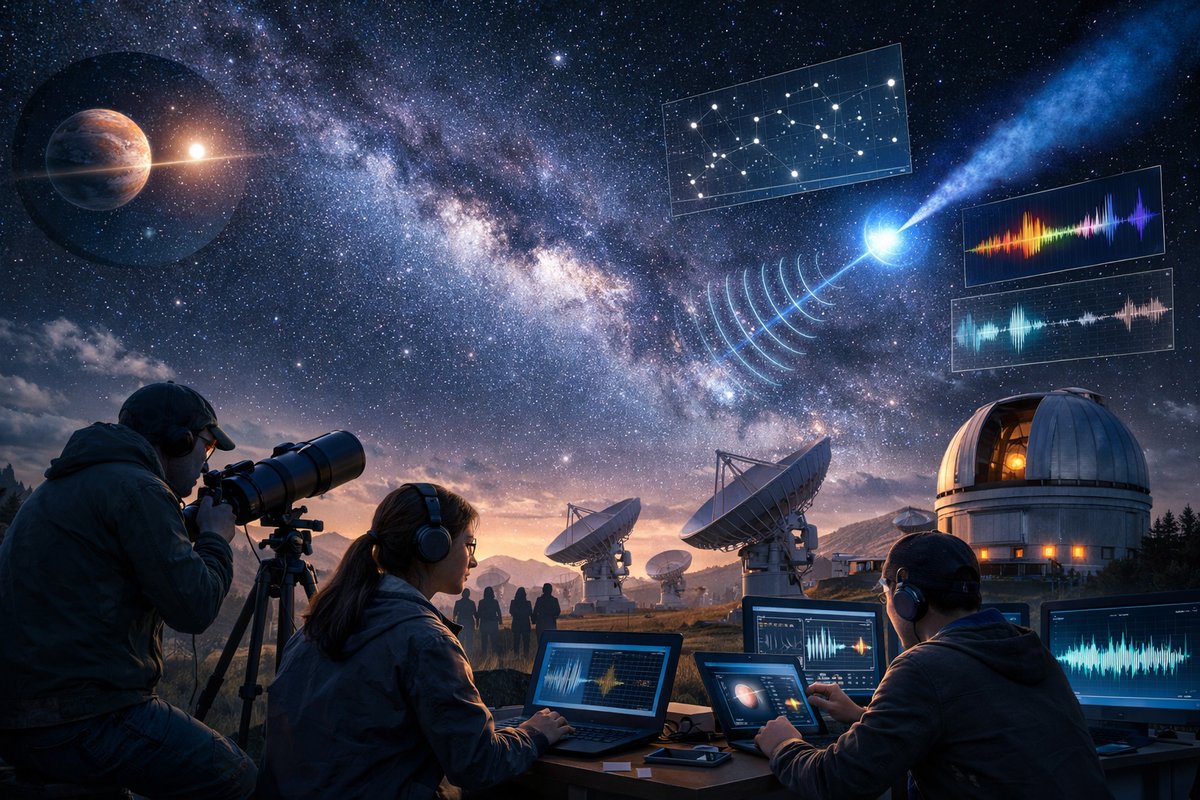

On a clear night, far from city lights, a cluster of backyard telescopes peers into the depths of space. What was once confined to professional observatories is now unfolding in suburban backyards, community centers, and online collaborations. This grassroots movement is not only rekindling our collective sense of wonder but also producing genuine scientific breakthroughs.
Astronomy has always been a field shaped by pioneers who refused to accept boundaries. In recent years, however, a surprising shift has taken place: nonprofessionals armed with modest equipment and boundless curiosity are pushing forward discoveries once reserved for large research institutions. At the heart of this transformation lies unprecedented access to open data from space agencies, ground-based telescopes, and gravitational wave observatories.
The Laser Interferometer Gravitational-Wave Observatory (LIGO) and its European counterpart Virgo have captured ripples in space-time generated by colliding black holes and neutron stars. While the raw data is complex, sets of citizen science platforms have emerged to help volunteers sift through noise and spot candidate events. Volunteers listen for faint chirps buried in sensor readings, effectively augmenting the search for signals that confirm theories of general relativity.
Meanwhile, space telescopes scan thousands of stars in search of transiting exoplanets. Public databases publish light curves that record dips in brightness when a planet crosses its host star. Through user-friendly interfaces, enthusiasts around the globe flag unusual patterns, some of which later become confirmed worlds. In one case, a high-school astronomy club identified the transit of a previously unknown exoplanet, earning a spot in a scientific publication alongside professional researchers.
Citizen science doesn’t end with signal detection. Projects that digitize photographic plates from century-old astronomical archives invite volunteers to tag and classify historical data. This effort has led to the rediscovery of long-lost comets and supernovae that faded from professional attention decades ago. The exercise is equal parts archaeology and adventure: every scan holds a chance to rewrite a chapter of cosmic history.
Backyard stargazers are also taking astrophotography to new heights. With smartphone adapters that clip onto optical scopes, amateurs capture detailed images of lunar craters, nebulae, and even the faint band of our galaxy. Social media groups dedicated to night-sky imaging share tips on exposure settings, light pollution filters, and DIY rigs for motorized mounts that track Earth’s rotation.
Some enthusiasts have gone further, building open-source radio telescopes from off-the-shelf electronics. By tuning into hydrogen-line emissions, they map the structure of the Milky Way’s spiral arms. Others repurpose low-cost software-defined radios to eavesdrop on solar flares and distant pulsars. The key ingredient is curiosity, combined with a willingness to tinker and learn.
In the realm of professional research, collaborations between seasoned scientists and citizen contributors are becoming routine. Online platforms match volunteers with tasks that range from counting sunspots to classifying galaxy shapes in deep-field images. Each classification helps automate the next generation of machine-learning algorithms, accelerating data analysis in large-scale sky surveys.
Virtual reality experiences are now bringing cosmic phenomena into living rooms. Through real-time feeds from observatories, users can glide between planets, float alongside asteroid missions, and witness simulated black-hole mergers. This immersive approach isn’t just entertainment. Educators use VR modules to teach gravitational dynamics, helping students grasp concepts that once lived solely in mathematical equations.
Open data policies from major space agencies have fueled this explosion of participation. Anyone with a broadband connection can download raw telescope observations, satellite imagery, or particle-detector readings. Combined with powerful, low-cost software tools for data visualization and statistical analysis, the barriers to entry have never been lower.
As community networks form around local planetariums, science centers, and online forums, passion often morphs into purpose. Amateur astronomers volunteer at public star parties, guiding newcomers through eyepieces and sharing stories of cosmic discoveries. In cities, rooftop observatories host free events, drawing families who gaze at Saturn’s rings or Jupiter’s cloud bands for the first time.
Grassroots efforts have also focused on sustainability. Dark-sky advocacy groups campaign to reduce light pollution, protecting both nocturnal wildlife and the visibility of faint celestial objects. Community fundraisers install shielded LED streetlights that preserve night horizons, demonstrating how environmental concerns can intersect with scientific curiosity.
Privacy considerations have entered the conversation too. As open data grows, so does awareness of how observational technology can capture sensitive information on Earth. Discussions around responsible data sharing emphasize anonymity for personal imagery and fair use of satellite photos, ensuring that the rush to explore the cosmos doesn’t compromise individual rights.
Despite the accelerating pace of discovery, the universe remains vast and mysterious. Dark energy, the cosmic microwave background, and the nature of dark matter still elude full explanation. Yet the tapestry of questions fuels ongoing engagement. Each new participant-regardless of age or background-becomes a thread in this tapestry, weaving together diverse perspectives and creative approaches.
Today, the gap between backyard telescopes and major research facilities is narrowing. The traditional image of the lone astronomer peering through a massive dome is evolving into a global network of collaborators. Whether sorting through gamma-ray bursts, logging meteor showers, or charting the movement of near-Earth objects, citizen explorers are both students and teachers, sharing discoveries and inspiring further quests.
The era of cosmic curiosity is more than a trend; it’s a cultural shift. It honors the natural drive to push beyond familiar horizons and find meaning in the night sky. In doing so, it reminds us that the greatest discoveries often arise when people unite across disciplines, cultures, and skill levels.
The universe may be infinite, but understanding it is a journey that starts with a single question: What’s out there? With open data, affordable tools, and an eager community of explorers, the answer is no longer distant-it begins in every backyard, classroom, and online forum where curiosity takes flight. Together, we are charting the cosmic unknown, one observation at a time.