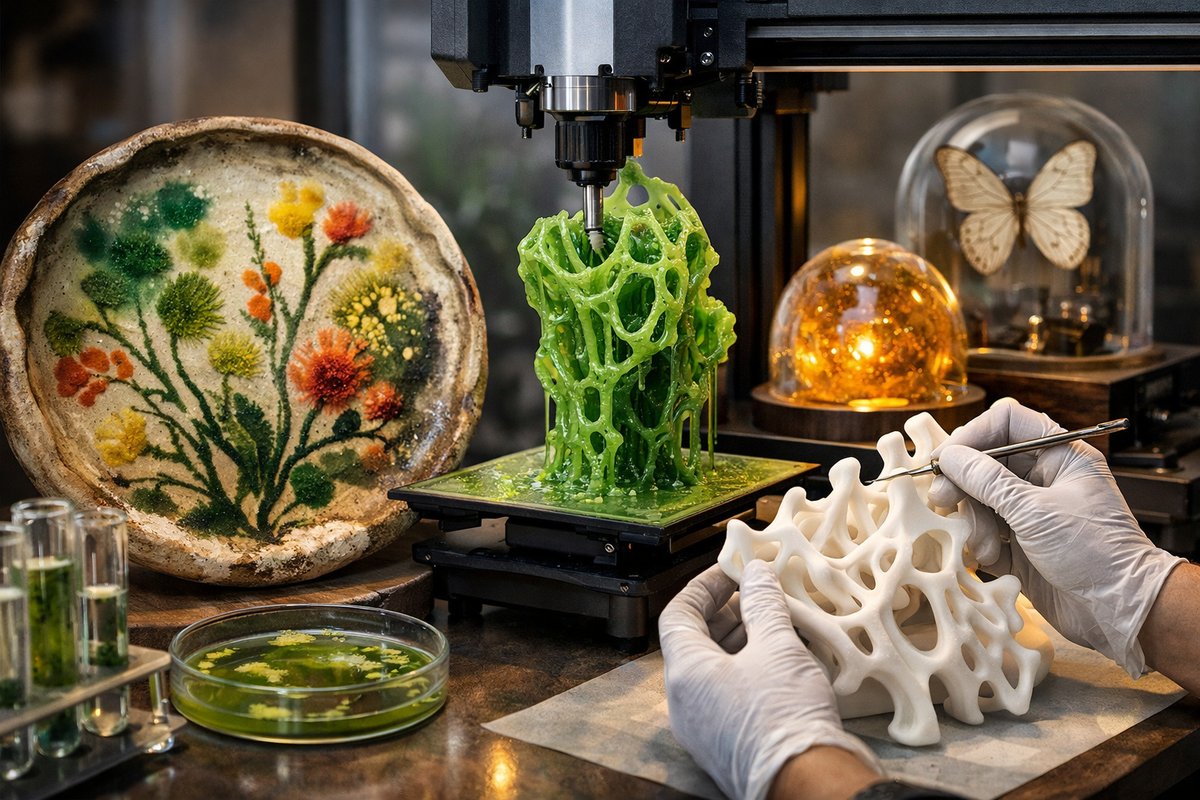

At the heart of the downtown cultural district, a sprawling new exhibition invites visitors into a world where art pulses with life and machines hum with organic potential. Walls are lined with ceramic tiles seeded with microbial paints that grow into microscopic forests of color. In a nearby gallery bay, gleaming sculptures rise in delicate lacework, each layer the product of a 3D printer fed by recycled filament and eco-friendly photopolymer resin. This showcase marks a pivotal moment in contemporary art, one in which the roles of artist, scientist, and engineer converge in unprecedented ways.
One of the exhibition’s most talked-about installations features living bacteria cultivated on custom clay canvases. Viewers lean in to observe swirls of orange and teal emerging over days, guided by invisible gradients of temperature and moisture. What seems like pure painterly abstraction is in fact the result of carefully calibrated lab conditions-an artwork that continues to evolve long after its creator steps back. This living painting challenges traditional notions of permanence and authorship, raising questions about the artist’s hand versus nature’s will.
A few steps away, a team of designers has built a modular pavilion entirely from 3D-printed components. Using an open-source digital model, they printed each piece from biodegradable polylactic acid filament derived from agricultural waste. Once on site, the parts snapped together like a life-size puzzle, forming an undulating canopy traced with fractal patterns inspired by tree branches. During evening events, LED projectors cast shifting kaleidoscopic patterns over the structure, further blurring the line between natural forms and digital frameworks.
The emergence of bio-design within fine art reflects broader cultural shifts. Increasingly, artists collaborate with microbiologists to tap into the creative potential of living systems. One sculptor partnered with a molecular biologist to embed antimicrobial pigments into earthenware vessels, creating decorative pottery that actively resists mold. Another collective used algal cultures to screenprint biodegradable posters, harnessing photosynthetic pigments in place of synthetic inks. These experimental works speak to an ecological urgency: as we face global environmental challenges, artists probe the possibilities of regenerative design.
Digital fabrication has become an equally powerful frontier. Over the past decade, desktop 3D printers and laser cutters have democratized access to high-precision tools once reserved for industrial settings. In this exhibition, visitors encounter sculptures that would have taken months of hand carving; instead, they emerged overnight through additive layering or selective laser sintering. A kinetic piece fashioned from powdered metal springs to life through embedded servomotors, its mechanical heart programmed via open-source code shared freely online.
Central to many installations is the notion of interactivity. In one immersive room, motion sensors track the motion of visitors, triggering streams of colored smoke from hidden vents. Elsewhere, a digital mural responds to ambient noise levels: the louder the crowd, the more dynamic the animations. These works demand that viewers become participants, turning passive observation into a collaborative act of creation. Such experiences underscore a shift toward relational aesthetics, where art exists not as static object but as a process shaped by community.
The technical demands of these hybrid projects are significant. Artists now contend with microbiological safety protocols alongside digital modeling challenges. Some maintain small onsite labs-complete with incubators, sterile hood benches, and culture flasks-while also integrating computer-aided design software and 3D printer control interfaces. Precision instruments like digital calipers and optical microscopes sit atop drafting desks next to sketchbooks packed with CRM-driven annotations. For many, the journey from concept to finished work involves iterative cycles of lab notes, rapid prototyping, and field testing under gallery lights.
Achieving accurate color reproduction is another critical concern. With living pigments, hues shift unpredictably over time, while digital prints can lose vibrancy under standard gallery lighting. To address this, curators have installed adjustable color-rendering LED fixtures calibrated to mimic natural daylight. Portable color calibration devices ensure that projected animations and monitor-based previews match onsite renderings, preserving the integrity of each piece as it moves from studio to exhibition.
Sustainability lies at the core of this movement. Recycled and renewable materials serve as the primary building blocks-from plant-based resins and post-consumer plastics to organic textile dyes cultivated in lab bioreactors. Closed-loop systems collect runoff from live-culture displays, using simple filtration to recycle water and nutrients. Some artists even incorporate solar panels into outdoor installations, allowing interactive elements to run off solar-charged batteries. This eco-centric approach demonstrates how creative practice can model responsible stewardship.
Ethical considerations weave through every corner of the exhibit. When working with living organisms, artists confront questions about consent and welfare. Do bacterial cultures deserve the same stewardship we afford higher life forms? Should genetic editing ever be part of an aesthetic endeavor? Panels featuring ethicists, biologists, and art historians tackle these issues head on, inviting audience members to weigh in. The resulting dialogues foster a deeper understanding of how novelty in material can reshape not only aesthetics but also moral frameworks.
Beyond the gallery walls, educational programs have sprung up to support emerging practitioners. Workshops teach the basics of sterile lab technique alongside introductory CAD tutorials. Pop-up maker spaces offer hands-on access to laser cutters, microcontrollers, and sustainable filament extruders. By lowering technical barriers, these initiatives cultivate a new generation of creators comfortable bridging petri dish and printer bed.
The influence of bio-digital art is also rippling into public spaces. City planners are piloting living murals on municipal buildings, using photosynthetic films that absorb urban pollution. At a local park, a pavilion of 3D-printed bamboo composite serves as both playground shade and interactive art piece. These prototypes suggest a future where art and infrastructure converge in responsive, self-sustaining systems.
As the exhibition draws to a close, visitors emerge with a renewed sense of possibility. The show has not only presented compelling artworks but also charted a roadmap for interdisciplinary creativity. It reveals how art can lead conversations about technology, environment, and ethics, planting seeds for innovations yet to come. For those who walked amid living pigments and algorithmic sculptures, the message is clear: the boundaries of material and machine are dissolving, and the next frontier of visual expression will be as dynamic and unpredictable as life itself.
In a world hungry for new perspectives, this bio-design movement offers a powerful reminder: art can be both a mirror to our ecological challenges and a laboratory for imagining alternatives. Whether through the slow unfolding of microbial paintings or the rapid assembly of 3D-printed forms, the works on display underscore a shared truth-creativity thrives at the intersection of curiosity and responsibility. As the lines between artist, engineer, and biologist blur, we are invited to envision a future in which art not only reflects our world but also grows within it, evolving alongside the living materials it employs.