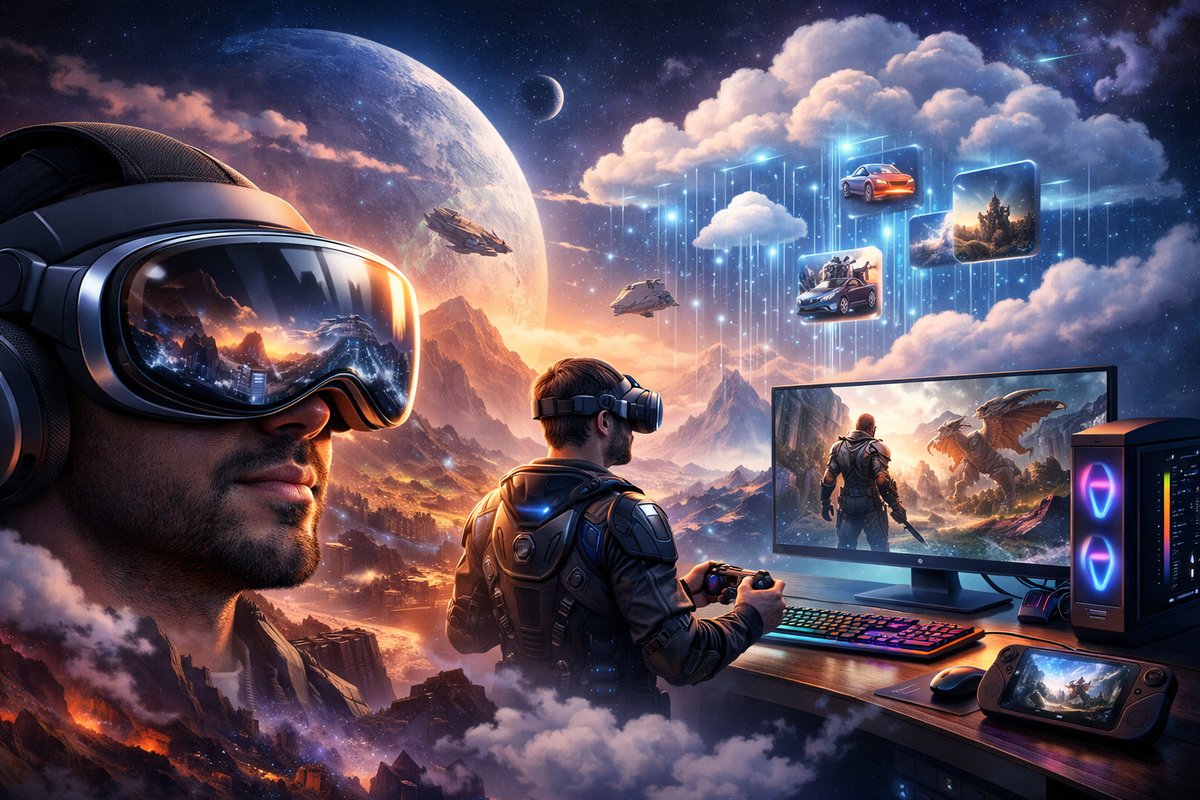

Imagine stepping into a digital arena where every sound, every movement, and every sensory cue feels indistinguishable from reality. That’s the promise driving today’s gaming and entertainment industries-and recent announcements suggest we’re closer than ever to living out that sci-fi dream. At a major summer showcase, several developers unveiled new mixed-reality prototypes and immersive live-event platforms, while hardware manufacturers teased next-generation accessories designed to heighten presence.
Behind the scenes, market analysts report that global spending on immersive hardware-headsets, haptic accessories, and spatial audio rigs-has surged by more than 35 percent over the last year. Cloud-based streaming services have also logged record-breaking subscriber growth, proving that even budget-minded players want instant, high-fidelity access to premium titles on any screen. These twin forces-state-of-the-art peripherals and ceaseless network innovation-are reshaping how we define “play.”
In the hardware realm, mixed-reality headsets are stealing the spotlight. One prototype demonstrated at a recent expo boasted eye-tracking sensors that adjust resolution dynamically, reducing motion blur and cutting power consumption. Another unveiling centered on full-body haptic vests, enabling users to feel virtual impacts as they explore simulated environments. Paired with advanced spatial audio systems woven into modular earcups, these setups transport players into worlds where every leaf flutter, footstep, and distant explosion registers as a tactile, immersive event.
Meanwhile, cloud gaming continues its rapid ascent. Major platforms now offer hundreds of titles in 4K resolution with sub-50-millisecond latency, thanks to edge-computing nodes stationed closer to urban centers. For players without the budget for top-tier hardware, simply streaming a blockbuster title from a midrange laptop or mobile device feels almost indistinguishable from running it on a high-end desktop. Developers are responding by optimizing real-time ray tracing and adaptive resolution scaling, ensuring that streamed visuals remain crisp without taxing network pipelines.
Equally transformative is the rise of cross-platform connectivity. Online communities no longer splinter based on device type; console, PC, and mobile players can now squad up seamlessly. Recent esports tournaments showcased five-platform lobbies-PC, console, handheld, cloud stream, and AR headset-competing in the same match. Social hubs within these ecosystems let friends drop into virtual lobbies, watch live events, or co-develop custom maps in real time. The result is a more inclusive, borderless landscape that elevates player agency and fosters fresh creative collaborations.
On the software side, developers are experimenting with modular design frameworks that adapt game mechanics on the fly. Early versions of this tech used procedural generation to craft environments; today, AI-driven narrative engines recalibrate story beats based on each player’s decisions, ensuring no two adventures feel identical. This personalized storytelling, paired with persistent world updates, keeps communities engaged long after launch. Indie studios have been quick to adopt these tools, releasing episodic titles that evolve in response to player-submitted assets, fan-driven events, and real-world data feeds.
Sustainability is another key trend reshaping the gaming ecosystem. Hardware makers now advertise energy-efficient chips built with low-power architectures, while some console manufacturers have committed to 100 percent renewable-energy data centers for their online services. Gamers themselves are embracing eco-friendly practices: modular consoles and PC components that can be upgraded instead of replaced, recycling programs for old peripherals, and a thriving market for refurbished gear. Even cardboard VR viewers and biodegradable packaging have entered the mainstream, reflecting a broader push toward circular-economy principles.
Community-driven events are taking on new forms, too. Instead of watching pro gamers on a flat screen, fans can don omnidirectional treadmills bundled with livestreaming overlays that let them share each running step, leap, or dodge with viewers in real time. Co-streamers can teleport into each other’s point-of-view feeds, creating multiangle broadcasts where audiences choose which player perspective to follow. Virtual concert venues now seat thousands of fully rendered avatars, complete with customizable stage lighting and pyrotechnics that synchronize to live performances. Such events blur the line between game and show, offering novel monetization channels for creators and fresh engagement opportunities for audiences.
Looking to the near future, several experimental projects hint at even deeper layers of immersion. Lightweight neural headbands promise to map facial expressions to in-game avatars with millisecond responsiveness. AR-capable contact lenses could project virtual elements into our physical surroundings without bulky eyewear. Tactile gloves under development may recreate the feeling of soft fabrics, rigid metals, and flowing water, delivering a banquet of new sensory cues. And AI companions built from large-language models could evolve alongside players, learning playstyles and even cracking inside jokes.
Yet for all this momentum, the heart of play remains the same: human curiosity and connection. Whether you’re exploring a neon-lit cyberpunk metropolis through a headset or leading a guild in a cloud-streamed fantasy MMO, the draw of shared narratives and friendly competition endures. Today’s hardware and software breakthroughs simply amplify the emotional beats that have driven gaming for decades-memorable characters, epic challenges, and the joy of triumphing together.
For novices setting up their first dedicated play nook, start by balancing comfort and performance. A supportive chair, proper ambient lighting, and a pairing of midrange peripherals can yield an experience far richer than a basic living-room TV and couch combo. As budgets expand, layering on immersive add-ons-spatial audio rigs, eye-tracking mounts, or motion-capture accessories-lets you discover new dimensions of presence without overhauling your entire space at once.
Veterans seeking the bleeding edge should watch for the next wave of AI integration in game engines, real-time worldbuilders, and procedurally adaptive soundscapes. Gear makers are already exploring how machine-learning algorithms can optimize haptic feedback patterns on the fly, ensuring that each impact or footstep feels distinct based on surface type, animation speed, and player weight distribution.
No matter where you land on the spectrum-casual mobile adventurer, hardcore VR pioneer, or live-streaming showrunner-today’s entertainment landscape is richer than ever. By merging bold hardware innovation with software that learns and adapts, gaming is fast becoming an all-encompassing medium that rivals film, theater, and live music in its ability to move us.
As the lines between play and reality continue to blur, one thing remains certain: the drive to explore, compete, and connect will push creators to ever greater heights. So gear up, log in, and prepare to discover worlds you never imagined-because the next frontier of play is yours to define.