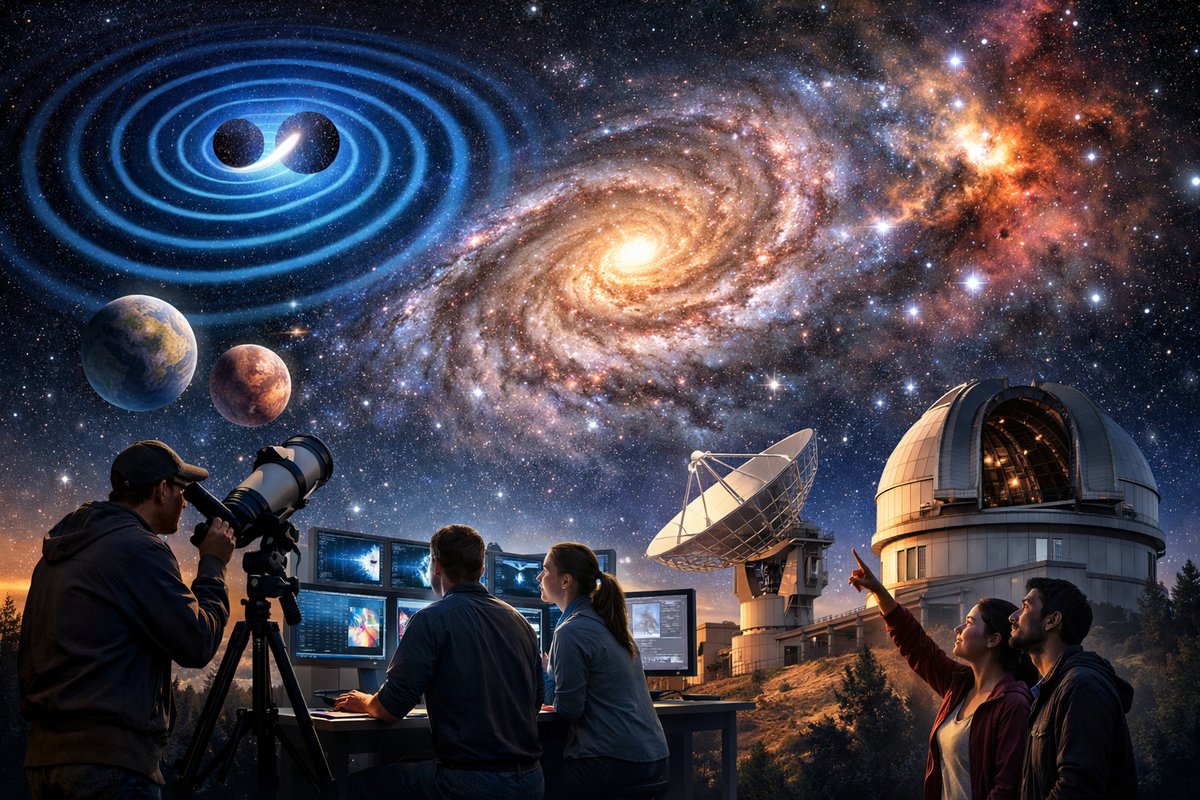

From the soft glow of distant nebulae to the sudden flash of a meteor streaking across the sky, cosmic phenomena have long inspired both awe and inquiry. In the past year alone, a series of breakthroughs has reignited public fascination: new detections of gravitational waves, unexpected radio bursts from far-off galaxies, and unprecedented infrared images revealing hidden pockets of star formation. Together, these revelations are weaving a new narrative of unity between professional researchers and amateur enthusiasts.
Early in the season, ground-based observatories reported fresh gravitational wave signals emanating from collisions between neutron stars and black holes. Unlike earlier detections, which often required elaborate filtering, these latest ripples arrived with clear patterns that challenged existing models of stellar evolution. The implications have sent theorists back to whiteboards, while outreach groups organized online seminars to explain the cosmic choreography in terms accessible to curious minds of all ages.
Meanwhile, a network of radio telescopes captured an unusually bright Fast Radio Burst (FRB) repeating every few hours. Although FRBs have been recorded before, this repeating pattern allowed researchers to pinpoint its origin in a small, distant galaxy. This finding has prompted a surge in crowd-sourced mapping efforts, inviting volunteers to help correlate FRB activity with optical telescope surveys. Citizen scientists now sift through vast data streams, marking potential source regions and accelerating professional follow-up observations.
Perhaps the most visually striking contributions have come from new infrared imagery that peels back interstellar dust to expose the birthplaces of stars. A space-borne observatory released mosaic views of dense molecular clouds, showing stellar nurseries in unprecedented detail. Amateur astrophotographers quickly began adapting long-exposure setups and specialized filters to record complementary images in visible light, creating side-by-side comparisons that highlight the hidden intricacies of cosmic scaffolding.
In response to these developments, public star parties have multiplied in parklands and schoolyards. Community groups are equipping portable refractor telescopes and binoculars, paired with red-light headlamps to preserve night vision. Attendees gather to watch transient events firsthand-be it a Jupiter occultation or a rare alignment of Saturn’s rings. For many, the act of pointing a telescope at a speck in the sky brings home how small our daily concerns become when measured against cosmic timescales.
This groundswell of engagement is reshaping the relationship between institutions and individuals. Universities are streaming live feeds from southern-hemisphere observatories, letting remote viewers guide telescope slews in real time. Data-analysis workshops teach participants how to run basic astrophysical codes on home computers, democratizing access to research-grade tools. Even planetariums are integrating satellite-derived light-pollution maps, encouraging local activism to protect dark-sky reserves and preserve the view for future generations.
The thirst for cosmic knowledge is extending beyond visible phenomena. Deep-sea neutrino detectors and mountain-top cosmic-ray arrays are now recruiting non-specialists to host sensors and track environmental variables. By participating, volunteers contribute to multimessenger astronomy-combining gravitational waves, neutrinos, and photons to assemble a more complete picture of high-energy events. The resulting datasets feed into open repositories, ensuring that science remains transparent, collaborative, and inclusive.
Amid these scientific pursuits, artists and poets are translating cosmic data into new works. Light-curve plots become motion-triggered installations, while spectral diagrams inspire interactive soundscapes. Workshops pair physicists with dancers, exploring how gravitational distortions might influence choreography. The dialogue between art and science underscores a shared drive: the desire to make sense of the vast unknown through creativity as much as through calculation.
Educational initiatives are also evolving. Virtual-reality modules transport students onto the surface of an icy moon, letting them inspect cryovolcanic features in immersive detail. Augmented-reality stargazing apps overlay constellation outlines onto real-time night skies, while built-in quizzes test orbital mechanics concepts. These tools are bridging the gap between textbook theory and experiential discovery, nurturing the next generation of astronomers, engineers, and dreamers.
On an individual level, the renewed cosmic curiosity offers practical benefits. Studies suggest that regular engagement with nature and night-sky observation can reduce stress, boost creativity, and foster a sense of wonder. Community science platforms report improved mental-health outcomes among volunteers who track meteor showers or help classify galaxy shapes. In a world of constant information overload, moments spent gazing at distant suns provide a grounding reminder of our place in a vast and ancient universe.
As humanity gears up for crewed missions to the Moon and Mars, the wave of enthusiasm for cosmic discovery plays a subtle but vital role. Public support influences funding decisions for next-generation telescopes and interplanetary probes. Enthusiastic amateurs often supply serendipitous observations-such as the first sighting of a new comet-that prompt rapid professional follow-up. In this sense, the bridge between backyard stargazer and research scientist is more than symbolic: it directly fuels the engines of exploration.
Looking ahead, several upcoming events promise to capture collective imaginations. A rare planetary conjunction will bring Venus, Saturn, and Jupiter into an arc visible at dusk. A predicted outburst of a lesser-known meteor shower could produce hundreds of meteors per hour for those in dark-sky locations. And next-generation gravitational-wave detectors are slated to come online, offering even greater sensitivity to faint cosmic whispers. Each of these phenomena opens a fresh window onto processes that shape galaxies, stars, and the very fabric of spacetime.
Ultimately, the recent surge in cosmic curiosity is more than a passing trend. It represents a profound shift: the recognition that exploring the universe is not the sole province of professionals, but a shared adventure open to anyone who looks up and wonders. By combining cutting-edge discoveries with inclusive outreach, science is cultivating a culture of lifelong learning rooted in humility, curiosity, and collaboration.
In living rooms and lecture halls, you’ll find people charting star paths and discussing the latest data on cosmic dust composition. In backyards and mountaintops, voices register surprise as a fleeting gamma-ray burst flashes on a portable display. Across online forums, new friendships form around deep questions: How did the first galaxies take shape? Might life exist elsewhere? What stories do the stars still have to tell?
These questions animate the collective soul of our species. They remind us that, despite our small size on a cosmic scale, we possess an unstoppable capacity to imagine, to explore, and to connect. Each photon captured by a telescope, every waveform logged by a detector, becomes part of an ever-growing tapestry stretching across time and space.
So on the next clear night, consider stepping outside. Find a spot away from bright lights, tune your eyes to the darkness, and let curiosity guide you. Whether you’re following a meteor trail, tracking the phases of the Moon, or simply contemplating the faint glow of the Milky Way, you become part of a grand story that spans eons and light-years. And in that shared experience, we find both perspective and purpose: the universe awaits, and there’s always more to discover.
May the wonder of starlight continue to spark new ideas, collaborations, and dreams. After all, cosmic curiosity is the fuel that drives humanity’s greatest adventures-both out among the stars and within the boundless landscapes of the mind.
-
Watch 700X70 Refractor Telescope with Adjustable Tripod on ...
Shop with expert advice from ESSLNB in their latest video 700X70 Refractor Telescope with Adjustable Tripod. -
18X70 High Power Binoculars for Adults-Outdoor and Astronomy ...
Amazon.com : 18X70 High Power Binoculars for Adults-Outdoor and Astronomy Binocular,Large Aperture for Long Distance Viewing with Smartphone Adapter Mount ... -
Star Tracker - Amazon.com
Motorized DSLR Night Sky Tracker Equatorial Mount for Portable Nightscapes, Time-Lapse and Panoramas – Wi-Fi App Camera Control – Long Exposure -
Falling Stars: A Guide to Meteors and Meteorites - Amazon.com
Print length. 148 pages. Language. English. Publisher. UNKNO. Publication ... Sky & Telescope's Pocket Sky Atlas. Roger ... -
Celestron – Night Vision Headlamp – Multiple Light Modes ...
Night Vision Red Headlamp ; Compact and Easy to Pack. Lightweight design fits easily into your gear bag or pocket. ; Long-Lasting Battery Life. Up to 100 hours on ... -
The Constellations Glow-in-The-Dark Star Map (Northern Hemisphere)
A glow-in-the-dark map showing the major constellations visible year-round from North America, Europe, and Asia · Glows for many hours after exposure to lamp ...