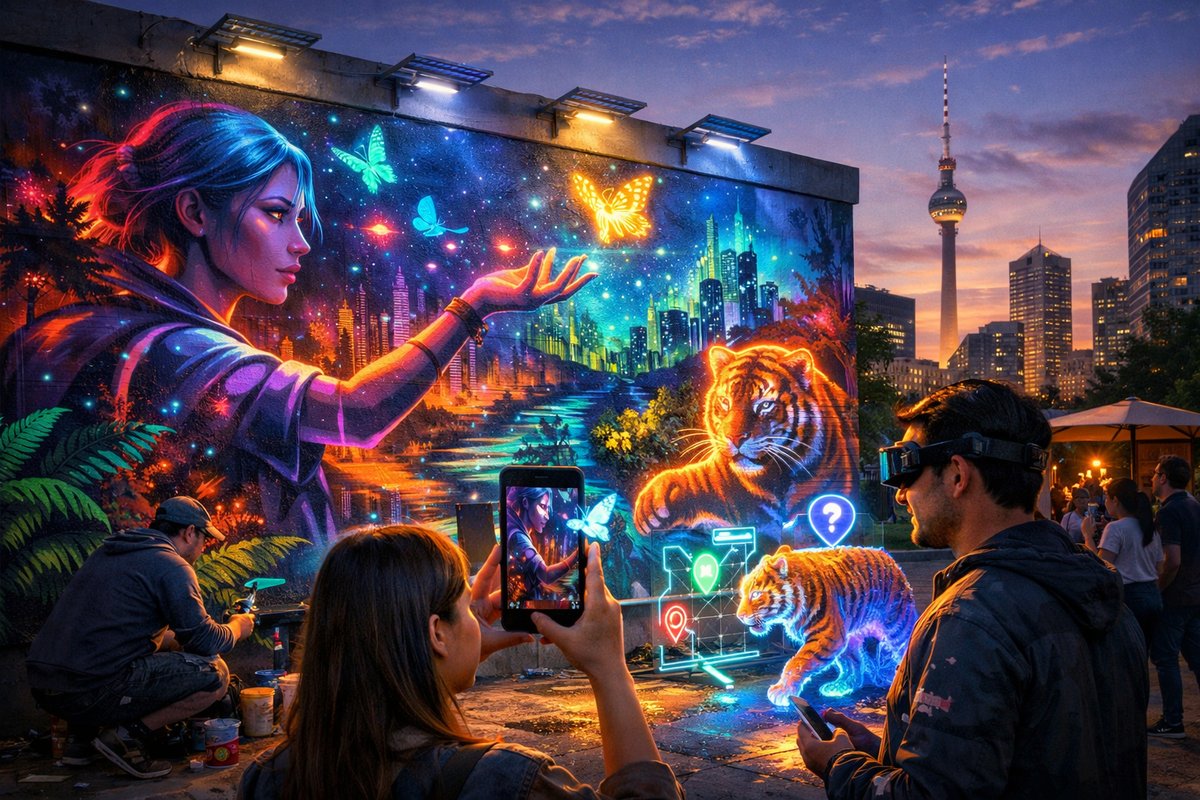

In neighborhoods once defined by static graffiti and hand-painted murals, a new generation of public artworks is emerging-ones that shift, dance, and respond to their surroundings. Artists and designers are using augmented reality (AR) to layer animated visuals on top of painted surfaces, creating evolving street canvases that visitors can unlock with a phone. These AR murals marry the tactile appeal of traditional spray paint and rollers with digital flourishes that loop, morph, or react to the time of day, weather, or passerby movement.
Earlier this year, an independent digital art studio debuted its first AR network of city walls in Vancouver’s historic district. The team painted large botanical forms in UV-reactive pigments, then overlaid a custom AR app that transformed vines into glowing tendrils at twilight. When the sun dips below the horizon, tiny fireflies flicker along the branches, and hidden characters peek from behind painted leaves. Viewers can scan QR codes stenciled near the mural to launch the AR layer, wandering alongside creatures that seem to sprout from the wall itself.
“We wanted to reconnect urban spaces with a sense of wonder,” says a lead designer at the studio. “People rush past murals every day, but adding motion and interactivity encourages them to pause, explore, and see the neighborhood through fresh eyes.” Their process combines hand-mixed eco-friendly paints with projection mapping tools, solar-powered LED strips for nighttime illumination, and an AR framework that works on most modern smartphones.
Similar projects have since rolled out in London, São Paulo, and Singapore, each with its own local twist. In London’s arts quarter, a collective used 3D-scanned models of architectural details to create digital overlays that highlight the city’s Victorian heritage. Tourists aim their phones at painted facades and watch ornate cornices come to life with filigree that twirls outwards. In São Paulo, a community-led initiative invited residents to contribute drawings inspired by local folklore. Once digitized, these sketches appear as animated storytellers slithering across alleyway walls.
Municipal authorities are taking notice too. Several city councils have started offering micro-grants to fund AR mural pilots, citing increased foot traffic and social media buzz as indicators of success. One urban planning director noted that interactive murals can help revitalize neglected districts by drawing crowds off the main thoroughfares. “It’s a form of placemaking that combines art, technology, and civic engagement,” she explains. “When people gather to watch a wall transform, they share space, stories, and a sense of belonging.”
Behind the scenes, studios are fine-tuning the technical underpinnings. High-resolution 3D mapping software is used to align digital assets precisely with the contours of a wall, while AR frameworks optimize performance for both iOS and Android devices. Artists hand-apply layers of UV-reactive and weather-resistant paints, then install rows of low-voltage LED floodlights or solar panels to power displays after dark. A portable battery pack often bridges the gap between sunset and sunrise, ensuring that animations remain visible through the night.
Sustainability plays a central role in these projects. Many studios favor paints with low volatile organic compounds (VOCs), recycled aluminum for mounting points, and solar fixtures to minimize grid dependence. When the collective in Vancouver decommissioned one mural after its six-month run, they donated leftover paints to a local youth art program and recycled the LED housings. Future iterations may even explore biodegradable pigments that fade on schedule, leaving no trace once the narrative cycle completes.
Community engagement is another key ingredient. Some initiatives start with open calls for sketches or digital assets, allowing residents to co-create the AR components. In a small town outside Berlin, for instance, students from the local high school designed the interactive elements for a mural celebrating regional folk music. Their illustrations of instruments and dancers were integrated into an AR layer that pulses in time with an original soundtrack.
The impact on local economies is tangible. Cafés near AR hotspots report a steady stream of visitors downloading apps and sharing clips on social platforms. Guided walking tours that focus on digital murals are beginning to sprout up, complete with handheld tablets preloaded with AR content. Independent retailers have joined the wave, commissioning interim projections on shopfronts that sync with seasonal promotions or special events.
Despite the enthusiasm, challenges remain. Digital layers require periodic maintenance-software updates, server bandwidth, and compatibility tweaks for new phone models. Physical murals face familiar risks: fading from sun exposure, graffiti tagging over paint, and surface damage in extreme weather. To address these concerns, studios are experimenting with durable primers, anti-graffiti coatings, and remote-monitoring sensors that alert teams to outages or vandalism.
Looking ahead, some artists envision fully immersive experiences that blend AR walls with local audio, haptic feedback, or interactive sculptures. One collective is prototyping streetwalkers equipped with wearable AR glasses, enabling them to place digital graffiti in real time without painting on walls at all. Others see potential in collaborative networks, where multiple murals across a city synchronize their animations into a choreographed journey.
For those drawn to this hybrid art form, a growing ecosystem of tools and materials is becoming available. From UV-reactive paint kits and portable mini projectors to drawing tablets that streamline concept art, the barrier to entry is lower than ever. Tech workshops and maker spaces are offering crash courses in projection mapping and AR app development, inviting traditional painters to explore digital frontiers.
Ultimately, AR-enhanced street art is more than a novelty-it signals a shift in how we perceive public spaces. Instead of fixed images, walls become living stages that evolve, communicate, and invite participation. When technology and brushstroke converge, the line between the real and the virtual blurs, sparking new conversations about art, place, and collective imagination.
As urban landscapes continue to change, these interactive canvases offer a glimpse into a future where murals respond to our presence, tell local stories, and connect communities in dynamic ways. The next time you pass a painted wall, point your phone and watch it bloom, flicker, or dance. The mural may be flat-but the experience is anything but.
-
Glow in the Dark Acrylic Paint - Set of 12 Colors, Uv Reactive ...
Perfect for artists, DIY enthusiasts, and anyone looking to add a luminous touch to their creations. Experience high-pigment, true-color quality under light and ... -
Mini Projector - Amazon.com
Magcubic 2026 Upgraded HY300PRO Mini Projector with WiFi and Bluetooth, Portable Projector 4K Support, Auto Keystone, 180 Degree Rotation, Smart Proyector for ... -
Drawing Tablet - Amazon.com
HUION Inspiroy H1060P Graphics Drawing Tablet with 8192 Pressure Sensitivity Battery-Free Stylus and 12 Customized Hot Keys, 10 x 6.25 inches Digital Art Tablet ... -
Led Solar Flood Light - Amazon.com
TECKNET 416 LED Solar Lights Outdoor Waterproof, 4200lm 300° Angle & 3 Lighting Modes Motion Sensor Outdoor Lights,2 Pack Solar Powered Flood Wall Lights ... -
High Capacity Power Bank 100000mAh Fast Charging 22.5W PD ...
The long-lasting large capacity power battery pack keeps the power for 24 days, making it perfect for travelling, hiking, outdoor camping and more. -
Lenovo Star Wars: Jedi Challenges, Smartphone ... - Amazon.com
Amazon.com: Lenovo Star Wars: Jedi Challenges, Smartphone Powered Augmented Reality Experience : Video Games. ... compatible smartphone. Players must be in ...