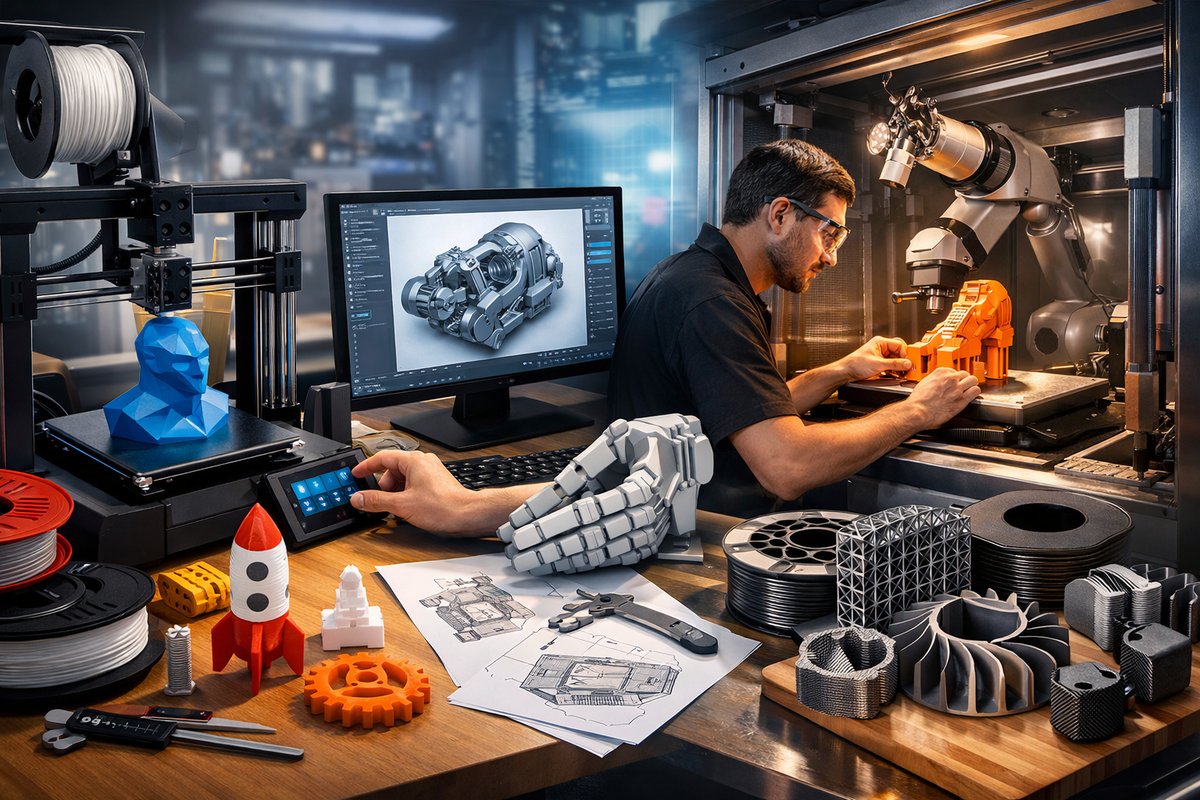

Imagine a world where ideas take shape in hours instead of weeks, where a personal laboratory can fit on a desk and where designers, educators, and inventors collaborate across continents. That world is no longer science fiction-3D printing, also known as additive manufacturing, has democratized access to rapid fabrication and fueled a new era of creativity. Whether you’re a curious newcomer or a seasoned maker, understanding the fundamentals of this layered approach to production helps you navigate an ecosystem rich in materials, hardware, and techniques.
The origins of 3D printing trace back to the early 1980s, when stereolithography (SLA) first introduced the idea of curing liquid resins with ultraviolet light, layer by layer. Shortly thereafter, fused deposition modeling (FDM) emerged, extruding molten thermoplastics through a nozzle to build shapes from the ground up. Over the decades, additional methods such as selective laser sintering (SLS) and digital light processing (DLP) expanded the palette of printable materials to powders and resins, each technology carving out its own niche in prototyping and production.
As prices dropped and open-source communities flourished, desktop 3D printers moved from industrial labs into hobbyist workshops. Enthusiasts began modifying firmware, sharing build files online, and contributing to firmware improvements-all with a spirit of collaborative innovation. Today’s entry-level machines rival early professional models in accuracy and repeatability, while advanced kits allow users to swap hot ends, upgrade electronics, and tweak mechanical assemblies to meet specialized needs.
Material selection lies at the heart of any successful print. Thermoplastics such as polylactic acid (PLA) offer ease of use, low warping, and a wide range of colors, making them ideal for prototypes and educational projects. Acrylonitrile butadiene styrene (ABS) delivers higher impact resistance and heat tolerance but requires a heated bed and often an enclosure to prevent cracks. PETG bridges the gap with good strength and minimal warping, while specialty filaments-wood-filled composites, metal-infused blends, and flexible thermoplastic polyurethane (TPU)-expand possibilities for tactile models, wearables, and functional parts.
For ultra-high resolution and intricate detail, resin-based processes remain unmatched. Photopolymer resins, cured by precise light sources, create smooth surfaces and fine features suitable for jewelry prototypes, dental models, and miniatures. SLA systems use a laser to trace each layer, while DLP printers flash an entire slice of light at once, speeding up production. Resin chemistry continues to evolve with castable, toughened, and biocompatible formulations designed for both creative hobbyists and regulated industries.
Hardware choices go beyond build volume. A sturdy frame-often constructed from aluminum extrusions or acrylic-minimizes vibrations during printing. Core components include the extruder mechanism, hot end, heated bed, motion rails or belts, and control electronics. Direct-drive extruders excel with flexible filaments, while Bowden setups reduce moving mass for faster print speeds. Heated beds and optional enclosures help manage thermal gradients, reducing warping and improving layer adhesion for challenging materials.
No printer is complete without software to translate digital models into machine movements. Slicing tools let you adjust layer height, print speed, infill density, and support structures. Open-source firmware and slicers encourage experimentation, while commercial software often integrates advanced features like adaptive layers and automatic support generation. Calibration routines, bed leveling aids, and temperature tuning guides deepen your understanding of how each parameter influences the final outcome.
Success often hinges on small but crucial accessories. Precision calipers reveal the true dimensions of finished parts. A set of interchangeable nozzles-from ultra-fine for detail work to larger diameters for rapid builds-enables versatility. Spatulas and scrapers gently separate completed prints from build plates, and filament dryers remove moisture that can cause bubbles or brittle extrusions. Basic safety gear such as gloves and ventilation units guard against fumes and sharp tools during maintenance.
Mastering print techniques transforms reliable machine motion into stunning creations. Achieving the perfect first layer demands careful bed leveling and optimized nozzle height. Adhesion aids-glue sticks, textured build surfaces, or specialized tapes-keep models anchored. Strategic use of support structures preserves overhangs, while varied infill patterns balance strength, weight, and print time. Experimenting with bridging settings refines the ability to span small gaps cleanly, and tuning retraction parameters reduces oozing and stringing.
Once parts exit the build chamber, post-processing elevates them from raw prototypes into polished products. For thermoplastic prints, sanding with progressively finer grits smooths layer lines, followed by primer and paint techniques that bring models to life. Vapor smoothing tanks can reduce surface roughness on select materials. Resin prints benefit from solvent washing to remove uncured resin, then a secondary UV curing stage ensures mechanical stability and long-term durability.
Sustainability considerations increasingly shape material choices and workflows. Biodegradable PLA filaments sourced from renewable resources reduce reliance on petrochemicals, and filament recycling systems reclaim failed prints and support waste into reusable pellets. Solar-powered printers and energy-efficient components contribute to lower carbon footprints. By combining local production with on-demand fabrication, communities can trim shipping emissions and foster circular-economy principles.
Shared spaces-makerspaces, libraries, and fab labs-have become crucibles of creativity and collaboration. Online repositories host millions of user-submitted designs, while social platforms spark conversations about troubleshooting and design optimization. Hackathons and design contests invite fresh perspectives on real-world challenges, from affordable medical devices in underserved regions to custom assistive tools for individuals with unique needs. This collective intelligence accelerates advancements far beyond what isolated teams could achieve.
On the industrial front, 3D printing has moved from prototyping to production. Custom tooling, jigs, and fixtures can be fabricated on demand, slashing lead times and inventory costs. Complex geometries once impossible through traditional machining-lattice structures, conformal cooling channels, and lightweight aerospace parts-are now practical. In healthcare, patient-specific surgical guides and anatomical models demonstrate how additive technologies can improve outcomes and personalize treatment plans.
The horizon of 3D printing brims with emerging trends. Multi-material printers co-deposit hard and soft polymers in a single build, opening doors for integrated hinges, gaskets, and electronics. Embedded sensors and conductive inks bring smart devices to life straight off the print plate. Bioprinting techniques layer living cells for tissue engineering research, while large-scale concrete extruders promise on-site construction of buildings and infrastructure.
Whether you’re printing your first calibration cube or integrating additive workflows into a production line, the journey of exploration never ends. Each layer is an opportunity to learn, refine, and push boundaries. By embracing curiosity, sustainable practices, and community collaboration, 3D printing can become more than a manufacturing method-it can be a catalyst for meaningful innovation and shared progress.
-
BEST Modern DIY KIT 3D Printer H1 High Print Precision ...
BEST Modern DIY KIT 3D Printer. Desktop FDM 3D Printer. Dimensions 14.09"D x 15.75"W x 20.39"H. High-quality stepper motor,high print precision to 0.05mm ... -
LET'S RESIN UV Resin with Light,Upgraded 200g Crystal ...
Best Sellers Rank. #410 in Arts, Crafts & Sewing (See Top 100 in Arts ... The Best UV Resin Starter Kit I've Ever Seen! Kristi. For this product.