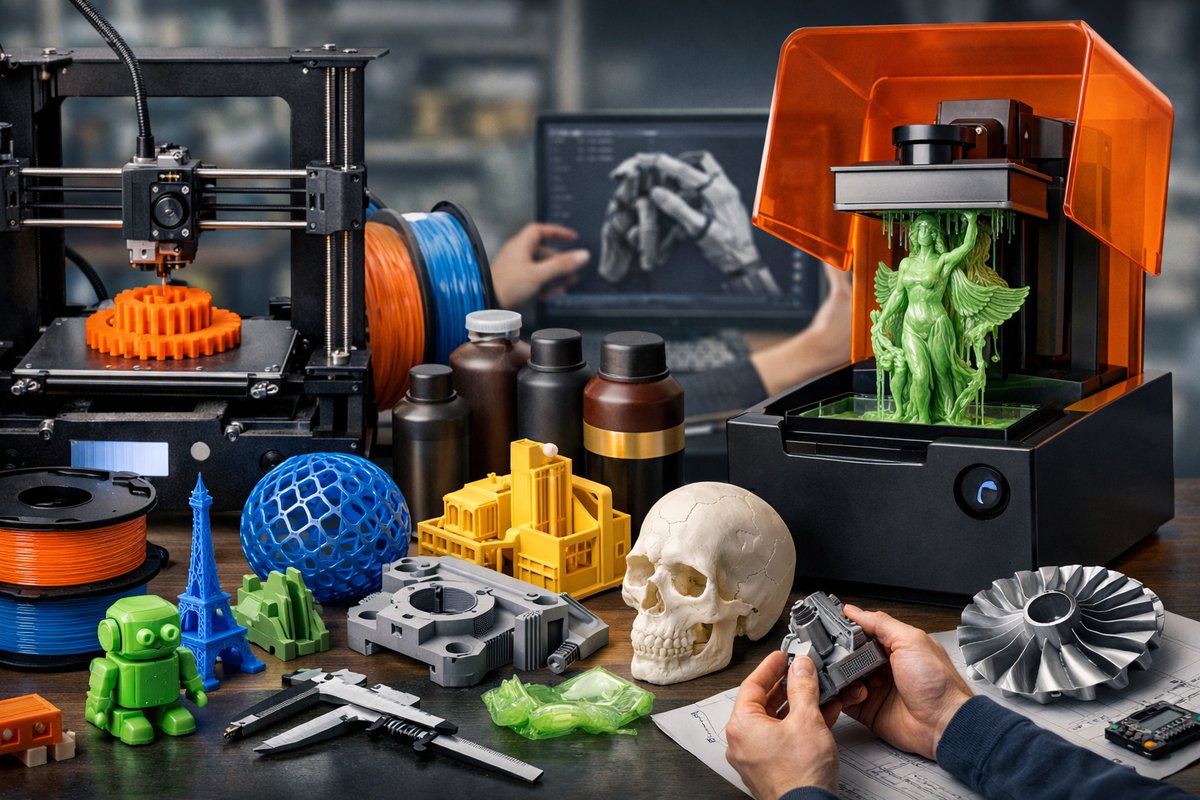

The story of 3D printing begins with a single extruding nozzle and filament spool, yet its chapters unfold across industries, studios, and classrooms. As hobbyists discovered the thrill of watching a model rise layer by layer, professionals recognized a breakthrough for rapid prototyping, custom tooling, and even bioprinting. Today’s landscape blends accessible desktop machines with powerful industrial arrays, but at the heart of every successful project lie the right tools, materials, and methods.
Every journey into additive manufacturing starts with selecting a printer platform suited to your goals. Desktop fused deposition modeling devices remain a popular entry point thanks to open firmware, large user communities, and a wide range of compatible filaments. These machines melt plastic spools into precision coordinates, building objects from the ground up. On the other side of the spectrum, resin-based stereolithography printers employ UV light to cure liquid resins into fine-featured details. Meanwhile, powder bed fusion systems, including selective laser sintering, deliver nylon parts with mechanical properties rivaling injection molding. Understanding these core technologies informs smart choices for budget, resolution, and mechanical strength.
Beyond the printer itself, calibration and control tools make the difference between a frustrating night of failed prints and a showcase-ready part. Digital calipers ensure that your initial model dimensions translate accurately into the physical world. Bed-leveling aids, whether manual feeler gauges or auto-levelling sensors, help prevent first-layer adhesion issues that lead to warping. Temperature probes for hotends and heated beds maintain consistent extrusion, while filament sensors can pause prints to avoid mid-run failures. A modular toolkit of pliers, scrapers, and fine nozzles rounds out the essentials for every maker bench.
The choice of printing material colors the entire workflow, from slicing profiles to post-processing steps. PLA remains the workhorse for many beginners: it’s easy to print, biodegradable, and available in vibrant hues. ABS offers greater toughness and temperature resistance but demands an enclosed build chamber to minimize warping. PETG combines the best of both, with chemical durability and less odor than ABS. Flexible TPU opens doors to wearable prototypes and shock-absorbing designs, though it may require specialized extruders. For ultra-high detail, photopolymer resins capture crisp edges, while reinforced blends with glass or carbon fibers boost stiffness and durability.
When initial prints fail, troubleshooting often circles back to one of three culprits: temperature, speed, or adhesion. If corners lift, increasing bed adhesion with textured sheets or adhesive sprays can help. Fine-tuning retraction settings and print speed minimizes stringing between details. For resin prints, eliminating tacky or brittle finishes involves calibrating exposure times and ensuring proper post-curing under UV light. A systematic attitude toward adjustments-changing one parameter at a time-turns failure into a controlled experiment rather than random frustration.
Slicing software sits at the nexus of digital design and physical reality. Freely available tools offer user-friendly interfaces and auto-generated support structures. More advanced packages unlock variable infill patterns, adaptive layer heights, and AI-driven orientation optimization. By slicing files with care, users can balance print time, material usage, and structural integrity. Some slicers even integrate hardware monitoring, allowing remote pauses or restarts when filament runs low or a glitch occurs.
Beyond the mechanics of printing lies the art of post-processing. Sanding kits, polishing compounds, and solvent vapors smooth layer lines on thermoplastics, while resin prints benefit from isopropyl alcohol washes and targeted UV curing stations. Painting and sealing add visual flair and environmental protection-consider clear coats for outdoor applications or food-safe varnishes for kitchen items. Each finishing step transforms a raw print into a tactile, functional object.
Sustainability has become a guiding value in recent years. Recycling filament initiatives collect failed prints, shredding them into pellets that can be re-extruded into new spools. Biodegradable resins and plant-based polymers reduce the ecological footprint of prototyping. Energy-efficient printers now employ smarter sleep modes and low-power standby states. By pairing conscientious material choices with energy monitoring, makers can leave a lighter impression on the planet.
Collaborative platforms amplify innovation across the 3D printing community. Online libraries host thousands of free and paid designs, ready for customization or direct printing. Open-source firmware updates unlock new performance gains on legacy machines. Social forums and local maker spaces offer peer support for troubleshooting and technique sharing. This spirit of collective discovery fuels a continuous feedback loop: new ideas spark upgraded hardware, which then inspires fresh design experiments.
Looking ahead, multi-material printing promises to blend plastics, metals, and ceramics in a single build. Embedded electronics, such as conductive filaments and printed sensors, foresee autonomous structures capable of real-time monitoring. AI-driven process optimization is already trimming print times and reducing waste by predicting ideal support geometries. At the same time, bioprinting research edges closer to creating custom tissue scaffolds and biodegradable implants, hinting at a future where additive manufacturing meets medical marvel.
For educators and parents, 3D printing unlocks STEM lessons that leap off the page. Students can design custom math manipulatives, explore geometry through tangible models, or prototype engineering solutions for real-world problems like small-scale wind turbines. The low barrier to entry encourages experimentation, failure, and iterative improvement-core pillars of the scientific method.
Entrepreneurs and small businesses find 3D printing invaluable for limited-run products and bespoke items. Jewelry designers craft intricate patterns that would be impossible to machine traditionally. Product developers iterate on ergonomic handles, custom phone cases, and specialized jigs without costly tooling. Even the fashion world experiments with printed textiles and avant-garde accessories, marrying digital patterning with physical form.
Regardless of application, the secret ingredient to success is a curious mindset. Treat each print as a mini research project: measure results, adjust parameters, and document findings. With every spool change and nozzle swap, you deepen your understanding of how heat, pressure, and geometry interplay. Over time, basic troubleshooting morphs into intuitive mastery-and what once seemed like complex equations of extrusion becomes second nature.
The future of 3D printing is shaped by modularity-both in hardware and in thinking. Swappable hotends let users switch between fine-detail nozzles and high-flow extruders in minutes. Upgradable camera modules and filament monitors transform entry-level machines into smart appliances. On the software side, open APIs enable creative scripting for custom toolpaths or automated quality checks. This modular ethos empowers makers to adapt their setup rather than replace it wholesale.
As you embark on your next project, remember that 3D printing is not just a machine process but a canvas for invention. The layers you build become more than plastic or resin; they carry the imprint of experimentation, resilience, and community. Embrace the inevitable setbacks as opportunities to learn, and share your breakthroughs so others may build upon them. In this layered reality, every print brings us one step closer to unlocking tomorrow’s forms today.