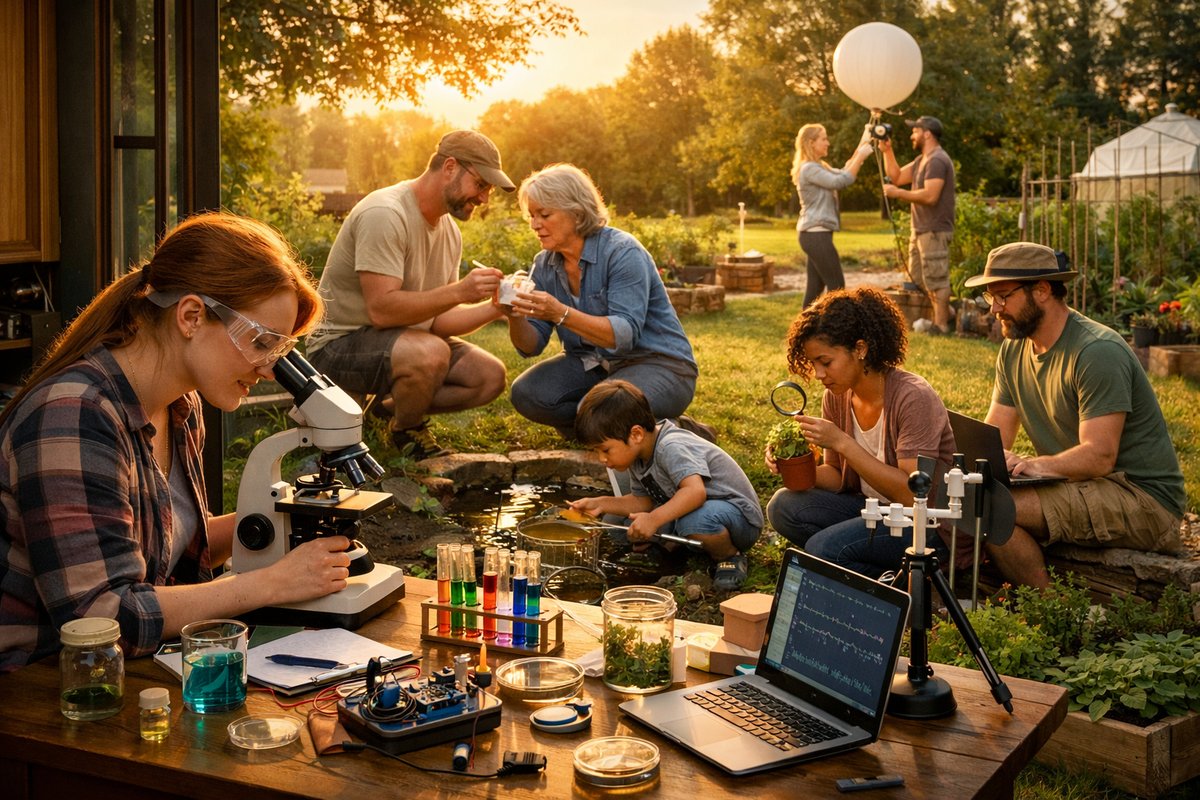

The era of the lone lab scientist peering through a microscope in a white room is giving way to something more expansive and inclusive. Whether you’re measuring the pH of rainwater on your porch, examining pond algae through a USB microscope in your kitchen, or tracking air quality with a compact sensor mounted by your window, science is sprouting in unexpected places. At the heart of this movement is a simple idea: curiosity need not wait for expensive equipment or formal training. With pocket-size instruments, open-source designs, and online communities, anyone with a questioning mind can conduct meaningful experiments and contribute data that fuels larger investigations.
Everyday devices we often take for granted are now being repurposed to answer scientific questions. A smartphone camera, for instance, can capture microscopic details when paired with a clip-on lens attachment. It can also record the subtle color shifts in a plant leaf to diagnose stress or nutrient deficiency. Free software tools stitch together images into time-lapse videos, revealing patterns of growth or decay. Meanwhile, hobby electronics kits-complete with microcontrollers and environmental sensors-let builders create their own weather stations, air-quality monitors, or plant-watering systems. The barrier between professional and amateur research is narrowing, and the results are both surprising and impactful.
Environmental monitoring has become one of the most visible success stories of this grassroots revolution. Local networks of citizen-run weather stations feed real-time data into public platforms, refining forecasts for microclimates in cities and rural areas alike. Compact air-quality sensors installed on balconies and lamp posts measure particulate matter, ozone, and nitrogen dioxide, alerting communities to pollution spikes long before official readings arrive. Schools, urban gardens, and neighborhood groups join forces to map these metrics, turning data points into stories about how construction projects, traffic patterns, or green corridors influence air we breathe.
Water quality testing has also leaped out of university labs and into kitchens and backyards. Portable test kits allow enthusiasts to measure parameters such as turbidity, dissolved oxygen, and conductivity in nearby streams, ponds, or rainwater collection barrels. Some kits come with color-chart reagents, while more advanced setups send digital readings via Bluetooth to a smartphone app. By sampling across different seasons and weather events, citizens build nuanced portraits of local watersheds. This data often informs community campaigns for wetland preservation or urban runoff mitigation, proving that small-scale efforts can ripple into wider policy decisions.
Biomimicry workshops, frequently hosted at makerspaces or science festivals, bridge biology and engineering. Participants observe the water-repellent properties of lotus leaves or the structural efficiency of honeycomb patterns and then prototype materials that echo these designs. 3D printers, laser cutters, and molding kits transform inspiration from nature into tangible objects: self-cleaning coatings, impact-absorbing foam, or lightweight structural brackets. These hands-on sessions foster emotional intelligence as well-teams learn to listen to the natural world, empathize with nonhuman forms, and collaborate across disciplines to solve practical challenges.
Looking skyward, stargazing has become more intimate and data-driven. Affordable foldable telescopes paired with smartphone adapters bring deep-sky objects into view, while cloud-computing platforms collect and compare images from backyard astronomers around the globe. Advanced hobbyists mount light-pollution sensors and track meteor showers, contributing to dark-sky preservation efforts. Even simple star-chart apps, when used in a group setting, spark conversations about our place in the cosmos, reinforcing a shared sense of wonder and responsibility toward planetary stewardship.
Community laboratories-sometimes called hackerspaces or biohacker hubs-are blossoming in urban centers and college towns. These shared facilities house 3D printers, centrifuges, gel-electrophoresis rigs, and basic chemical stocks. Seasoned volunteers mentor newcomers on laboratory safety, experimental design, and data ethics, creating inclusive environments for collaborative projects. From brewing kombucha strains designed to break down plastic waste to crowdsourcing genomic sequencing of local plant species, these community labs exemplify sustainability by repurposing surplus equipment and practicing waste-minimization protocols.
Science and art are converging in novel ways, too. Interactive installations use sensors to turn environmental data-like carbon dioxide levels or soil moisture-into soundscapes or visual projections. Participants move through these spaces, influencing the art piece and gaining tactile insight into invisible phenomena. This blending of creative expression and empirical observation cultivates emotional intelligence, encouraging audiences to relate to data on a human level and prompting conversations about shared challenges such as climate change or biodiversity loss.
Sustainability is woven into every aspect of this emergent culture. DIY experimenters swap or donate surplus gear through local “gear libraries,” extending the lifespan of instruments that might otherwise gather dust. Tutorials emphasize low-impact materials-bamboo lab racks instead of plastic, naturally derived pH indicators instead of synthetic dyes, and solar-powered sensor arrays. By integrating circular design principles, these grassroots scientists show that research and environmental responsibility can go hand in hand.
What lies ahead is an even blurrier line between professional and citizen science. Artificial intelligence tools are becoming accessible to non-experts, automating data analysis and pattern recognition in large datasets. Virtual reality platforms are hosting immersive lab simulations where users can test hypotheses together, regardless of geography. Blockchain-backed data ledgers promise transparent collaboration while preserving individual privacy and data ownership. As these technologies mature, the collective capacity for discovery and innovation only grows.
This is a golden moment for anyone who’s ever felt a spark of curiosity. You don’t need a PhD or a hefty research grant to ask questions, gather data, and share findings. Science is reshaping itself into a more democratic, emotionally intelligent endeavor-one that thrives on diversity of perspective, sustainable practices, and empathetic engagement with the natural world. So pick up that sensor, mount that lens, and start turning your daily observations into meaningful contributions. The next breakthrough might just spring from your backyard.