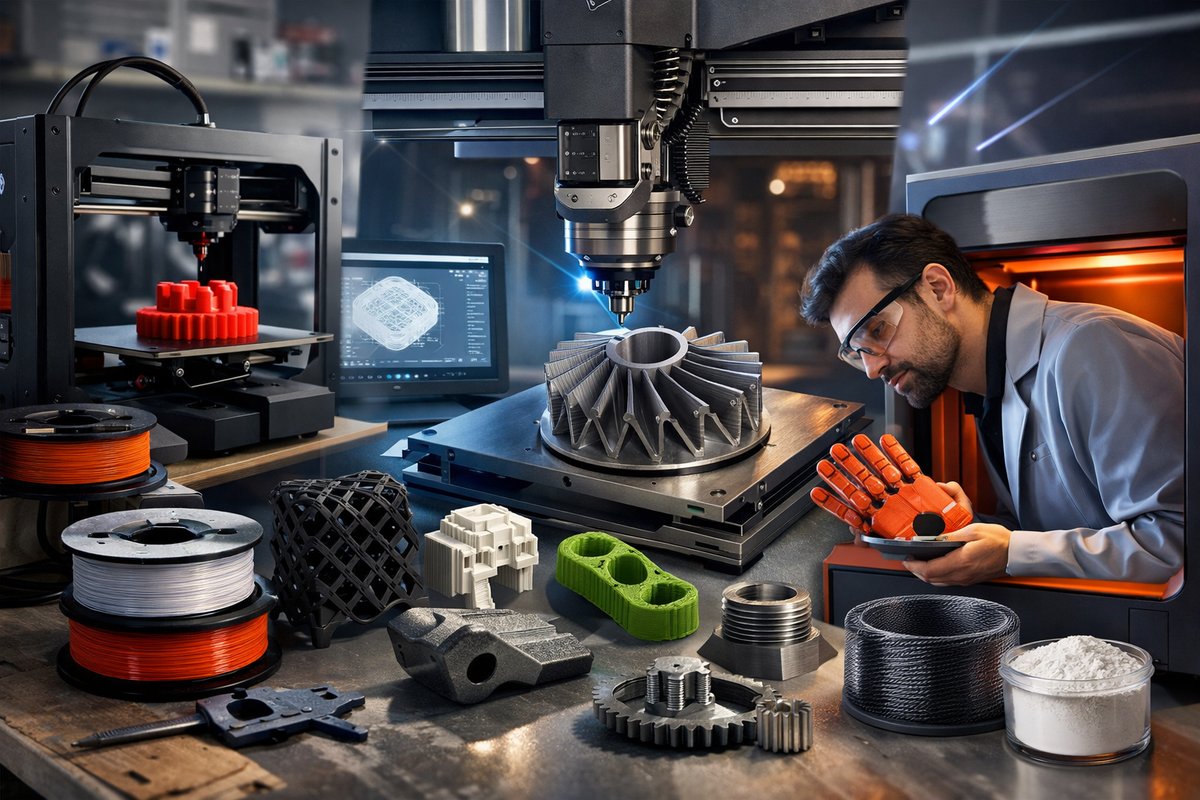

Walk into any maker space or home workshop today and you’re likely to spot a buzzing 3D printer in action, slowly building an object from the ground up. Additive manufacturing-commonly known as 3D printing-has become a gateway for hobbyists, educators, engineers, and entrepreneurs alike. Whether you’re prototyping a new gadget, crafting a custom tool, or simply exploring creative expression, the world of 3D printing offers a vast ecosystem of tools, materials, and techniques. This guide navigates the key elements that make modern 3D printing so accessible, versatile, and rewarding.
At its core, the process layers material one thin cross-section at a time, gradually constructing everything from jewelry and medical models to architectural scale mockups. Under the umbrella of additive manufacturing, several printer technologies coexist. Fused Deposition Modeling (FDM) devices melt thermoplastic filament and extrude it through a nozzle, building layer after layer on a heated build platform. Stereolithography (SLA) machines, by contrast, use a UV laser or projector to selectively cure liquid resin in a vat. For more advanced industrial needs, Selective Laser Sintering (SLS) fuses powdered materials-often nylon-into robust components without any support structures. Understanding these core options helps you choose the right machine for your ambitions.
Choosing the ideal build material is just as critical as picking a printer type. The most beginner-friendly filament is polylactic acid (PLA), derived from renewable resources like corn starch. It prints at relatively low temperatures, cools quickly, and emits a pleasant, nearly odorless scent. PLA is ideal for decorative items, educational projects, and conceptual prototypes. But when you need greater toughness or heat resistance, acrylonitrile butadiene styrene (ABS) steps in. ABS withstands higher operating temperatures and enjoys wider adoption in the automotive and consumer electronics sectors. Other thermoplastics-such as PETG, TPU, and nylon blends-serve specialized roles, from flexible parts to mechanical components that demand durability and chemical resistance.
SLA resin options span from general-purpose photopolymer for high-detail miniatures to engineering-grade formulas that exhibit impressive strength and heat tolerance. Powder-based SLS offers yet another palette: glass-filled or carbon-fiber-reinforced powders can produce stiff, lightweight parts ideal for functional end-use applications. And behind the scenes, research labs are exploring composite filaments infused with wood, metal, or ceramic powders, allowing makers to mimic real wood grain or metal finishes straight off the printer.
While selecting hardware and feedstock sets the stage, mastering the slicing software transforms digital dreams into machine-readable commands. Popular slicing tools translate 3D designs into G-code instructions, dictating nozzle temperature, print speed, infill percentage, and layer height. Fine-tuning these parameters is part science, part art. Lowering layer height enhances surface smoothness but increases print duration. Increasing infill adds rigidity at the expense of material usage. Deciding when to include supports-and learning how to orient your model-can make or break complex overhangs and delicate features.
Beyond digital inputs and raw materials, a small arsenal of finishing tools brings printed parts into polished form. A basic scraper helps safely remove adherent prints from build plates, while precision side cutters trim away support structures with minimal scarring. Sandpaper and small rotary tools refine surfaces, eliminating layer lines and achieving a uniform finish. For resin prints, a dedicated UV curing station strengthens parts after initial washing in isopropyl alcohol. Even simple additions-like kapton tape or specialized build-surface films-can improve first-layer adhesion and reduce warping.
Finding Your Footing
Starting out, many enthusiasts choose a reliable desktop FDM machine with a sturdy metal frame, heated bed, and auto-leveling probe. At the same time, entry-level resin printers have become surprisingly affordable, producing astonishing detail for miniatures and jewelry models. Prioritize enclosed or semi-enclosed builds if you plan to work with odor-emitting materials, or if temperature consistency contributes to print success. Modular designs that accommodate interchangeable tool heads-such as dual-extrusion nozzles or paste-dispensing attachments-expand your creative horizons without needing separate machines.
As your confidence grows, consider advanced calibration techniques. Bed leveling-whether manual or automated-ensures the first layer bonds uniformly. Fine-tune extrusion multipliers to prevent under- or over-extrusion, which can cause weak spots or unsightly blobs. Periodic maintenance-lubricating rods, checking belt tensions, and cleaning nozzles-keeps machines running smoothly. Maintain a print log to track successful settings for different materials and geometries, building your own knowledge base for future projects.
Innovation in Action
Today’s 3D printing frontier stretches far beyond desktop setups. Bioprinting explores layering living cells to generate tissue scaffolds. Large-format FDM printers assemble entire building modules from concrete or polymer composites. Multi-material systems can embed electronics or soluble supports, enabling internal channels for fluid flow or intricate assembly. Meanwhile, metal 3D printers sinter or melt metal powders under inert atmospheres, fabricating aerospace-grade parts with complex geometries that would be impossible using subtractive methods.
Each of these breakthroughs reinforces the principle that 3D printing is more than a hobby; it’s an engine of innovation. Engineers use additive manufacturing to create lightweight brackets that reduce aircraft fuel consumption. Medical researchers develop personalized prosthetics matched precisely to patient anatomy. Educators deploy machines in classrooms to teach design thinking, encouraging students to iterate rapidly and learn from failures without wasteful trial and error.
A Community of Creators
One of the most valuable resources in the 3D printing world is its open community. Designers freely share STL files on platforms that host everything from replacement parts for household fixtures to next-generation robotics components. Online forums and social media groups offer troubleshooting help, firmware hacks, and mod guides that can breathe new life into older hardware. Local maker spaces often hold workshops, letting newcomers touch, feel, and operate diverse machines before making a purchase.
This collaborative spirit extends to sustainability efforts as well. Filament recycling systems can shred failed prints and unwanted parts back into pellet form, ready for extrusion into fresh filament. Some small-batch manufacturers sell recycled PLA spools incorporating post-consumer plastic. By choosing greener feedstock and minimizing support structures, makers can reduce their environmental footprint and contribute to a more circular approach to manufacturing.
Empowering Your Next Project
Getting the most from 3D printing means embracing continuous learning. Regularly update your firmware to benefit from improved motion planning and new features. Experiment with custom profiles in slicing software, and discover community-tested settings for exotic materials. Document failures as diligently as successes-they often hold the key to breakthroughs. Above all, remain curious: each miscalculation reveals fresh opportunities to deepen your understanding of how temperatures, speeds, and layer heights interact.
Whether your goal is functional engineering, artistic expression, or classroom exploration, the tools, materials, and techniques of 3D printing equip you to turn ideas into reality. As you refine your workflow-tweaking machine settings, mastering post-processing, and exploring new feedstocks-you’ll find that the only true limit is your imagination. The next great innovation could be waiting on your build plate: one layer at a time.