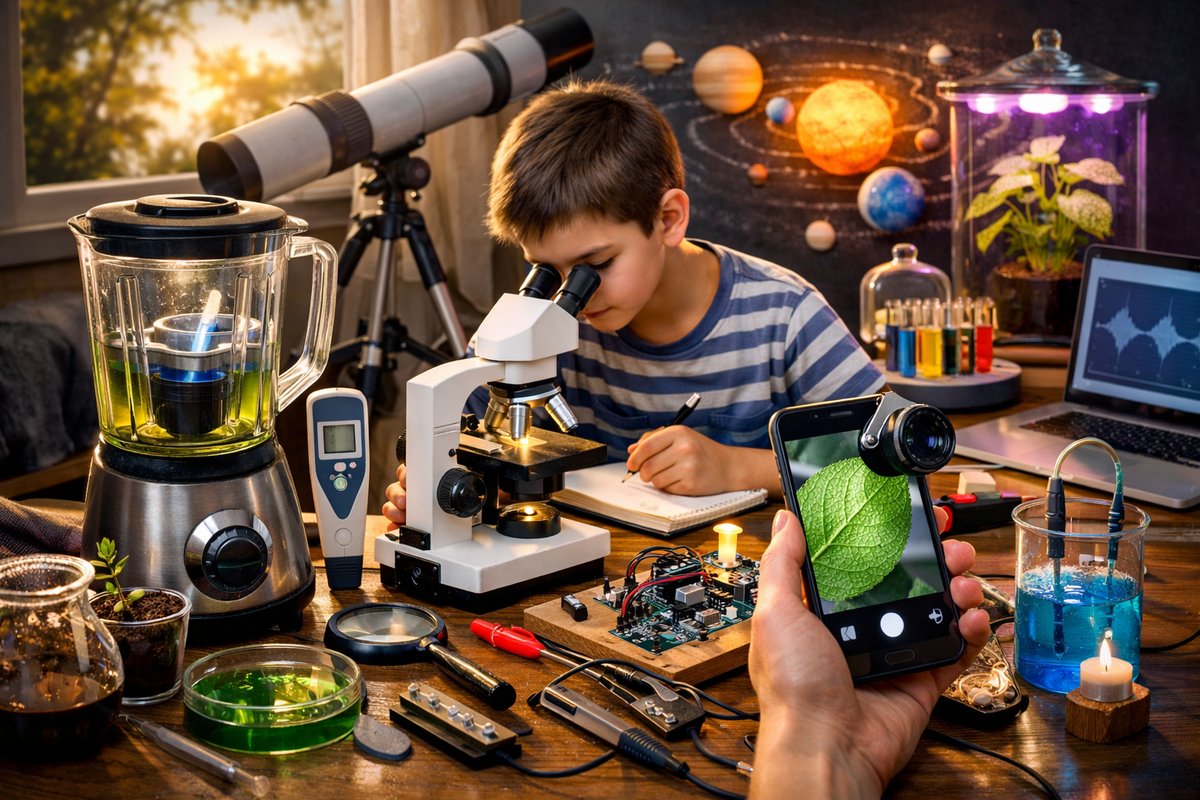

The traditional image of scientific research often involves sterile laboratories, specialized equipment, and expert teams. Yet a quiet revolution is unfolding at kitchen tables, workshops, and community spaces around the world. Everyday tools-microwave ovens, coffee grinders, hobby electronics and even smartphones-are being reimagined as instruments of inquiry. Driven by open-source designs, sustainability concerns, and a thirst for firsthand exploration, DIY scientists are breaking down barriers and proving that discovery can happen anywhere.
For centuries, amateur naturalists carried field guides and hand lenses to examine insects and plants. Today’s DIY researcher may use a paper microscope that unfolds for a few dollars, or attach a compact digital sensor to a smartphone camera for detailed imaging. These low-cost, portable tools open windows into biology, chemistry, physics and environmental science, letting novices and experts alike collect data and test hypotheses without a major grant or a dedicated lab space.
One popular example is the pocket-sized foldable microscope made from paper and a tiny lens. Distributed through open-source plans, these microscopes have reached schools in remote villages, amateur science clubs, and even health clinics tracking waterborne parasites. Users assemble the device, calibrate it under ambient light, and peer into waterways, soil samples or cheek swabs with surprising clarity. Beyond the technical specs, the real impact lies in empowering communities to participate in research-tracking algal blooms, monitoring food safety or mapping local biodiversity.
Meanwhile, hobby electronics have become a mainstay for sensor-based investigations. Development boards once reserved for engineers now ship with easy-to-use software, preassembled headers and graphical programming interfaces. A single-board computer connected to gas sensors can measure indoor air quality, while a UV probe attached to a handheld device tracks sun exposure in real time. Environmental clubs use these kits to log temperature fluctuations in urban heat islands, and curious families chart soil moisture to optimize home gardens. The combination of low cost, online tutorials and active maker forums has turned once-intimidating experiments into weekend projects.
Kitchen appliances have also found second lives as lab tools. A standard coffee grinder, for instance, can pulverize seeds and minerals into fine powders suitable for spectroscopic analysis. Slow-cookers and sous-vide machines offer precise temperature control for chemical reactions or enzyme studies. Even refrigerators become incubators when paired with simple PID controllers and temperature probes. This repurposing not only cuts costs but underscores a values-driven approach to sustainability-using what’s on hand instead of buying proprietary lab gear.
3D printers, now common in workshops and libraries, have unlocked rapid prototyping for scientific hardware. Researchers can design custom centrifuge rotors, flow chambers, or microscope stands and print them in plastic within hours. Online repositories host millions of design files shared under open licenses, so a budding chemist in one country can download and produce the exact same device developed by a team halfway across the globe. This fluid exchange accelerates iteration, improves reproducibility, and reduces waste by letting users print only what they need.
Behind this wave of accessibility stands the ethos of open science: sharing protocols, data and designs to spark collaboration. Citizen science platforms invite volunteers to classify galaxies, count bird calls or monitor light pollution using smartphone apps. These projects rely on crowdsourced observations but increasingly incorporate DIY hardware to gather quantitative measurements. Enthusiasts assemble spectrometers from acrylic sheets and diffraction grating, then upload spectra to global databases tracking air quality or verifying water composition.
The latest frontier is cloud-enabled experimentation. Some startups offer robotic lab benches that users can control remotely via a web interface. A homegrown chemist drafts a protocol online, ships reagents to a shared facility and watches reactions unfold through live video. Results, including high-resolution chromatograms and spectroscopic data, are streamed back to the user’s dashboard. Though these services carry fees, they democratize access to expensive equipment-mass spectrometers, high-precision pipetting robots and advanced imaging systems-once confined to elite institutions.
Of course, DIY science raises questions of safety, ethics and data quality. Responsible tinkerers learn protocols for handling chemicals safely, dispose of waste properly and validate their setups against known standards. Online communities stress transparency, review procedures peer-to-peer and encourage formal collaborations with academic labs when venturing into high-stakes territory like engineered organisms or pharmacology. In many places, community labs provide shared space, liability insurance and mentorship to help newcomers navigate regulations.
The emotional allure of this movement lies in reclaiming curiosity and creativity. Science becomes personal again: a weekend project, a community event or a teachable moment with family. A teenager builds a microbial fuel cell in the basement, while a retired engineer designs a low-cost defibrillator circuit. Each experiment is a story of trial and error, frustration and wonder. These narratives reconnect people with the practices of observation, measurement and critical thinking that underpin scientific literacy.
In classrooms, teachers weave these DIY tools into lessons on ecology, material science and physics. Students compare plant growth under LED lights set to different spectra using light sensors, or measure the pH of rainwater samples collected around town. These hands-on activities reinforce concepts far more deeply than textbook diagrams. When students see real-time graphs charting changes in dissolved oxygen or soil conductivity they grasp the dynamic nature of living systems and the interplay of variables in experiments.
DIY science does not replace professional research, but it complements and expands it. Amateur weather stations feeding into meteorological databases increase both spatial coverage and community engagement. Open-hardware PCR machines help small labs and independent researchers run genetic tests at a fraction of the cost. Crowdfunding campaigns support the development of low-cost prosthetic hands, with designs shared openly so users can customize them for individual needs.
Looking ahead, advances in materials, miniaturization and data analytics will only broaden the range of accessible experiments. Nanopore sequencers are shrinking toward the size of a USB thumb drive, and lab-on-a-chip platforms promise multiplexed assays in a drop of fluid. Machine learning tools will help novices interpret complex datasets with guided workflows. All of these innovations underscore an inclusive vision: science by anyone, for everyone.
The DIY science renaissance is more than a trend; it’s a cultural shift. By harnessing everyday items-kitchen appliances, paper microscopes, single-board computers and 3D printers-curious minds overcome cost barriers and institutional gatekeeping. Open-source communities share expertise and designs, ensuring that privacy, sustainability and collaboration remain central values. In this new era, scientific discovery is no longer the secret province of specialized labs, but a shared journey accessible to all who dare to ask questions, build tools and explore the unknown.