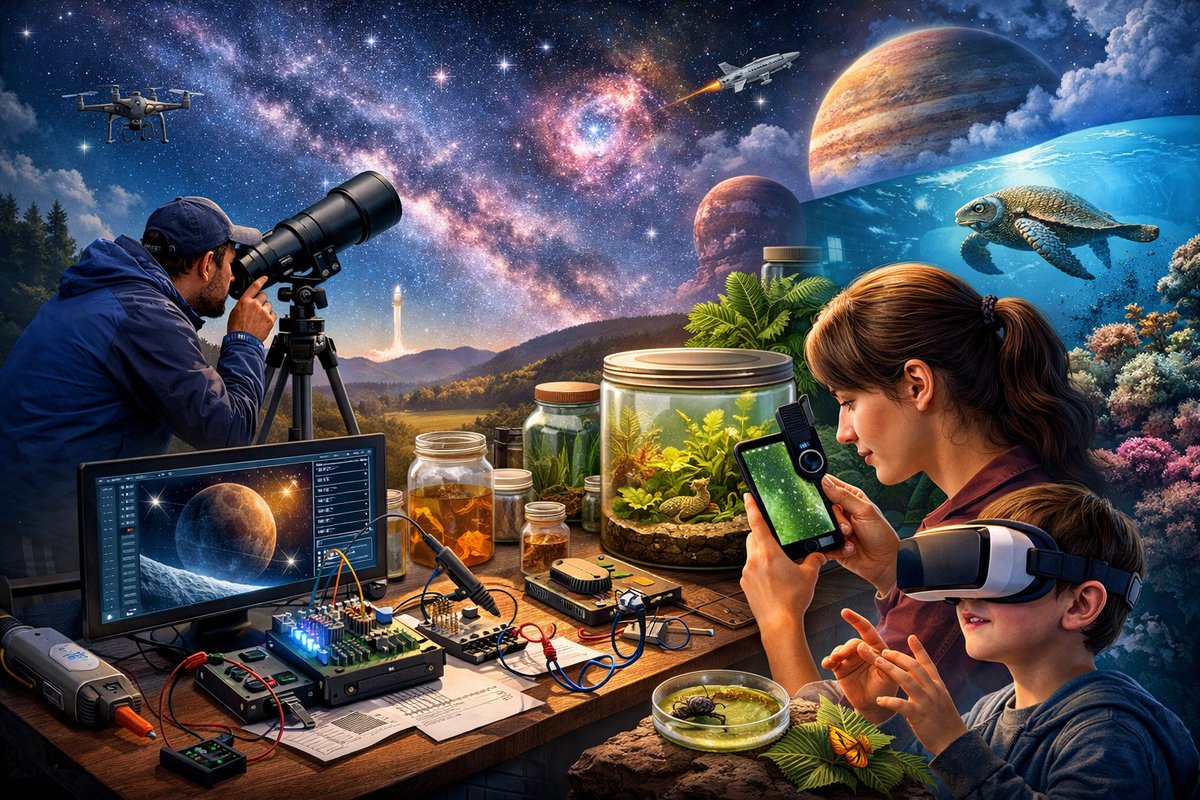

Science has always thrived on curiosity: the urge to ask questions that blur boundaries and challenge assumptions. Today, that urge finds fresh momentum in a wave of accessible, modular tools that put investigation directly into the hands of students, hobbyists, and community groups. No longer confined to elite labs, these instruments empower anyone with a spark of inquiry to chart planets, probe cells, monitor local air quality, and even build custom labware. The effect is a democratization of discovery, where passion outpaces budgets and collaboration outstrips hierarchy.
Field telescopes once meant hefty investments and remote observatories. Now a modest refractor telescope paired with a smartphone adapter can reveal lunar craters, star clusters, and the rings of Saturn from a suburban backyard. Simple equatorial mounts keep targets steady, while free planetarium apps help beginners identify constellations and track planetary motion. Amateur astronomers swapTips online for optimizing focus and capturing faint nebulae exposures. That sense of wonder, rekindled night after night, fuels not just stargazing but hands-on experiments: photometry to measure star brightness, long-exposure imaging to detect transits, and even radio astronomy kits that convert ambient cosmic noise into audible signals.
On the opposite end of scale, the microscopic universe is suddenly within reach of anyone with a desktop computer. USB digital microscopes with up to 2000× magnification and built-in LED illumination turn leaves, fabric weaves, insect wings, and pond microbes into deeply fascinating landscapes. Advanced hobbyist versions add adjustable polarizers and dark-field condensers for exploring birefringence in minerals or tracking motile cells in wet preparations. Smartphone microscope adapters hinge on that same principle: aligning eyepiece optics to a phone camera sensor and using apps to measure object size or even record time-lapse videos of cell division in onion roots. In classrooms around the world, students are digitizing their slides and sharing high-resolution images online, sparking collaborative identification of novel microorganisms.
Beyond pointing lenses upward or downward, a third frontier lies in the invisible flows that govern ecological health. Community science programs celebrate crowdsourced air and water quality surveys using compact environmental sensor kits. A handheld module can sample particulate matter, carbon dioxide, temperature, and humidity, transmitting real-time data via Wi-Fi or Bluetooth to open dashboards. Local data scouts set up rooftop stations, compile seasonal trends, and contribute to regional models of pollution dispersal. In parallel, low-cost soil moisture and pH sensors allow urban gardeners to optimize irrigation and composting practices. These data-driven ecosystems cultivate scientific literacy and environmental stewardship, as neighborhoods band together to map hotspots and advocate for cleaner air.
At the intersection of physical making and digital design, desktop 3D printers have unlocked new avenues for rapid prototyping. Students can model custom sample chambers, microscope stage adapters, or field-deployable reagent holders in CAD software, then print them in PLA or PETG filament. A once-expensive assembly of parts now emerges layer by layer at a fraction of the cost. Maker spaces across campuses stock filament spools and soldering irons, guiding beginners through open-source blueprints for reaction vessels, pipette holders, or modular incubators. As communities share and remix designs on platforms like Git repositories, improvements propagate swiftly: a redesigned lid here, a snap-fit clip there, until the simplest setups approach lab-grade reliability.
Parallel to physical tools, immersive digital environments are gaining traction in science education. Virtual reality platforms host simulated laboratories where learners practice titrations, assemble circuit boards, or dissect virtual specimens without actual chemicals or animals. Haptic feedback gloves convey the resistance of surgical probes, and 3D renderings let students manipulate molecular models with intuitive gestures. Augmented reality apps overlay topographical contours onto local parks, guiding geology enthusiasts to sample rock strata or fossil outcrops. This blend of virtual and physical investigation builds both muscle memory for experimental steps and spatial understanding of complex structures-from crystal lattices to tectonic fault lines.
Yet tools alone do not guarantee discovery: they need data analysis pipelines that respect privacy, reproducibility, and sustainability. Open-source software ecosystems such as Python notebooks, R scripts, and browser-based dashboards equip citizen scientists with the same computational techniques used in research institutions. Real-time plotting libraries visualize streaming sensor feeds; machine learning kits classify photos of insects or rocks; geospatial tools map bird migrations tracked by low-power radio tags. Crucially, communities set data-sharing permissions publicly or anonymously, ensuring that personal information and sensitive locations remain protected. This ethical framework nurtures trust and broad participation.
In tandem with environmental sampling and imaging, inexpensive DNA barcoding initiatives are letting backyard biologists identify local flora and fauna. Ready-made kits contain reagents for polymerase chain reaction (PCR) and gel electrophoresis chambers that plug into USB ports. After swabbing leaves or collecting pond water, learners amplify target genes and compare them against online databases. The result? Documenting invasive species, cataloging neighborhood biodiversity, and enriching global genetic repositories-all from a modest garage bench.
As the maker ecosystem evolves, miniaturized electronics boards and modular sensors inspired by open-source microcontroller platforms become staples for custom projects. Hobbyists integrate laser distance modules, Bluetooth low-energy radios, and GPS units to build weather balloons, autonomous rovers, or wildlife camera traps. Students learn soldering, circuit design, and firmware programming by controlling servo motors, reading ADC values, or streaming MQTT messages to remote servers. A single microcontroller can power multi-sensor networks that ping environmental thresholds, triggering automated alerts for high pollen counts or sudden temperature drops.
None of these advances would be complete without a record-keeping practice that ties observations, hypotheses, and raw data together over time. Traditional lab notebooks are making a comeback in digital form: high-resolution scan pages, optical character recognition for handwritten entries, and encrypted cloud backups ensure that experiments survive computer crashes and lab relocations alike. Embedded timestamping and version control link each notebook entry to images, sensor logs, and code repositories, preserving lineage and enabling peer review. This archival layer strengthens scientific rigor across formal labs and citizen projects alike.
Looking ahead, the next wave integrates artificial intelligence into both design and discovery. Generative algorithms propose optimal 3D-printed microfluidic channels, predict chemical reaction yields, or classify astronomical objects in massive sky surveys. Citizen scientists armed with edge-AI cameras help identify migrating birds or track urban wildlife in real time. Ethical considerations around algorithmic bias and data privacy spin off new discussions on governance, transparency, and community oversight. The dialogue is not just about what machines can do but about how humans collaborate with them, nurturing curiosity rather than replacing it.
The story of modern science is no longer confined to ivory towers and specialized institutes. Instead, it unfolds in backyards, classrooms, maker spaces, and online forums, where telescopes, microscopes, sensors, and software converge in the hands of everyday explorers. By weaving together accessible hardware, open-source principles, and values of sustainability and privacy, this hands-on revolution invites everyone to ask questions, test ideas, and share insights. Whether mapping air quality near a school playground or imaging distant galaxies at home, the tools may vary-but the spirit of discovery remains constant, fueled by curiosity, community, and the joy of learning.
End of the chapter? Or the opening for a new one, written by the next curious mind? The answer awaits in your own workshop, under your own night sky, or inside your next microscope slide. Science is now yours to shape.