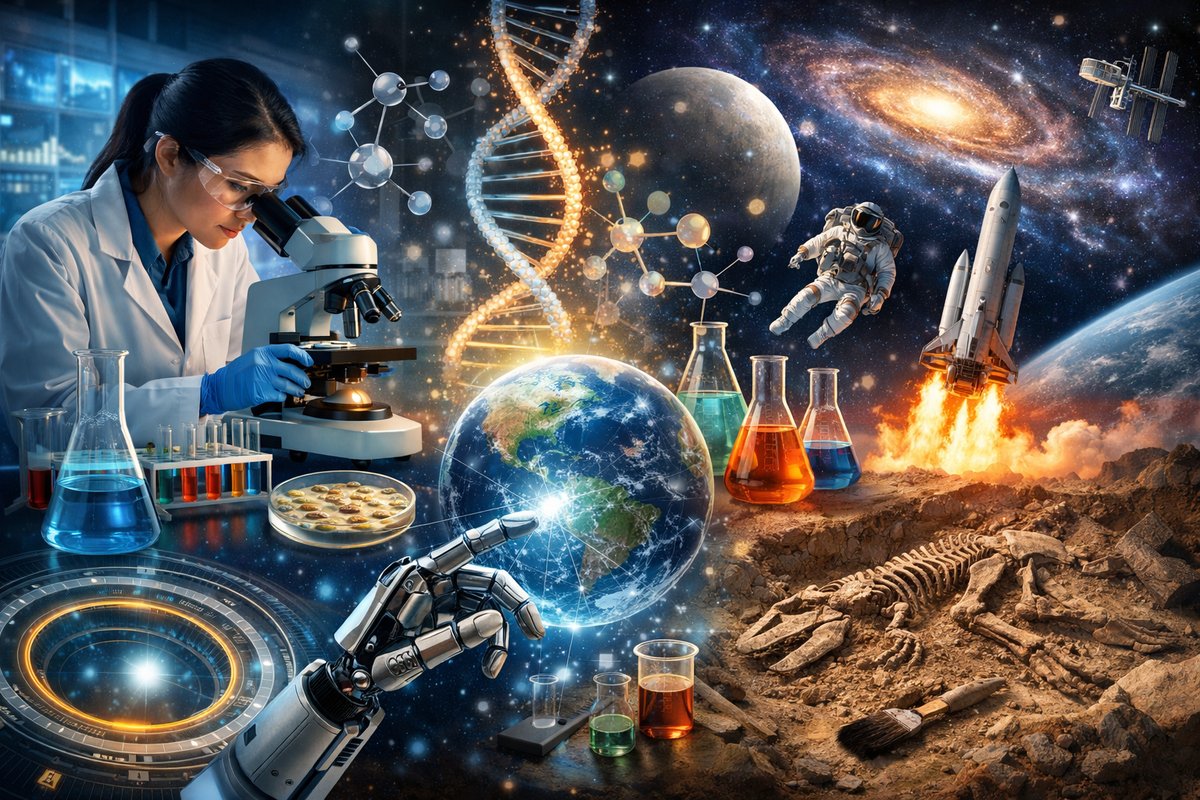

Science begins with a spark of curiosity-an urge to understand why something happens, from a leaf’s fall to the motion of planets. It is more than a body of facts; it is a structured approach to asking questions, testing ideas, and drawing conclusions. At its heart lies a commitment to evidence, transparency, and continuous refinement of knowledge. Whether you are a lifelong learner or a newcomer to the lab, this journey through science invites you to see the world through a lens of inquiry and wonder.
Our lives are steeped in scientific principles, even when we’re not aware. The physics that governs motion carries a bicycle down the street, while chemistry underpins cooking, cleaning, and the glow of screens. Biology explains how our bodies heal, how crops grow, and why ecosystems thrive. Observational habits born in childhood-like watching raindrops race down a window-can blossom into a scientific mindset that values careful measurement and systematic thinking.
The backbone of scientific endeavor is the scientific method: a cyclic process of observation, hypothesis, experimentation, analysis, and revision. It starts when you notice a pattern or anomaly-perhaps plants in one corner of your garden grow faster than the rest. You form a hypothesis to explain the difference, design an experiment to test variables like sunlight or soil composition, gather data, and draw evidence-based conclusions. Crucially, results are shared so others can replicate and build on your work.
Some branches of science rely on natural observations rather than controlled experiments. Astronomers study distant galaxies using telescopes and data from space missions, while ecologists monitor animal behavior in the wild. This observational approach hinges on careful documentation, long-term monitoring, and statistical tools to detect trends. In contrast, laboratory scientists can run experiments under tightly controlled conditions, manipulating variables one at a time to isolate cause and effect.
Physics explores the fundamental forces and particles that shape reality. From classical mechanics to quantum theory, it seeks unifying principles that explain motion, energy, gravity, and electromagnetism. Advances here have driven breakthroughs like semiconductors, laser technology, and breakthroughs in materials science. Whether you’re interested in the motion of everyday objects or the behavior of subatomic particles, physics reveals the rules that govern the universe at every scale.
Chemistry focuses on the interactions between atoms and molecules. It deciphers reaction pathways that produce fuels, materials, medicines, and even the flavors in your favorite meal. Organic chemistry unravels the complexities of carbon-based compounds, while physical chemistry examines energy changes in reactions. Chemists design new molecules for drug development, sustainable polymers, and alternative energy solutions, making this field a cornerstone of modern innovation.
Biology is the study of living systems-cells, organisms, and ecosystems. It encompasses genetics, evolution, physiology, and ecology. Biologists have unraveled the human genome, engineered crops for greater yield, and discovered new microorganisms in extreme environments. Biotechnology merges biology with engineering principles to create tools like gene editing and renewable biofuels. By exploring life at molecular and ecosystem levels, biology holds keys to health, conservation, and global food security.
Earth and space sciences examine our planet and its place in the cosmos. Geologists probe rock formations to reconstruct Earth’s history, seismologists monitor earthquakes, and climatologists model weather patterns and climate change. In space science, researchers study planetary atmospheres, solar wind interactions, and cosmic background radiation. These insights inform everything from resource management to space exploration missions, expanding our knowledge of distant worlds and safeguarding our own.
Interdisciplinary fields blend core disciplines to tackle complex challenges. Climate science draws from atmospheric physics, oceanography, and ecology to forecast long-term environmental shifts. Bioinformatics merges biology and computer science to analyze massive genomic data sets. Materials science combines chemistry and engineering to develop next-generation alloys and nanomaterials. This cross-pollination sparks creativity, driving solutions that no single discipline could achieve alone.
Real-world applications of science permeate medicine, technology, and agriculture. In healthcare, rigorous clinical trials and biomedical research have led to vaccines, imaging techniques, and precision therapies that save lives. In technology, computer scientists optimize algorithms that power search engines, artificial intelligence, and secure communications. In agriculture, soil analysis, plant genetics, and pest management strategies boost crop efficiency and resilience, directly influencing global food supply.
Technology born from scientific research redefines daily life. Advances in renewable energy-solar panels, wind turbines, and energy storage-are rooted in materials science and electrical engineering. Water-purification systems driven by nanofiltration ensure safe drinking water for communities worldwide. Smart sensors and data analytics optimize manufacturing processes, reduce waste, and enhance sustainability. Each innovation reflects decades of foundational research translated into tangible solutions.
Environmental science underscores the need for sustainable practices. Scientists study greenhouse-gas levels, biodiversity loss, and soil degradation to inform policies and stewardship efforts. Conservation biology restores habitats and protects endangered species. Urban planners use environmental data to design green infrastructure and reduce pollution. By applying rigorous analysis to ecological problems, environmental science guides societies toward more responsible resource use and a healthier planet.
Hands-on exploration fuels both learning and community engagement. At home, simple experiments-measuring pH with indicator strips, modeling volcanic eruptions with baking soda and vinegar, or building a small solar-powered circuit-demonstrate core principles. Citizen science platforms invite volunteers to catalog bird migrations, monitor air quality, or classify galaxy images. These experiences ignite curiosity, develop critical-thinking skills, and foster a sense of belonging in the scientific enterprise.
Cultivating scientific literacy is essential for informed citizenship. Understanding basic concepts in data interpretation, risk assessment, and experimental design empowers people to evaluate news reports on health, technology, and the environment. Science communication-from podcasts to popular science books-bridges gaps between researchers and the public, promoting transparent dialogue and trust. When individuals grasp the scientific process, they can advocate for evidence-based policies and make decisions grounded in facts.
Looking ahead, science is poised to tackle emerging frontiers. Artificial intelligence accelerates data analysis, revealing patterns in climate models, genetic sequences, and particle collisions. Quantum computing promises unprecedented computing power to solve intractable problems. Space exploration will extend to lunar habitats and Mars missions, unlocking new resources and insights. As science evolves, the principles of curiosity, rigor, and collaboration remain constant, guiding discoveries that enrich our lives.
Whether you aim to run experiments, analyze data, or simply appreciate the intricate workings of nature, science offers a lifelong adventure in understanding. Each question you ask, experiment you conduct, and insight you share adds to a global tapestry of knowledge. By embracing the scientific mindset-open-minded inquiry, systematic testing, and respectful debate-you join a community dedicated to illuminating the unknown and crafting a more informed future.