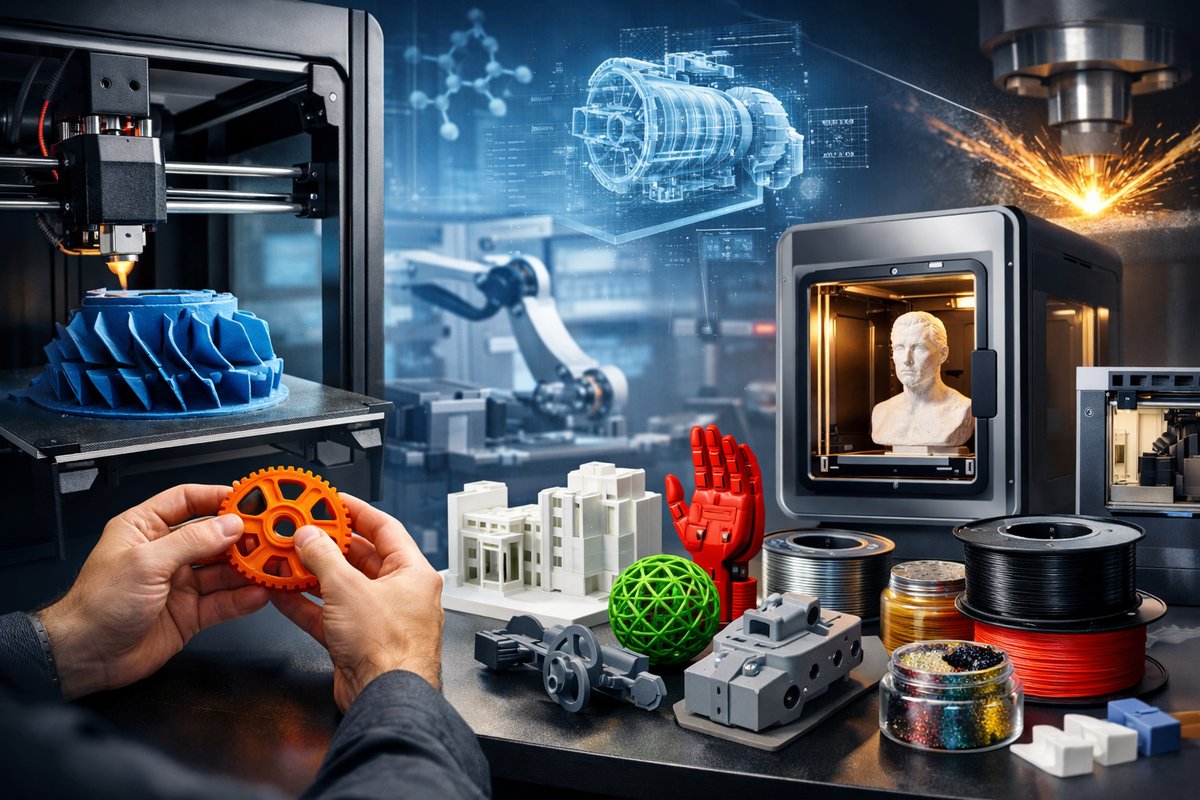

3D printing has evolved from a niche prototyping tool into a versatile manufacturing platform that touches industries as diverse as healthcare, aerospace, and consumer goods. Whether you’re a hobbyist experimenting with small figurines or a professional developing functional prototypes, understanding the landscape of tools, materials, technologies, and techniques is key to success. This article lays out the fundamentals, surveys the most popular materials, compares leading printing technologies, and offers practical advice for achieving consistent, high-quality results.
The Building Blocks of Additive Manufacturing
At its core, 3D printing is an additive process: instead of cutting away material, the printer builds an object layer by layer based on a digital model. That digital model usually lives in an STL or OBJ file, created in a computer-aided design (CAD) program or captured via 3D scanning. Preparation begins by slicing the model into thin horizontal layers with specialized software. You’ll set parameters such as layer height, infill density, print speed, and support structures.
The machine itself can take many forms, but two dominant classes are fused deposition modeling (FDM) and vat photopolymerization (commonly called resin or SLA printing). FDM heads melt and extrude thermoplastic filament through a heated nozzle, while SLA units use ultraviolet light to selectively cure liquid resin. A sturdy frame, motion axes, a motion control board, and a heated build platform support these processes. Over the past decade, price points have dropped dramatically, making desktop units accessible for under a few hundred dollars, though higher-end prosumer machines with enclosures and precision components can cost several times more.
Choosing the Right Materials
One of the most exciting aspects of 3D printing is the ever-growing palette of materials. Thermoplastics remain the entry point for many makers:
• PLA (polylactic acid): A biodegradable, user-friendly filament derived from renewable resources. PLA has low warping, minimal odor, and prints at moderate temperatures, making it ideal for beginners. Advanced blends include silk PLA, wood-filled PLA, and glow-in-the-dark PLA for unique visual effects.
• ABS (acrylonitrile butadiene styrene): Known for strength, impact resistance, and moderate heat tolerance. ABS requires a heated build plate and can warp if cooled too quickly, so many users employ enclosed chambers.
• PETG (polyethylene terephthalate glycol): A hybrid material combining the ease of PLA with improved chemical resistance and toughness. PETG’s semi-rigid nature and clear finish make it popular for mechanical parts and functional prototypes.
Beyond standard filaments, specialty materials have opened new applications:
• Flexible filaments (TPU, TPE): Rubber-like polymers that stretch and compress, used for gaskets, grips, and wearable items.
• Composite filaments: Base polymers loaded with fibers or powders-carbon fiber-reinforced nylon for rigid, lightweight parts; metal-infused filaments for post-print polishing to achieve a metallic sheen.
• Engineering polymers: Nylon, polycarbonate, and PEEK for high-temperature and load-bearing uses in automotive, aerospace, and industrial sectors.
On the resin side, formulations range from standard gray and clear to tough, flexible, dental, and castable resins. Castable resin is particularly popular among jewelers and small foundries because it burns out cleanly, enabling investment casting workflows.
Comparing 3D Printing Technologies
While FDM and SLA dominate the desktop market, other methods gain traction in specialized contexts:
• Selective laser sintering (SLS): Uses a high-power laser to fuse powdered nylon or metal into solid parts. SLS requires industrial-grade equipment and offers excellent mechanical properties with no need for support structures, as the surrounding powder acts as support. It’s widely used for functional prototypes and low-volume production.
• MultiJet fusion (MJF): Similar to SLS but employs a fusing agent printed onto a powder bed, followed by infrared heating. MJF achieves finer detail and faster build speeds, with uniform mechanical characteristics.
• Digital light processing (DLP): A variant of resin printing where each layer is cured by projecting an image with a digital micromirror device. DLP can be faster than SLA for certain layer heights and yields highly detailed prints, making it popular for dental models and jewelry patterns.
• Direct metal laser sintering (DMLS) and electron beam melting (EBM): High-end processes that build fully metal parts layer by layer. These require specialized facilities but open doors to lightweight aerospace structures and custom medical implants.
Selecting the right technology depends on your priorities: cost, resolution, material properties, build volume, and post-processing needs. Desktop FDM is unbeatable for low cost and ease of use; desktop resin printers elevate detail and surface finish; industrial systems tackle large volumes and exotic materials.
Mastering Workflow and Best Practices
Achieving repeatable, high-quality prints involves careful calibration and routine maintenance. Here are key practices:
• Bed leveling and first-layer calibration: A perfectly leveled build plate and correct nozzle distance ensure strong first-layer adhesion. Automated bed-leveling sensors can help, but manual mesh leveling remains common on budget machines.
• Temperature tuning: Filament blends vary in optimal extrusion and bed temperatures. Conduct temperature towers to find the sweet spot that maximizes layer bonding without stringing or overheating.
• Monitoring filament moisture: Hygroscopic materials like nylon and TPU absorb moisture, leading to brittle strands and noisy extrusion. A filament dryer or airtight storage with desiccant helps maintain print quality.
• Print orientation and support strategies: Orient parts to minimize overhangs and reduce support usage. Software options allow custom support placement, tree supports for resin prints, and variable density scaffolding that balances stability and ease of removal.
• Post-processing: FDM prints often benefit from light sanding, primer, and paint. Resin prints require isopropyl alcohol washes and UV curing; some resins also need controlled post-cure to achieve full mechanical properties.
• Safety and ventilation: Filament emissions can produce ultrafine particles and volatile organic compounds. Enclosures with filtered airflow or operation in well-ventilated areas are recommended. When working with resin, use nitrile gloves and eye protection to avoid skin contact.
Looking Ahead: Trends and Emerging Techniques
Additive manufacturing continues to push boundaries, with trends that promise to reshape industries:
• Multi-material printing: Dual-extrusion FDM and hybrid resin-filament systems enable combining rigid and flexible materials or incorporating soluble supports that wash away after printing. This simplifies complex geometries and streamlines assembly.
• Large-format 3D printing: Industrial gantry printers now tackle furniture, architectural components, and custom molds with build volumes spanning multiple cubic meters.
• Bio-printing: Experimental systems lay down living cells within biocompatible gels, advancing regenerative medicine and tissue engineering. While still largely in research labs, commercial systems for biopolymer scaffolds are emerging.
• Artificial intelligence in slicing: Machine learning algorithms analyze part geometry and stress profiles to automatically optimize infill patterns, wall thicknesses, and support structures, reducing print time and material waste.
• Circular economy initiatives: Recycled filament from post-consumer plastics and closed-loop recycling systems for failed prints are gaining traction, reflecting a growing focus on sustainability.
Next Steps in Your Printing Journey
Whether you’re setting up your first machine or scaling a professional prototyping lab, the key is experimentation and continuous learning. Start with simple shapes and reliable filaments before progressing to composite blends or SLA resins. Engage with online communities to share calibration files, troubleshooting tips, and design ideas. As hardware and software evolve, new capabilities will unlock, fueling innovations in art, engineering, healthcare, and beyond. Armed with the right tools, materials, and techniques, your only limit is imagination.