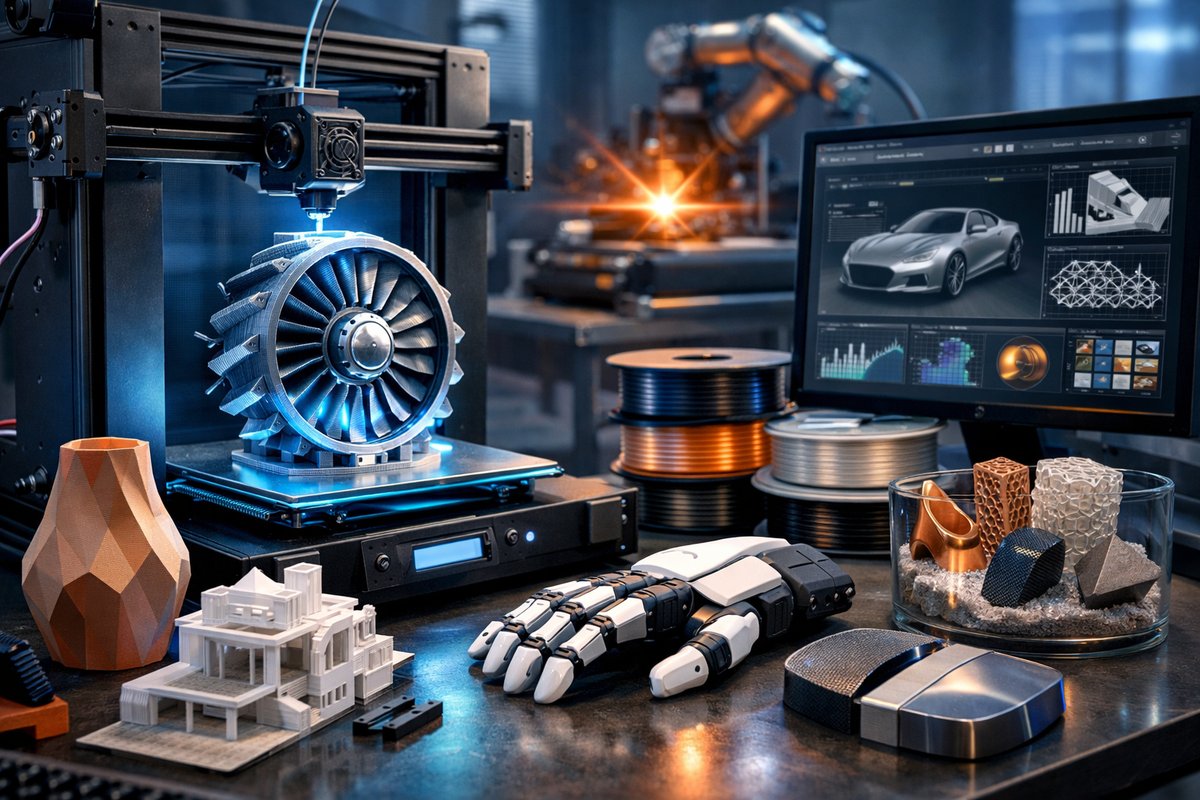

The world of 3D printing is undergoing a quiet but profound revolution. What once was a niche technology reserved for specialized industries has blossomed into a versatile tool accessible to hobbyists, educators, and professionals alike. This transformation is fueled by continuous advancements in hardware, materials, and software that collectively reduce costs, improve reliability, and expand the range of applications.
At the heart of modern 3D printing’s evolution is the push toward greater economy without sacrificing quality. Traditional fused filament fabrication (FFF) printers have become more affordable and user-friendly, but the latest wave of innovation extends beyond price drops. For instance, the integration of advanced motion control systems and closed-loop feedback mechanisms in printers enhances precision and repeatability, minimizing failed prints and wasted material. This means fewer costly errors and less environmental impact due to discarded filament.
Material science has also made impressive strides. New composite filaments infused with recycled plastics or bio-based polymers offer sustainable alternatives to conventional thermoplastics. These eco-friendly materials not only lower the carbon footprint of printing but also often provide improved mechanical properties, such as increased strength or flexibility. Additionally, developments in resin formulations for stereolithography (SLA) and digital light processing (DLP) printers have led to faster curing times and reduced shrinkage, resulting in smoother finishes and finer details.
Hybrid printing techniques are another frontier making 3D printing more feasible for complex projects. Combining additive manufacturing with subtractive processes like CNC milling allows creators to produce parts with superior surface quality and dimensional accuracy. This synergy is particularly valuable in industries like aerospace and medical devices, where precision is critical.
Software advancements play a pivotal role in boosting success rates and user experience. Modern slicing software now incorporates artificial intelligence algorithms that optimize print paths and parameters automatically based on the model’s geometry and the printer’s capabilities. This intelligent preparation reduces trial-and-error cycles, making the printing process more predictable and less intimidating for newcomers.
Moreover, cloud-based platforms enable remote monitoring and control of 3D printers, facilitating collaborative workflows and efficient resource management. Users can queue multiple print jobs, receive real-time alerts, and analyze print performance data to refine future projects. This connectivity not only streamlines production but also fosters communities of practice where knowledge and best practices are shared.
The accessibility of multi-material and multi-color printing has also expanded creative possibilities. Recent innovations in printer heads and filament switching mechanisms allow seamless transitions between materials within a single print. This capability is transforming prototyping and product design by enabling functional parts with integrated electronics, flexible joints, or aesthetic color gradients without assembly.
In the medical field, 3D printing breakthroughs are enabling more personalized care. Biocompatible materials and precise imaging integration allow for custom implants, surgical guides, and prosthetics tailored to individual patients. The speed and cost-effectiveness of these solutions are improving outcomes and reducing wait times.
Education and hobbyist communities benefit from these technological advances as well. Affordable printers equipped with user-friendly interfaces and comprehensive support materials encourage experimentation and skill development. Open-source hardware and software ecosystems empower makers to customize and improve their setups, fueling innovation from the grassroots level.
In summary, the latest technologies and techniques in 3D printing are making the craft more economical, feasible, and successful by enhancing precision, sustainability, and usability. As the boundaries between virtual design and physical creation continue to blur, this layered approach to making is not only democratizing manufacturing but also inspiring new forms of artistic and functional expression. Whether for rapid prototyping, bespoke production, or creative exploration, 3D printing stands as a testament to the power of imagination fused with technical ingenuity.
-
Fused Materials PVA Filament 1.75mm – Water-Soluble Support ...
Amazon.com: Fused Materials PVA Filament 1.75mm – Water-Soluble Support Material for 3D Printing – Compatible with Bambu Lab, Polymaker, Overture, ... -
ROBO 3D C2 Compact Smart 3D Printer - 5" x 5" x 6" Build Size
Mini 3D Printer for Ki-ds Beginners Fully Assembled Auto Leveling Educational STEM Desktop Printer ... Print Technology: Fused Filament Fabrication; Layer ... -
Amazon.com: Protopasta 3D Printer Filament | Black Recycled PLA
Amazon.com: Protopasta 3D Printer Filament | PLA Filament 1.75mm | Black Recycled PLA | 1kg Spool : Industrial & Scientific. -
Comgrow 6KG PLA 3D Printer Filament, 3D ... - Walmart Business
I love the fact that the spools are sturdy cardboard and can be recycled instead of plastic that cannot. I wish all filament manufacturers would do this. I ... -
SUNLU Water Washable Resin 1000g, Fast Curing 3D Printer Resin ...
Amazon.com: SUNLU Water Washable Resin 1000g, Fast Curing 3D Printer Resin for LCD DLP SLA Resin 3D Printers, 395 to 405nm UV Curing 3D Printing Liquid ... -
3D Printer Resin, SUNLU Fast Curing Standard 3D Resin for LCD ...
Buy 3D Printer Resin, SUNLU Fast Curing Standard 3D Resin for LCD DLP SLA Resin 3D Printers, 395-405nm UV Light Curing 3D Printing Liquid Photopolymer Resin ...