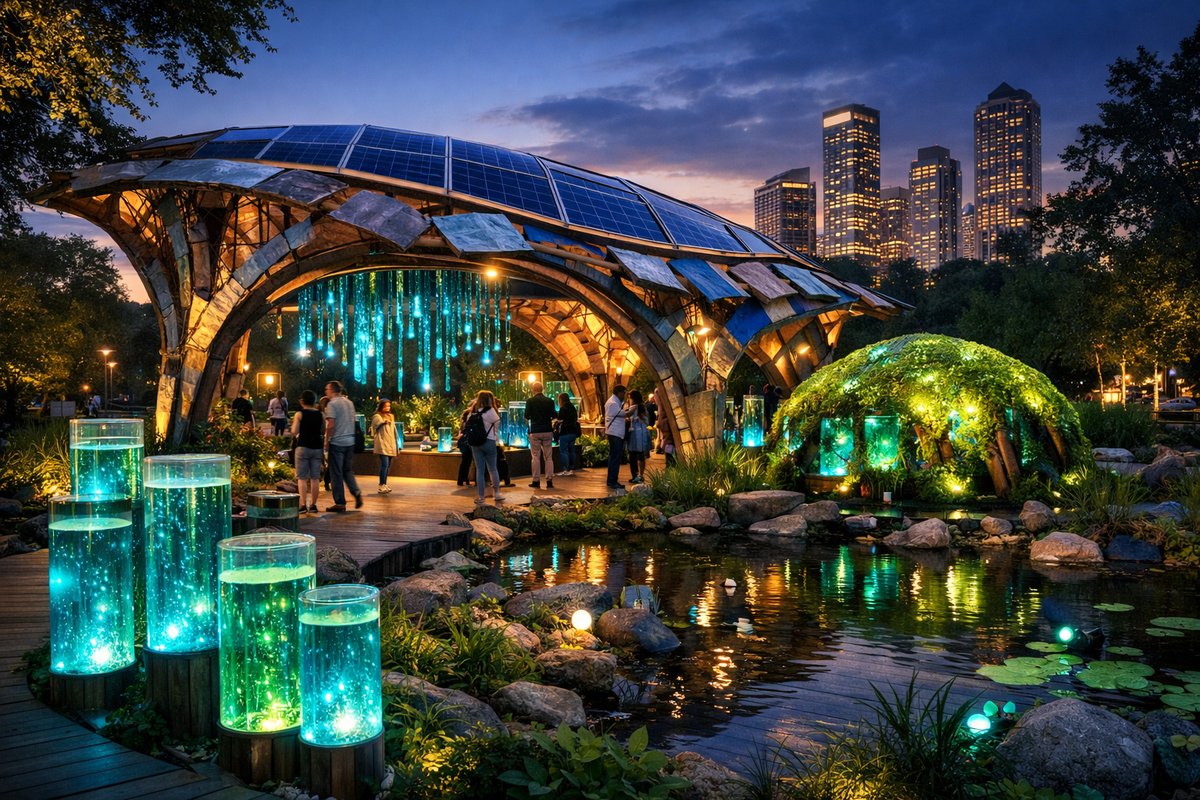

When dusk settles over the city’s central green, slender pillars begin to glow with a gentle blue-green pulse. Titled “Forest of Echoes,” this public art installation merges reclaimed plastics, solar modules, and living bioluminescent cultures into a nocturnal grove that hums in time with visitors’ movements. Conceived by a collective of designers, engineers, and environmental advocates, the work unfolds as both a light sculpture and a community experiment in sustainability-driven creativity.
The piece occupies a former rose garden, where rows of translucent columns-each nearly ten feet tall-line winding paths through mature oaks and maples. By day, they look like oversized recycled plastic spires, their surfaces matte and pale. Panel by panel, the material evokes the plastic bottles and food containers reclaimed from local waste streams, ground down and molded into modular units. Hidden within each is a bank of tiny solar panels that harvest daylight, while embedded microcontrollers collect readings on ambient light, motion, and humidity.
As evening approaches, onboard batteries charge up and trigger the first glimmer of the bioluminescent phase. Inside sealed glass vials at the columns’ core, a nonpathogenic marine microorganism begins to fluoresce, its cells aglow with the result of engineered genes sourced from natural species. Although the living cultures produce much of the luminescence, small arrays of addressable LEDs amplify the glow and extend its duration, ensuring that the installation remains luminous even on overcast nights.
The project’s philosophy rests on three pillars: ecological mindfulness, open-source collaboration, and sensory discovery. To ensure ecological mindfulness, the collective partnered with local recycling centers to secure feedstock for the plastic columns. A neighborhood workshop series introduced residents to basic recycling techniques, demonstrating how household plastics can be cleaned, shredded, and remelted into new forms. This not only reduced the installation’s carbon footprint but also fostered a sense of shared ownership.
Open-source collaboration guided every technical decision. All circuit schematics, code for the microcontrollers, and instructions for cultivating the bioluminescent cultures are freely available online. Visitors can scan QR codes at the site to download files, customize their own light patterns, or even adapt the design for smaller-scale home or classroom projects. By publishing data and design files under a liberal license, the team hopes that similar installations will spring up in schools, community centers, and other public spaces around the globe.
Sensory discovery emerges as the installation’s most immediate impact. Motion sensors trigger light pulses that ripple along the columns whenever a passerby approaches, creating a cascading echo of illumination-hence the name. In quieter moments, the bioluminescence itself shifts in intensity, responding to changes in humidity and temperature. According to the designers, these subtle fluctuations offer an intimate reflection of the local microclimate, inviting observers to feel their environment in a new, luminous language.
On opening night, families, cyclists, and art enthusiasts flocked to the park. Children traced fingerpaths along the bases of the columns, giggling as the lights arced out toward them. Older visitors paused beneath the glowing canopy, marveling at the way the algae-inspired hue seemed to shimmer like living water. Nearby, small stages hosted impromptu performances-dancers clad in reflective fabrics, musicians playing glass harmonicas-each integrating their craft into the installation’s mesmeric aura.
Local environmental groups have praised “Forest of Echoes” for its educational value. Guided tours explain how solar cells feed into portable battery packs, which in turn power the LEDs and support conditions for the bioluminescent organisms. Posters outline the life cycle of the microorganisms, offering insights into how genetic engineering can be steered toward ecological ends. Workshops scheduled through the month allow participants to build mini versions of the columns, complete with tiny algae chambers and LED arrays powered by mini solar panels.
Yet the project is not without its skeptics. Some critics worry about the long-term viability of hosting living organisms in public art without constant maintenance, or the ethics of modifying natural species for purely aesthetic ends. The collective responds that safety protocols, redundant water filtration systems, and carefully monitored growth cycles minimize risks, while emphasizing that transparency and community oversight remain central. All culture media used in the algae chambers are housed behind locked panels, and daily logs of water chemistry are posted online.
Beyond the technicalities, “Forest of Echoes” operates as a philosophical statement. In an era when disposable plastics and fossil fuel dependence dominate global discourse, the installation offers an alternative narrative: that technology and nature need not stand in opposition. By upcycling waste materials, harnessing clean energy, and employing living organisms, the artwork embodies a circular mindset-materials flow through multiple stages of use, returning vitality to the environment rather than languishing as landfill.
Curators note that the work also draws on a long tradition of light art, from early experiments with neon and lasers to recent digital projections on urban facades. What sets this installation apart is its living component, which transforms a static form of illumination into a dynamic, breathing ecosystem. Rather than broadcasting a predetermined sequence, the sculpture’s behavior evolves alongside visitors and weather conditions, forging an unpredictable, co-creative relationship.
For the designers, the ultimate hope is that “Forest of Echoes” will seed new ideas about how public art can function as a platform for civic engagement. Plans are already underway for a companion mobile app that lets remote users trigger light pulses from anywhere in the world, fostering a global network of glowing participatory gardens. In parallel, research partnerships with local schools aim to integrate modules of the installation into STEM curricula, demonstrating real-world applications of coding, renewable energy, and biotechnology.
As the installation continues through its run, park managers are tracking pedestrian traffic, gathering feedback on visitor experiences, and monitoring ecological indicators such as soil moisture and nighttime light pollution. Preliminary data suggests that foot traffic in the garden has increased by over 40 percent compared to this time last year, while average dwell times have doubled. Anecdotal reports hint at calming effects for visitors suffering from stress or insomnia, though formal studies would be needed to confirm any therapeutic claims.
At its core, “Forest of Echoes” exemplifies a new wave of art and design that places sustainability and interactivity at its heart. It invites everyone-from curious passersby to seasoned technologists-to step into a luminous forest where every footprint and flicker of light carries meaning. As the bioluminescent glow pulses into the night, it reminds us that innovation need not consume; it can cultivate, radiate, and renew.
-
KEYESTUDIO Leonardo R3 Microcontroller Development Board ...
Amazon.com: KEYESTUDIO Leonardo R3 Microcontroller Development Board with USB Cable Kit for Arduino Project : Electronics. -
ARM CANBed - Arduino CAN-Bus RP2040 development board
... Microcontroller Development Board. Add. $2347. current ... Super Starter Kit for Projector Microcontroller Board Breadboard / Step Motor / SG90 Servo /1602. -
DOKIO 200W Portable Foldable Solar Panel Kit for 12V Battery ...
【TRAVEL LIGHT, POWER ANYWHERE】 Weighing only 9.7lb and folding to 20×27×1.1in, this 200W panel is slim, portable, and easy to carry or mount—perfect for RVs, ... -
DOKIO Portable Foldable 100W 18v Solar Suitcase Monocrystalline ...
Buy DOKIO Portable Foldable 100W 18v Solar Suitcase Monocrystalline, Folding Solar Panel Kit with Controller to Charge 12 Volts Batteries (AGM Lead/Acid ... -
Amazon.com: Speclux PC Addressable RGB LED Strip Lights Kit
PACKAGE INCLUDES · 2 x Addressable LED Strip (35cm) · 1 x Extension Cable (40cm) · 1 x Key Controller with 5V SATA Connection Cable · 1 x ADD-RGB Extension ... -
ALITOVE 6.56ft COB LED Strip Lights WS2811 Addressable RGB IC ...
【Rainbow Color Chasing Effects】ALITOVE WS2811 Addressable COB LED strips display multiple colors on one line at a time compared with traditional RGB ...