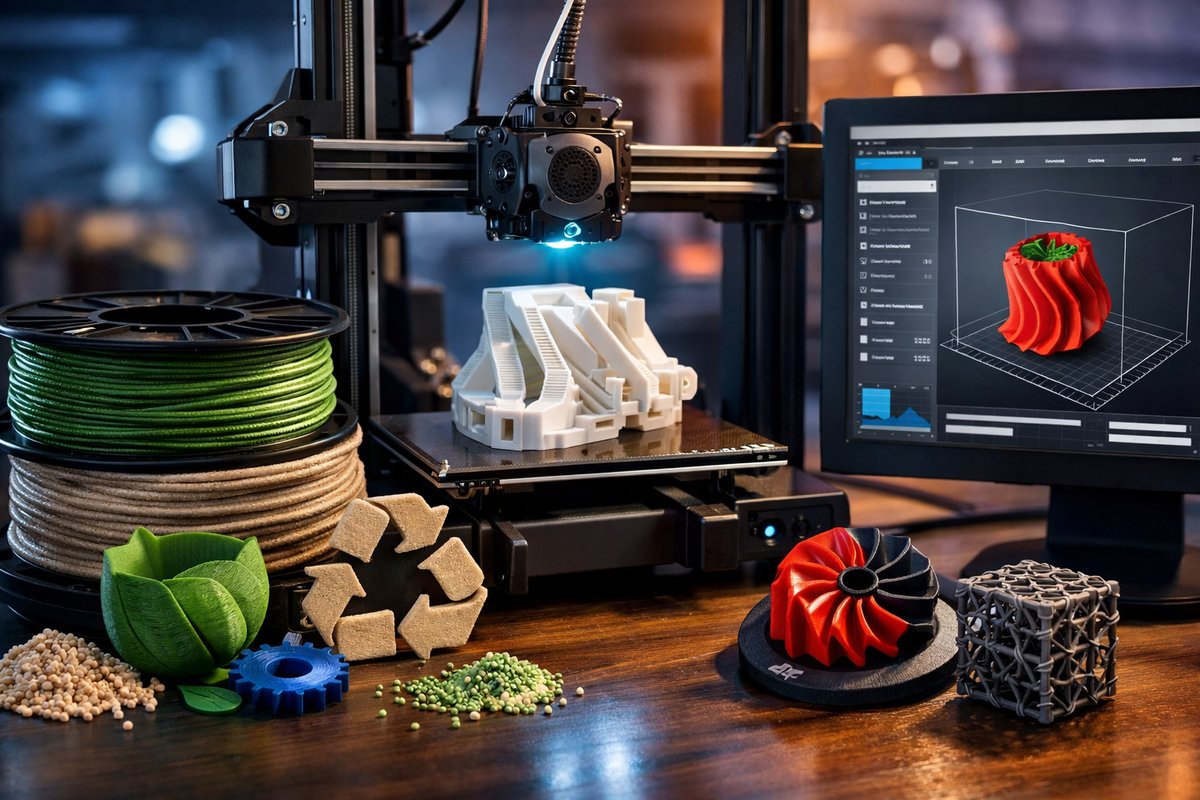

The world of additive manufacturing has evolved beyond simple desktop machines churning out trinkets. Today’s 3D printers bring industrial-grade precision to garages, studios, classrooms, and small workshops, while specialized resin systems bridge the gap between dental-grade models and fine-art sculptures. As the community grows, the quest to cut costs-without sacrificing quality-has inspired a wave of clever materials, hardware hacks, and smarter workflows.
Cutting printing time and material waste starts at the slicing stage. Modern slicers now offer adaptive layer height, automatically thinning layers on curved surfaces and thickening them on flat stretches. That simple shift can slash print times by up to 30 percent, while preserving fine detail where it counts. Experimenting with variable infill also pays dividends: smart patterns such as gyroid and cubic infill strike a balance between strength and filament use, often requiring 20 to 40 percent less plastic than traditional grid fills.
Infill aside, support structures have undergone a makeover. Tree supports and organic branching supports hug models more lightly than boxy scaffolds, reducing material consumption while minimizing breakaway marks. Some slicers even let creators fine-tune support density just under overhangs, trimming branches that never see the light of day. Paired with breakaway or water-soluble support filaments, these strategies make complex geometries more accessible-especially for novices still finding their removal confidence.
Material science has joined the affordability push in exciting ways. Recycled PLA filaments, sourced from industrial scraps and failed prints, now sell at prices comparable to virgin PLA. Advances in pellet extruder attachments allow hobbyist machines to feed directly off plastic pellets-often half the price of spooled filaments-and tune extruder temperatures for specialty polymers like ABS, PETG, or even eco-friendly bio-composites infused with wood, coffee grounds, or algae.
Pellet-fed printers represent a game changer for large-format printing. Instead of limiting builds to one- or two-kilogram spools, pellet extruders can run continuous material feeds, slashing costs for oversized models from architectural mockups to stage props. The upfront extruder add-on is more affordable than buying successive spools, and pellets themselves can be purchased in 25-kilogram bags at a fraction of per-kilogram spool prices.
Multi-material hot ends and swappable nozzle kits push versatility further. Makers can swap in hardened nozzles for abrasive composite filaments or low-temperature nozzles for specialty PLA blends in minutes. Dual-extrusion setups now support soluble supports, color transitions, and co-printing of flexible and rigid materials in a single build. Modular hot-end designs simplify maintenance: clogged nozzles can be replaced instead of cleaned, reducing downtime and frustration.
On the resin side, masked stereolithography (mSLA) has matured with higher-resolution LCD panels and faster UV arrays, cutting per-model print times dramatically. Low-viscosity resins formulated for rapid cure cycles now enable batch printing speeds once thought exclusive to industrial systems. Economical resin blends-designed for prototyping rather than end-use parts-cost up to 40 percent less while still delivering crisp detail for miniatures, dental models, or jewelry patterns.
Waste reduction in resin printing is also improving. Some platforms allow mid-print resin swaps, so a customer can print bulk items in a standard resin before switching to a high-detail formula for fine features, avoiding the need to drain vats between jobs. Reusable resin traps and precision filtering extend usable resin life by catching cured particles before they cloud the tank floor. Combined with long-life FEP sheets and protective build plates, these measures push per-print material costs ever lower.
Once parts come off the build plate, post-processing often adds hidden costs in time and supplies. Affordable UV curing stations now feature adjustable intensity and rotating turntables, speeding uniform post-cure while preventing over-baking. Portable vapor smoothing kits-using safe, food-grade solvents in closed chambers-enable glossy finishes on ABS and ASA prints with minimal manual sanding. Meanwhile, tabletop sandblaster cabinets help hobbyists blast away layer lines efficiently, eliminating hours of hand work.
Open-source slicers and community-driven profiles have democratized expertise. Shared configuration sets for printers, nozzles, and filament brands let newcomers dial in reliable settings without endless trial and error. Cloud-based slicing platforms now offer instant G-code previews, automated support generation, and advanced mesh repair-right in the browser. Removing the barrier of powerful desktop hardware lowers the cost of entry and expands creative possibilities.
Remote monitoring and control systems bring server-grade reliability to home workshops. Add-ons for popular printer firmware enable smartphone alerts for failed prints, live webcam feeds, and timed filament change prompts. Integrations with IoT hubs automate bed leveling checks and temperature calibration cycles at startup. When unexpected jams or power outages hit, remote commands can pause, cancel, or resume jobs-saving expensive material from going to waste.
Sustainability and the circular design mindset underpin many cost-cutting practices. Refiling failed prints and support material into desktop shredder-filament extruder pipelines closes the loop on plastic waste. Solar-powered print farms, while still niche, are proving viable for remote labs and community makerspaces seeking zero-emissions workflows. Meanwhile, universities are pioneering natural fiber composites and plant-derived polymers that match conventional plastics in strength and cost.
Looking ahead, artificial intelligence promises to turbocharge efficiency. Early experiments in AI-driven slicing adapt wall thickness, infill patterns, and print speeds in real time, responding to sensor feedback on nozzle pressure and temperature. Generative design tools are already creating organic lattice structures that slash weight while maximizing stiffness-ideal for drone frames and lightweight tooling. As these innovations mature and migrate from industrial labs to open-source ecosystems, the next layer of 3D printing may be its most transformative yet.
Whether you’re a hobby baker printing cookie cutters or an engineer fabricating custom jigs, the innovations driving affordability are within reach. By combining smarter slicing strategies, low-cost materials, modular hardware add-ons, and sustainable practices, makers of every skill level can push boundaries without emptying their wallets. The quiet revolution of layer-by-layer creation continues-one cost-saving breakthrough at a time.
-
HATCHBOX PLA Filament 1.75mm Apple Sauce, 3D Printer ...
Amazon.com: HATCHBOX PLA Filament 1.75mm Apple Sauce, 3D Printer Filament 1KG Spool, Dimensional Accuracy +/- 0.03mm, Clog Free & Tangle Free, Vacuum Sealed ... -
TekDeals 20 Colors 3D Pen Printer PLA Filament Refills High ...
Buy TekDeals 20 Colors 3D Pen Printer PLA Filament Refills High Precision, 1.75 mm Dia., 323 Feet at Walmart.com. -
Amazon.com: Protopasta 3D Printer Filament | Black Recycled PLA
Recycled PLA filament - Since 2013, Protopasta has valued quality, reliability, and creativity. We seek to reduce waste in our production and build ... -
rPLA 1.75mm 1000 gram OFF-WHITE 3D Printer Filament
Buy Recycled PLA filament ReForm - rPLA 1.75mm 1000 gram OFF-WHITE 3D Printer Filament at business.walmart.com Facilities Maintenance, Repair & Operations ... -
YIEHO 300g UV Resin Kit with Light-Upgraded Crystal Clear Hard ...
Buy YIEHO 300g UV Resin Kit with Light-Upgraded Crystal Clear Hard UV Curing Premixed Epoxy Resin Starter Supplies for Art Craft Beginner Jewelry Making ... -
Visland Crystal Clear Ultraviolet UV Curing Resin, Hard Transparent ...
Produces a crystal clear, hard, and transparent finish. Diverse Crafting Uses. Diverse Crafting Uses. Ideal for resin casting, coating, bezels, molds, and DIY ...