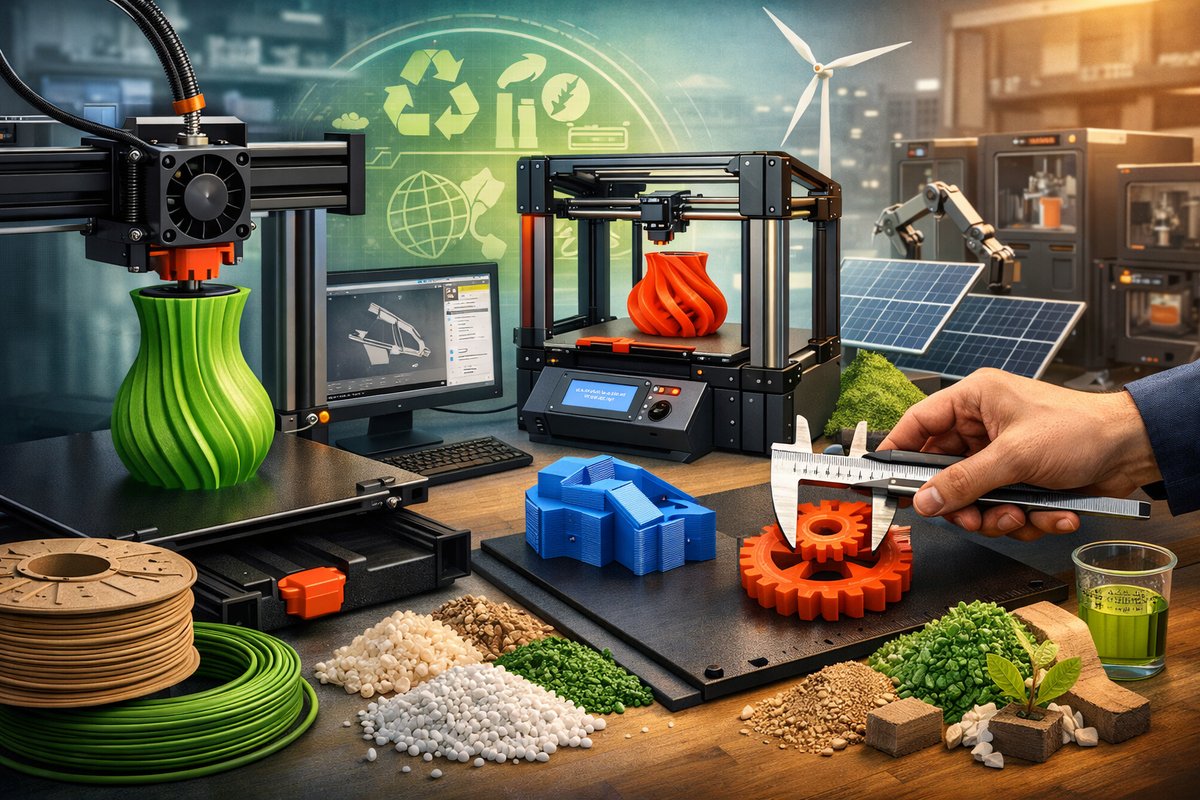

The world of 3D printing has evolved from a niche prototyping toy to a central tool in workshops, educational labs, and small factories. Yet many newcomers and veteran users still face familiar challenges: balancing material costs, managing print failures, and squeezing out every drop of performance from their machines. Affordable, dependable results once required deep pockets or specialized facilities. Today, however, a wave of creative solutions is making high-quality, economical additive manufacturing accessible to anyone with a design file and a bit of patience. This article explores the latest developments in materials, hardware, software, and workflows that are driving down costs and sharpening reliability across the layered world of 3D printing.
At the heart of any budget-minded build lies the filament-or resin-spool. Traditional PLA and ABS remain popular, but new low-cost blends made from recycled plastics or wood and stone composites cut raw material expenses by up to 25 percent without sacrificing dimensional accuracy. These eco-friendly spools often cost under fifteen dollars per kilogram, compared with twenty to twenty-five dollars for premium grades. Metal-infused filaments bring exotic properties like conductivity or magnetism to desktop machines at a fraction of the price of full metal sintering. Even more radical are pellets designed for use in single-screw extruders, dropping material costs below ten dollars per kilogram and opening the door to industrial-scale polymer printing in smaller workshops.
Hardware upgrades can turn an entry-level machine into a precision instrument. Auto-leveling sensor kits eliminate manual bed adjustments and improve first-layer adhesion, cutting failed prints by as much as 60 percent. All-metal hotends expand the temperature range, allowing advanced materials such as polycarbonate, nylon, and carbon-fiber composites to flow smoothly. Swappable nozzles made from hardened steel resist abrasive filaments, extending lifespan and reducing maintenance. Pair these with upgraded stepper drivers and vibration-damping mounts, and you’ll see crisper corners and finer surface finishes-features once reserved for machines priced well above a thousand dollars.
Software has become a silent partner in cost optimization. Modern slicers support variable layer heights, which automatically switch between coarse and fine layers depending on geometry. This dynamic slicing can shave print times by up to 30 percent without limiting detail where it matters. Adaptive infill patterns deposit material only where strength is needed, trimming filament usage by 15 percent on average. Real-time print monitoring algorithms detect anomalies like under-extrusion or layer shifts early, pausing the job and alerting the operator before a full-hour loss of build time occurs. Open-source firmware now lets you fine-tune acceleration and jerk settings for each axis, further reducing ringing and improving dimensional accuracy.
Once a print is complete, post-processing often determines whether it’s a keeper-or scrap. Affordable UV LED curing stations now include rotating platforms and programmable timers to ensure even resin hardening. For FDM parts, wet sanding kits with adjustable speed polishers cut finish time in half compared to manual methods. Low-cost vapor smoothing chambers use safe solvents under controlled conditions to give ABS parts a glossy, layer-free appearance. Specialty tumblers loaded with ceramic media can deburr metal-infused or nylon prints, unlocking mechanical properties without costing hundreds in industrial finishing services.
Streamlining your printing schedule is another path to efficiency. Grouping smaller parts into a single build plate run reduces the number of heat-up and cool-down cycles, saving both time and power. Strategic nesting tools place multiple models in tight, non-conflicting arrangements, maximizing plate utilization. Keeping a well-stocked lineup of common spare parts-nozzles, PTFE liners, belts, and thermistors-prevents day-long downtime waiting for replacements. And a simple log of temperature, humidity, and print settings for each material helps dial in optimal parameters on the first try.
Moisture-related failures have long bedeviled filament users, but countertop drying and storage systems now offer automated humidity control. These units preheat spools at the correct temperature, then seal them under vacuum or desiccant environments. The result: fewer brittle layers, cleaner extrusion, and a drop in clog-related maintenance. For environments prone to dust or temperature swings, enclosures with integrated HEPA filters and thermostatic controllers create a stable micro-climate around the build chamber, trimming warping failures by an estimated 20 percent.
Sustainability has also taken root as a cost-saving ethic. Digital inventory platforms track leftover filament, resin vats, and spare parts across projects, turning potential waste into planned maintenance or backup supplies. Many makers are even recovering failed prints, grinding them into pellets for on-site recycling systems. Lifecycle analyses of desktop setups show that optimized print plans, low-energy materials, and local finishing reduce overall carbon footprints by 40 percent compared to centralized manufacturing.
Looking ahead, artificial intelligence promises to automate much of the tinkering that still underlies successful prints. AI-driven slicing engines could predict optimal support structures before layouts are locked in. Computer vision modules may intervene mid-print to correct layering issues on the fly. Meanwhile, multi-material heads are democratizing composite and full-color printing, once the domain of expensive industrial machines. As open-source communities continue to share designs and optimizations, the gulf between prototype lab and home workshop will shrink further, making additive manufacturing a true do-it-together craft.
Every innovation-from recycled filaments and auto-leveling sensors to adaptive slicing and curing stations-feeds into a virtuous cycle of lower costs and fewer failures. Whether you’re shaping your first keychain or engineering a functional end-use part, these techniques and technologies ensure that the next layer you print is cleaner, stronger, and more affordable than the last.
-
phrozen Sonic Mini 8K S LCD Resin 3D Printer, 7.1 ... - Amazon.com
Compact and Powerful - The resin printer offers sufficient space to let your creativity run wild with a printing volume of 16.5 x 7.2 x 17 cm and a load ... -
10Pcs FEP Film for Photon Resin 3D Printer 140X200mm SLA/LCD ...
Buy 10Pcs FEP Film for Photon Resin 3D Printer 140X200mm SLA/LCD Fep Sheets 0.15-0.2mm 3D Printer Filaments Impresora at Walmart.com. -
Microswiss All Metal Hotend Kit for Creality CR-10 / CR10 / CR10S ...
Top highlights · Brand. Micro-Swiss · Material. Aluminum , Titanium, Brass , Silicone · Color. Silver · Item Weight. 0.06 kg · Compatible Devices · Supported ... -
Micro Swiss MK10 Slotted Cooling Block All Metal Hotend Kit - 0.6mm
Buy Micro Swiss MK10 Slotted Cooling Block All Metal Hotend Kit - 0.6mm at business.walmart.com Technology - Walmart Business Supplies. -
FAST MELT UV Resin Curing Box, 395nm UV Curing Light Station ...
FAST MELT UV Resin Curing Box, 395nm UV Curing Light Station with 36 LED Beads, Auto UV Curing Resin Dryer Timer Setting Digital Display(S/M/H) with Tray, ... -
3D Printer UV Curing Light Box for LCD/DLP/SLA Resin ... - Walmart
Upgrade your 3D printing with our DIY 405nm UV Resin Curing Station. Features 360° turntable and intelligent time control ... UV LED lights which can fully curing ...