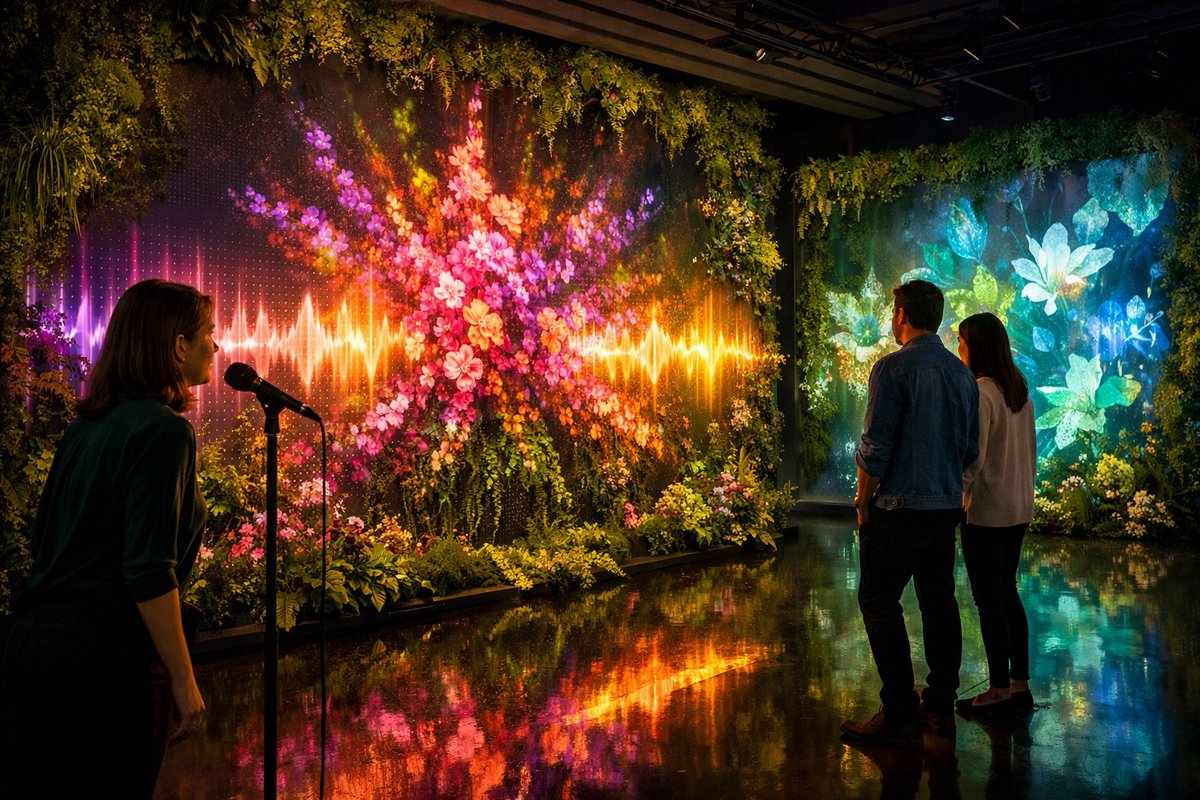

A hush falls over the gallery as a visitor leans forward to speak softly into a sleek, tabletop microphone. Moments later, a cascade of undulating colors arcs across a large canvas suspended on the far wall. What began as a whisper becomes a vibrant bloom of teal, amber, and rose. This is “Echoes in Pigment,” a pioneering interactive art installation that transforms spoken words into living paintings before the viewer’s eyes.
Conceived by a collective of designers, engineers, and neuroscientists, Echoes in Pigment officially opened last week at the Vanguard Design Hub, an adaptive space devoted to experimental media and sustainable art. Rather than simply responding to pre-programmed sounds or beats, the installation uses a neural network trained on thousands of voice recordings to parse tone, pitch, and emotional inflection. These vocal signatures are then mapped to specific pigment flows and brushstroke patterns, projected in real time onto a compostable, plant-based canvas.
From its earliest concept sketches to its public debut, the project emphasized sustainability and emotional intelligence. The canvas substrate is woven from fast-growing bamboo fibers and treated with a low-VOC coating, ensuring that each interactive painting can eventually return to the earth without heavy waste. Underneath the surface, a grid of micro-LED modules and hidden motion sensors allow the visual projections to wrap around the support structure, giving the artwork a sculptural depth that responds as visitors move through the space.
“We wanted to create a space where the boundary between audience and artist disappears,” explains the installation’s curator. “By tapping directly into the voice, which is deeply tied to our identity and emotions, we make each person a collaborator in the art itself. The work evolves with every utterance, every sigh, every laugh.”
The technical backbone is equally intricate. A directional USB microphone picks up the visitor’s voice, sending data to a compact processing unit tucked under the podium. There, a lightweight voice-recognition model analyzes acoustic features and emotional tone. In under a second, the system relays color and brushstroke commands to a network of projectors and LED strips arrayed around the canvas. The entire visual synthesis is handled by open-source tools, enabling future artists to customize the mapping between vocal inputs and visual outputs.
While real-time voice-to-color translation is the central draw, the installation also records each interaction. Over the course of the exhibition, the curatorial team will compile a digital anthology of the hundreds of living paintings created each day. Visitors can opt to receive a high-resolution digital download of their personal artwork, preserving a fleeting moment when voice, emotion, and color converged.
A guided walkthrough highlights several signature experiences. In one chamber, a pair of projectors weave two separate voices into a single cohesive painting-a dialogic canvas where overlapping hues signify moments of agreement, and contrasting streaks mark dissonance. In another nook, low-hanging speakers replay ambient fragments of visitor-generated brushstrokes as gentle whispers in the dark, creating a loop of sound and light that almost feels alive.
Feedback from early visitors has been overwhelmingly positive. Many cite a sense of intimacy in hearing their own recorded voice layered into the ambient soundtrack. Some have marveled at the unpredictability of color choices: a hesitant whisper yields icy blue, while a more forceful declaration erupts in fiery gold.
Beyond the immediate spectacle, Echoes in Pigment gestures toward broader conversations about the role of generative systems in art. By leveraging neural algorithms trained on diverse vocal samples, the installation asks: To what degree can a machine interpret and express human emotion? And how might that shape our understanding of creativity in an era of intelligent systems?
Critics have praised the exhibit for its blend of high-tech wizardry and human warmth. Writing for a contemporary art journal, one reviewer noted that the work “transcends gimmickry by grounding its technology in genuine emotional exchange.” Another pointed out that the use of biodegradable materials sets a new benchmark for responsible design in immersive experiences.
Behind the scenes, the development team faced challenges common to cutting-edge interactive art. Synchronizing multiple projectors to avoid blurring, calibrating sensors to detect subtle gestures, and tuning the voice model to respect cultural variations in speech all required months of iterative testing. To accommodate these complexities in a museum setting, the curators installed a dedicated climate-control enclosure around the mechanics, maintaining optimal temperature and humidity for both the electronics and the bamboo canvas.
Still, the creative payoff is clear. On opening night, thousands of visitors wove through the rooms, speaking phrases of hope, singing snippets of favorite songs, and even reciting poems. Each voice left a chromatic footprint, contributing to a communal tapestry that now stretches across the gallery’s walls. By the show’s final week, the space will host a closing event where select paintings will be collectively unveiled in an immersive light-and-sound performance.
The project also serves as an educational platform. Local schools have booked field trips to explore the intersection of neuroscience, design, and environmental stewardship. Hands-on workshops allow young students to experiment with open-source coding tools, building miniature prototypes that translate sensor data into simple visual patterns. These community outreach sessions underscore the installation’s commitment to curiosity, sustainability, and democratic access to creative technology.
Looking ahead, the core team hopes to tour Echoes in Pigment to other institutions around the world. Plans are already in discussion for a pop-up version in public parks, using weatherproof components to bring the installation outdoors. There, passersby could activate voice-triggered color blooms against urban walls or within shipping containers repurposed as micro-galleries.
In an era where digital art often lives solely on screens, Echoes in Pigment reminds us of the power of embodiment-the visceral thrill of seeing one’s own voice traced in living hues on a tactile surface. It’s a testament to the potential of multidisciplinary collaboration, fusing art, science, and ecology into a single, resonant experience.
Whether you speak a single word or sing an entire verse, your voice leaves a trace that outlasts the moment. As the final event approaches, the gallery hums with the anticipation of thousands more voices ready to ignite the next wave of living paintings. In this space, art is not just observed; it’s sung, it’s lived, it’s woven into the very fabric of our collective imagination.