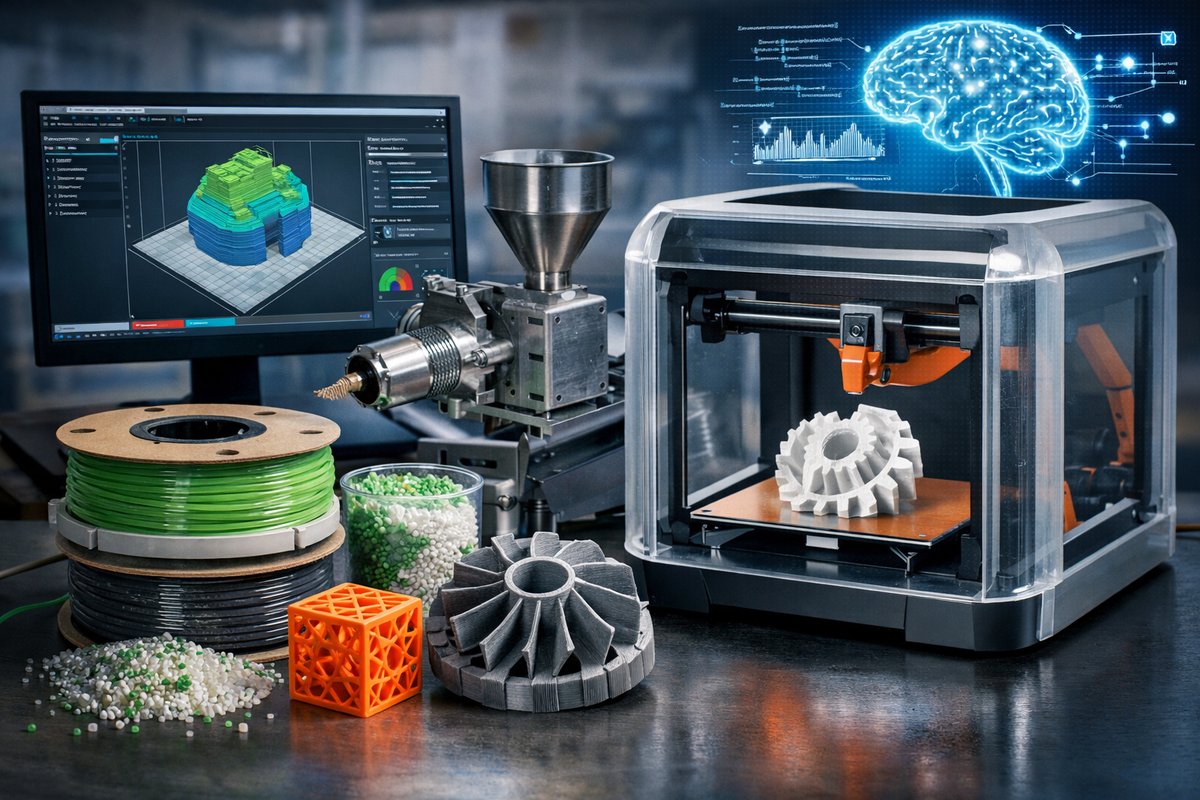

In the ever-evolving realm of additive manufacturing, cost and performance need not pull in opposite directions. Advances in material processing, open-source software, and modular hardware upgrades are closing the gap between hobbyist setups and industrial workhorses. Whether you’re crafting scale models in a home workshop or prototyping functional parts in a small engineering studio, the tools and techniques on the horizon promise to streamline workflows, slash material expenses, and boost print success rates-all while retaining the flexibility and creativity that make 3D printing so magnetic.
The conventional filament spool has long dominated hobbyist machines, but today’s innovators are harnessing everything from plastic pellets to composite blends to recycled waste. Pellet-fed extruders, once confined to industrial lines, are now available in compact formats that bolt onto desktop printers. They tap bulk resin, polystyrene, or even chopped plastic pellets for a per-gram cost reduction of up to 50 percent compared to branded spools. Running off granular feedstock also opens the door to custom formula blending, so you can dial in strength, flexibility, or temperature resistance by mixing polymers on the fly.
Recycling initiatives are another frontier for budget-minded makers. Filament recyclers grind failed prints and supports into uniform pellets suitable for extrusion. Paired with a desktop extruder, this loop transforms waste into fresh feedstock, trimming materials bills and minimizing landfill contributions. Some communities have even established shared recycling hubs where makers drop off PLA prints for bulk grinding, then split the recycled filament among participants. This cooperative model not only democratizes access but amplifies the sustainability benefits of additive manufacturing.
Composite filaments-infused with wood fibers, metal powders, carbon fibers, or ceramic particles-are delivering specialized performance that used to require multi-step post-processing. Recent breakthroughs in supplier consistency and particle dispersion mean these blends can print smoothly at desktop nozzle sizes, producing parts with enhanced solidity and surface finish straight off the build plate. While composite spools cost a premium, their expanded application space-jigs, mounts, decorative inlays, and lightweight structural elements-often offsets the higher unit price by eliminating secondary machining or coating steps.
Beyond material tricks, breakthroughs in slicing software are redefining how effortlessly you go from model to print. Open-source slicers have integrated AI-driven infill strategies, adaptive layer heights, and context-aware support generation that cuts print times by 10 to 30 percent without compromising strength. Machine-learning algorithms analyze each cross-section, pinpointing areas requiring extra reinforcement while reducing infill density elsewhere. The result: faster cycles, lighter parts, and predictable mechanical properties.
Real-time failure detection further safeguards every print run. Cameras and vibration sensors now feed data into analytics platforms that flag anomalies-nozzle clogs, layer shifts, or under-extrusion-within minutes of occurrence. Some solutions can even pause the job, report a diagnostic message, and resume once corrective action is taken. This hands-off monitoring not only prevents wasted material but frees creators to manage multiple printers or attend to other tasks.
Hardware modifications also play a starring role. Printable enclosures crafted from flame-retardant PLA or ABS sheets trap heat for consistent ambient temperatures, reducing warp on nylon and ABS parts. Filament dryers-heated, desiccant-filled containers-ward off moisture that causes bubbles and brittle strands in hygroscopic materials like nylon, PVA, and PETG. And quick-swap hot ends allow you to alternate between abrasive-resistant nozzles for carbon-fiber blends and ultra-fine tips for detailed resin venting. Each upgrade delivers small improvements that compound into steadier results and fewer reruns.
Cost-share platforms are emerging to offset the steep entry price of advanced printers. Local makerspaces have begun offering subscription-style access to resin and metal printers, high-power laser sintering chambers, and large-format polymer extruders. Members book time slots, tap into professional-grade maintenance, and pay only for their material usage. This communal model makes state-of-the-art equipment accessible to designers, engineers, and artists who might otherwise never cross the threshold of an industrial lab.
Innovation has also taken shape in modular build plates and adhesion solutions. Removable magnetic beds and flexible spring sheets let you pop finished prints free without tools or scrapers that risk gouging the surface. Adhesive hairsprays, specialized tapes, and textured PEI sheets are now optimized for particular polymers, ensuring first-layer adhesion is rock solid. A flawless start cuts away a major source of print failures and wasted filament.
On the materials frontier, biodegradable and bio-composite resins are gaining traction. Plant-based photopolymers, reinforced with natural cellulose or alginate fibers, bridge the gap between performance and environmental stewardship. While still costlier than petrochemical alternatives, they highlight a trajectory toward greener additive workflows. Researchers are also exploring fungal mycelium filaments and algae-derived powders, pointing toward a future when every print might return harmlessly to the ecosystem at end of life.
Digital fabrication events have spotlighted low-cost multi-material printing heads that swap filaments mid-print or blend two polymers seamlessly in a single extrusion. Imagine a structurally solid PLA skeleton overlaid with flexible TPU joints-or seamlessly transitioning from spray-paint-like surface color to rigid infill beneath. These hybrid heads, once reserved for million-dollar machines, are finding their way into open-source communities, complete with firmware tweaks and calibration rigs you can 3D print yourself.
Finally, turnkey cloud slicing and edge-compute services are reducing the need for high-end local hardware. Models upload to remote servers, slice in minutes, and stream optimized G-code back to your printer. This eliminates clunky desktop applications and keeps your workstation free for design, simulation, or video conferencing. Pay-as-you-go credits can be shared across teams, balancing cost with convenience.
All these techniques converge on a single theme: layer-by-layer democratization. As material pipelines expand, software grows smarter, and hardware becomes more modular, 3D printing steps closer to a universal tool for creation-one where budgets matter less than ingenuity. Whether you’re mapping out complex mechanical assemblies or experimenting with sculptural forms, a budget-friendly high-performance printer is no longer a pipe dream. It’s the next object sitting on your build plate-waiting for its first layer to lay down the blueprint of possibility.
By combining recycled materials, advanced slicer algorithms, sensor-driven monitoring, and community resource sharing, both novices and seasoned makers can reduce waste, time, and expense while unlocking new design frontiers. The revolution of making has never been more inclusive, more experimental, or more economical. Turn on your printer, choose your material, and watch as imagination fuses precision-one layer at a time.