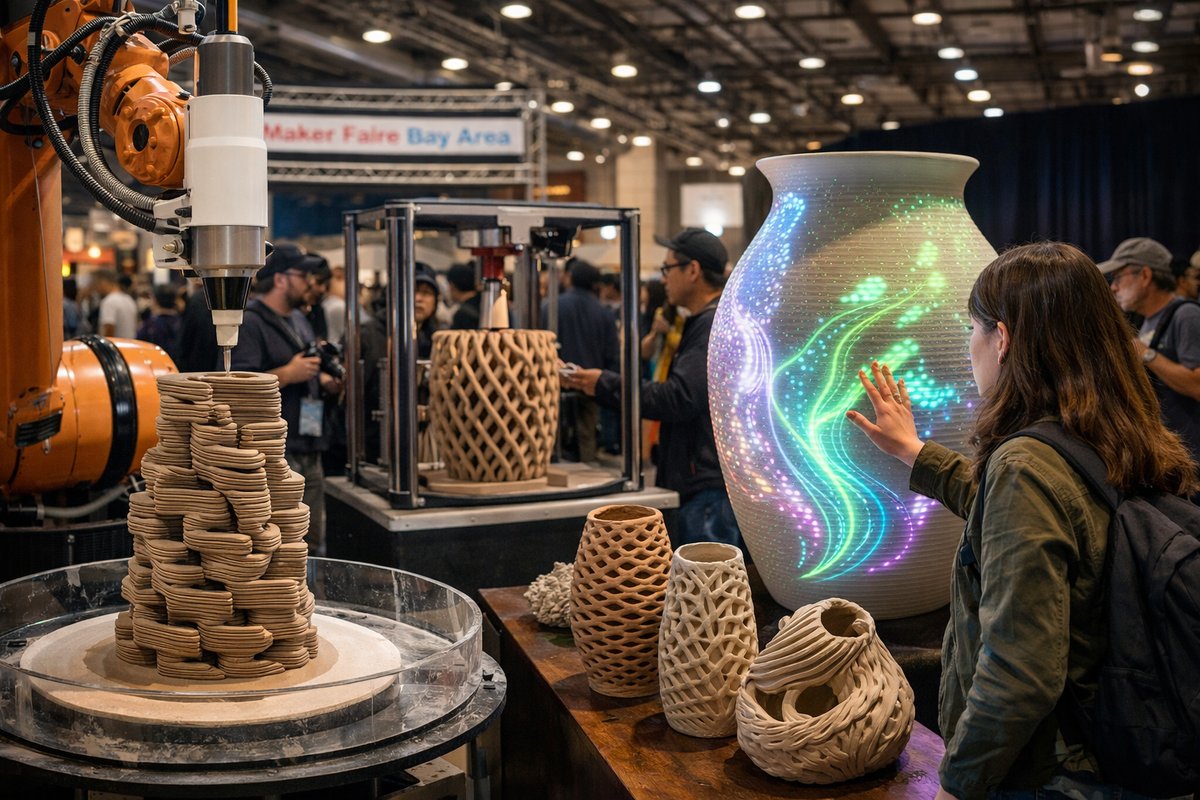

Maker Faire Bay Area has long been the proving ground for tinkerers, inventors, and artists who push the limits of materials and machines. This year, among the drones buzzing overhead and solar-powered contraptions on display, the fair’s ceramics pavilion was packed with visitors drawn by an unlikely sight: clay sculptures spun out by 3D printers, scanned into parametric models, and animated with projection mapping. The synergy of hands-on craft and digital workflows spelled out a vision for ceramics that blends ancient mediums with tomorrow’s technologies.
Historically, ceramics has been defined by wheel-thrown forms, kiln firings, and the alchemy of glaze. Yet in recent years, innovators have introduced code, robotics, and computer-aided design into every stage of the process. At Maker Faire Bay Area’s “Clay Circuit” exhibit, clusters of extruded lattice vessels stood alongside traditional bowls, forming a dialogue between lineage and innovation. Each lattice form was produced by a desktop clay 3D printer, depositing clay filaments layer by layer to build structures that would have challenged even the most skilled potter to throw on a wheel.
Central to the exhibit was a row of desktop extrusion systems, often called clay 3D printers. These machines use a syringe-like mechanism to push soft clay through nozzles of varying diameters, creating continuous filaments that wind into intricate geometries. Festival-goers crowded around live demos, their phones raised to capture the printing process in close-up. The slow, rhythmic hum of stepper motors guided the nozzle on an X-Y-Z axis, tracing precise paths defined by an open-source G-code file. One surprising feature: users could swap nozzles mid-print to change filament width, creating panels that graduated from fine lace-like grids to sturdy ribbed walls.
Once a raw print was complete, artists whisked the pieces to a high-temperature electric kiln. There, the clay particles sintered together, losing moisture and gaining strength. After cooling, multi-layer glazes were applied with brushes and airbrush systems, producing gradients reminiscent of watercolor washes. The final firing locked in the color shifts, yielding a surface that glowed with iridescent highlights. Observers noted how digital precision combined with the serendipity of glaze drips to create objects that felt both manufactured and alive.
Adjacent to the printing stations, a photogrammetry booth invited attendees to scan their own prototypes. Using a motorized turntable and a handheld camera rig, visitors placed small clay models on the rotating platform. A digital camera captured hundreds of images from every angle. Open-source photogrammetry software then stitched these photos into dense 3D meshes. Designers could manipulate these meshes in parametric environments like Rhinoceros with Grasshopper or Autodesk Fusion 360, adding algorithmic patterns and organic perturbations before sending the revised geometry back to print.
This seamless loop-scan, modify, print-exemplified how digital tools amplify creative agency. Rather than draft elaborate CAD models from scratch, artists worked from physical sketches, letting hands-on prototyping dictate the starting form. Parametric scripts introduced fractal perforations, biomimetic branching networks, or tessellated patterns drawn from nature. One installation heard about at the fair featured a series of bowls whose edges undulated in response to a visitor’s voice. An array of microphones captured ambient sound, triggering generative algorithms that morphed rim patterns in near-real time. The result: each vessel became a living echo of the conversation it witnessed.
Traditional methods were far from obsolete. Nearby, an electric mini pottery wheel demonstrated how handcrafted adjustment remains integral to the process. Attendants coaxed prints into rounder outlines, refining layer lines with rib tools and sponges. A potter’s toolset-rubber ribs, wooden modeling sticks, loop tools-sat beside the wheel, poised for last-minute tweaks. Handing a piece over to the wheel allowed subtle changes in wall thickness and surface curvature that digital extrusion alone couldn’t achieve. For many, this hybrid workflow felt like a best-of-both-worlds scenario: algorithmic complexity anchored by human touch.
Sustainability resonated as a core theme. Several collectives showcased experiments in clay bodies mixed with recycled porcelain shards, ground glass, or locally sourced volcanic ash. These additives lightened the fired weight and introduced unexpected textures-tiny flecks of color that caught the light. A small solar-powered grinder unit shredded excess slip and over-fired test tiles, turning waste into fresh tooling material. Eco-conscious makers emphasized that digital ceramics can reduce material waste by optimizing infill densities and printing only the required structural support.
The exhibit’s crowning piece was an amphitheater of sixty projection-mapped vessels arranged in concentric circles. A silent symphony of light danced across their surfaces as visitors uploaded images via a tethered tablet. Each photograph was converted into a pattern of shifting pixels that wrapped around the curved forms. The installation invited onlookers to step inside the circle, becoming part of an immersive dialogue between clay, light, and memory. Guests reported feeling transported-tactile earth beneath their feet, luminous visions overhead-pointing to an emotional resonance that transcended the technical wizardry.
As the fair drew to a close, attendees lingered at the info desk, signing up for upcoming workshops that promise deeper dives into parametric scripting, clay extrusion setups, and kiln control strategies. In a corner, a chalkboard listed community studio hours where makers can reserve clay printers, kilns, and photogrammetry rigs. The buzz of collaboration was unmistakable: hobbyists, professional ceramists, architects, and digital artists swapping tips on nozzle calibration and glaze recipes.
Maker Faire Bay Area’s ceramics pavilion proved that clay remains as vital today as ever, even as it absorbs new digital vocabularies. By marrying tactile tradition with code-driven form-making, these projects point toward a future where craft is not at odds with technology but enriched by it. The next generation of ceramicists will arrive armed with laptops and kelly green clay alike, ready to shape matter and algorithms into functional art.
The exhibit underscored a broader shift in creative culture-one that celebrates the messy interplay of human intuition and computational rigor. As visitors walked away clutching miniature extruded bud vases or printed tiles decorated with digital brushwork, it was clear that the boundaries between artisan and engineer are dissolving. At this intersection, each new object stands as a testament to the power of curiosity: clay meets code, and the results are nothing short of magical.
-
3D Printer Tools Kit, 46PCS 3D Printing Accessories for FDM SLA ...
3D Printer Tools Kit, 46PCS 3D Printing Accessories for FDM SLA Resin Printers, Includes Nozzle Cleaning Kit, Print Removal Tools, Deburring Tool, Files, Flush ... -
CaiLab PLA+ 3D Print Filament Kit for FDM 3D Printer ... - Walmart
Buy CaiLab PLA+ 3D Print Filament Kit for FDM 3D Printer Printing Materials,1KG Per Spool, 1.75mm Diameter Mixed colors at Walmart.com. -
GemRed Wireless Digital Caliper 6 Inch with Data Transfer to Excel ...
【True Wireless One-Click Transmission, Zero-Error Data Capture】 Digital caliper measurements transmit instantly to Excel/Phone/PC with one click—10-meter ... -
1113-300 INSIZE Wireless Digital Caliper: 0-12″/0-300mm - Walmart
Buy 1113-300 INSIZE Wireless Digital Caliper: 0-12″/0-300mm at Walmart.com. -
Revopoint Dual Axis Turntable for Accurate 3D Scanning, Easy ...
Creality Official 8 Inches Rotating Turntable Display Stand, 360˚ Rotation Portable Turntable ... Photogrammetry, for Small-Large Objects, Outdoor Scan, ...