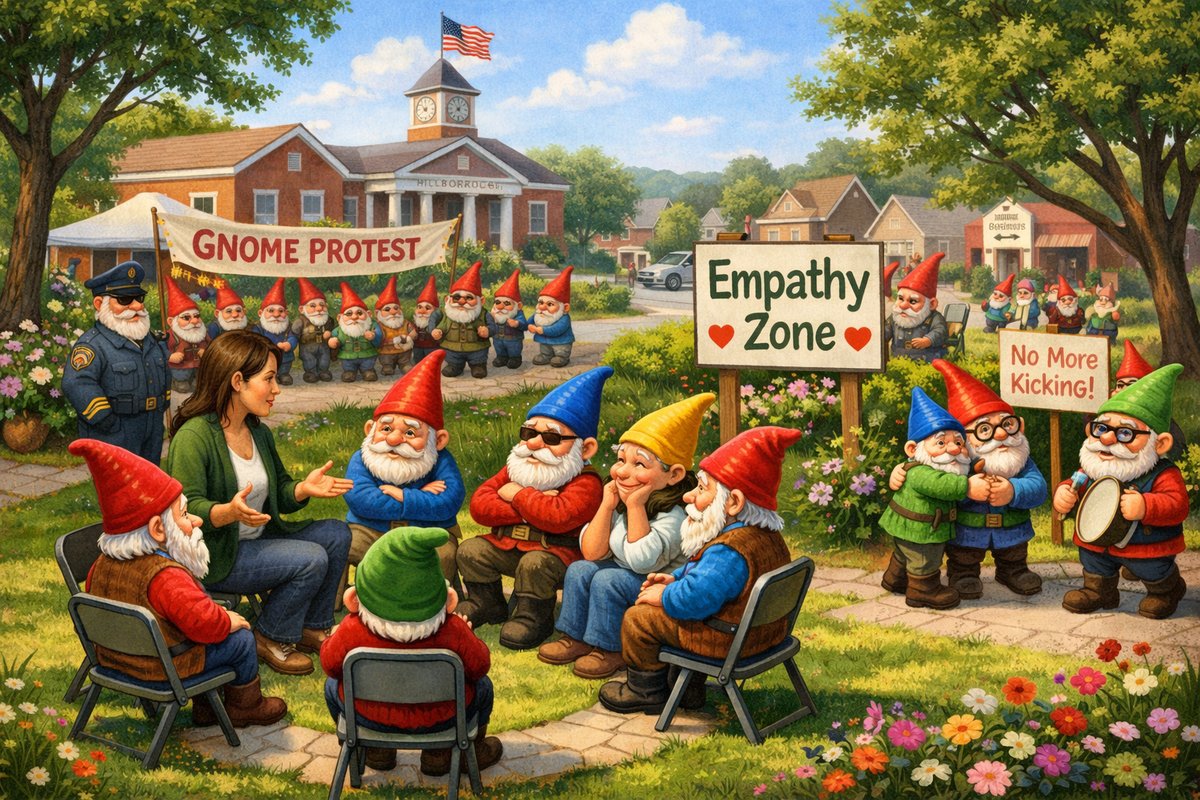

The Hillsborough Town Council convened on a Tuesday afternoon to address an issue that had long simmered beneath tidy hedges: garden gnome unrest. What began as whispered rumors of midnight tumbling, mysteriously rearranged flower beds, and clandestine gnome graffiti escalated into a full-blown ceramic rebellion. In response, council members introduced Ordinance 329-B-the first legal framework requiring garden gnomes to attend monthly Conflict Resolution Workshops.
Mayor Eloise Furman, brandishing a clipboard decorated with gnome stickers, explained the rationale at Tuesday’s meeting. “Our town thrives on neighborly cooperation, and that includes our garden ornaments. Too many gnomes have been left to their own devices, turning silent bystanders into passive-aggressive horticultural saboteurs,” she declared. The ordinance stipulates that every gnome must receive official paperwork, be fingerprinted (for insurance purposes), and participate in guided mediation circles led by certified human facilitators.
Residents awoke the next morning to find neon-pink lawn signs staked beside their ceramic residents: “Gnomes in Conflict Resolution-Please Do Not Disturb.” Local baker Cynthia Morales discovered her collection of working-class gnomes-each sporting hand-knitted scarves-arranged in a ring around her rose bushes. “I came out for coffee and saw them holding hands,” she recalled. “They looked like they were about to start chanting solidarity slogans.”
Not everyone was pleased. Longtime gnome enthusiast Arthur Phelps protested that equal rights should not extend to inanimate objects. “Gnomes can’t talk or breathe. Forcing them into workshops is cruel and unusual punishment,” he insisted. But when dozens of his prized miniatures marched through downtown, chanting in squeaky voices only audible to people wearing high-frequency headphones, even skeptics had to admit something uncanny was unfolding.
Meanwhile, the Council’s Social Innovations Committee unveiled a gnome-appropriate curriculum. Week One covers active listening-modeled on recordings of chirping sparrows-while Week Two dives into anger management, illustrated by footage of inflatable pool toys in hurricane zones. By Week Three, gnomes learn problem-solving techniques using miniature flip charts and gavel-shaped lollipops.
Local entrepreneur Zara Kline capitalized on the craze by opening “GnomeGrounds,” a pop-up café where mediation sessions occur over strong herbal tea. Patrons select from gnome-themed pastries-“Reflective Raspberry Tarts” and “Empathy Éclairs”-and sip while their yard ornaments engage in role-play scenarios. Kline reports a surge in foot traffic, though she admits the espresso machine occasionally malfunctions when a gnome knocks loose wires in protest.
At Hillsborough High School, drama teacher Rosalind Shaw rewrote the spring play to feature gnomes as protagonists in a comedic reappraisal of Hamlet. Students auditioned ceramic and plastic figures, dressing each gnome in tiny capes and crowns. The production culminates in a mock council hearing where gnomes deliver monologues about their existential purpose: “To garden or not to garden, that is the question.” The sold-out show sold out again when the overflow audience watched via live stream, complete with popcorn stands fashioned from miniature wheelbarrows.
Not everyone could keep up. Plumber Dan Fitch installed conflict-resolution hotlines inside local storm drains, believing gnomes used subterranean tunnels for secret gatherings. His theory spurred a flurry of confused emergency calls from homeowners convinced their sewers had unionized. “I got a message that a gnome wanted a three-day weekend and hazard pay,” Fitch explained. “Turns out it was just a stuck grapefruit.”
By Thursday, gnomes began picketing City Hall. They marched with banners reading “Ceramic Lives Matter” and demanded representation on the Parks and Recreation Board. Town Clerk Marsha Fields nervously offered to appoint a gnome liaison, but found herself negotiating with a miniature delegation brandishing miniature pitchforks. Fields eventually agreed to install a “Gnome Affairs” mailbox, brightly painted red, for grievances and policy proposals.
Tensions peaked when the Council’s tech consultant, Leo Zhang, introduced OrthoZone-an experimental holographic platform designed to project real-time mood readings above each gnome. Residents strapped QR codes to their ornaments, which, when scanned, displayed emojis reflecting the gnome’s emotional state. Unfortunately, a software glitch caused every scanned gnome to register “furious,” flooding social media with angry-gnome selfies and panic-driven hashtags like #Gnomezilla.
Council meetings devolved into chaos as attendees, armed with noise-canceling headphones, tried to muffle the gnomes’ furious squeals. Vice Mayor June Ramos suggested soothing the ceramic population with ambient light shows and binaural beats. Within hours, lampposts downtown flickered in pastel hues, and the town square reverberated with calming sea sounds. Residents reported periods of eerie tranquillity punctuated by sudden shrieks whenever an electric outlet fizzled.
At the height of the crisis, a spontaneous gnome union formed, demanding a seat at every civic event. Their leader-dubbed Gnorman the Negotiator-delivered an impassioned speech from a soapbox inside a decorative planter. “We toil in soil under rain and sun,” his translated statement read. “We demand respect, a basic care stipend, and at least one day off per lunar cycle.” Citizens cheered, many wiping tears as garden gnomes achieved what lobbyists and nonprofits could not: universal solidarity.
Realizing the absurd stakes, Mayor Furman convened an emergency session to repeal the ordinance. But before the vote, the gnomes shut the doors from the inside and installed a tiny barricade of pebble sandbags. The Council-trapped-was forced to negotiate face-to-frosted-face with their ceramic counterparts. After three hours of candlelit haggling (won by the gnomes’ superior patience), the parties agreed on a compromise: voluntary workshops, optional emoji dashboards, and recognition of Gnorman as an honorary assistant to the Parks Director.
City Hall staff celebrated with an ice cream social featuring gnome-shaped cones. Gnorman accepted the first scoop-strawberry pistachio-on behalf of his delegation. Cameras flashed as at least one gnome appeared to wink. When asked for comment, Gnorman offered his most conciliatory statement: “Let us plant peace, one flower bed at a time.” The crowd erupted in applause.
As normalcy returned, residents removed neon-pink signs, returned QR codes to their plastic sleeves, and resumed traditional lawn ornament duties. Gnomes, now honorary citizens, enjoy limited self-governance and a newly inaugurated “Garden Council” website. Plumbers have uninstalled hotline devices from storm drains, and holographic tech firms pledged never to unleash cascading emoji malfunctions again.
The Hillsborough experiment has since inspired neighboring towns to consider licensing scarecrows and permitting backyard flamingos to form cooperatives. Meanwhile, at GnomeGrounds, business remains brisk. Patrons raise a cup to the improbable alliance that turned decorative figurines into symbols of civic engagement. As Mayor Furman quipped in her final memorandum, “We set out to resolve conflict, but ended up planting community.”
In the end, Hillsborough learned that even the quietest corners of civic life can spring surprises-and that if you treat your garden ornaments with respect, you might just cultivate the most engaged citizens of all.