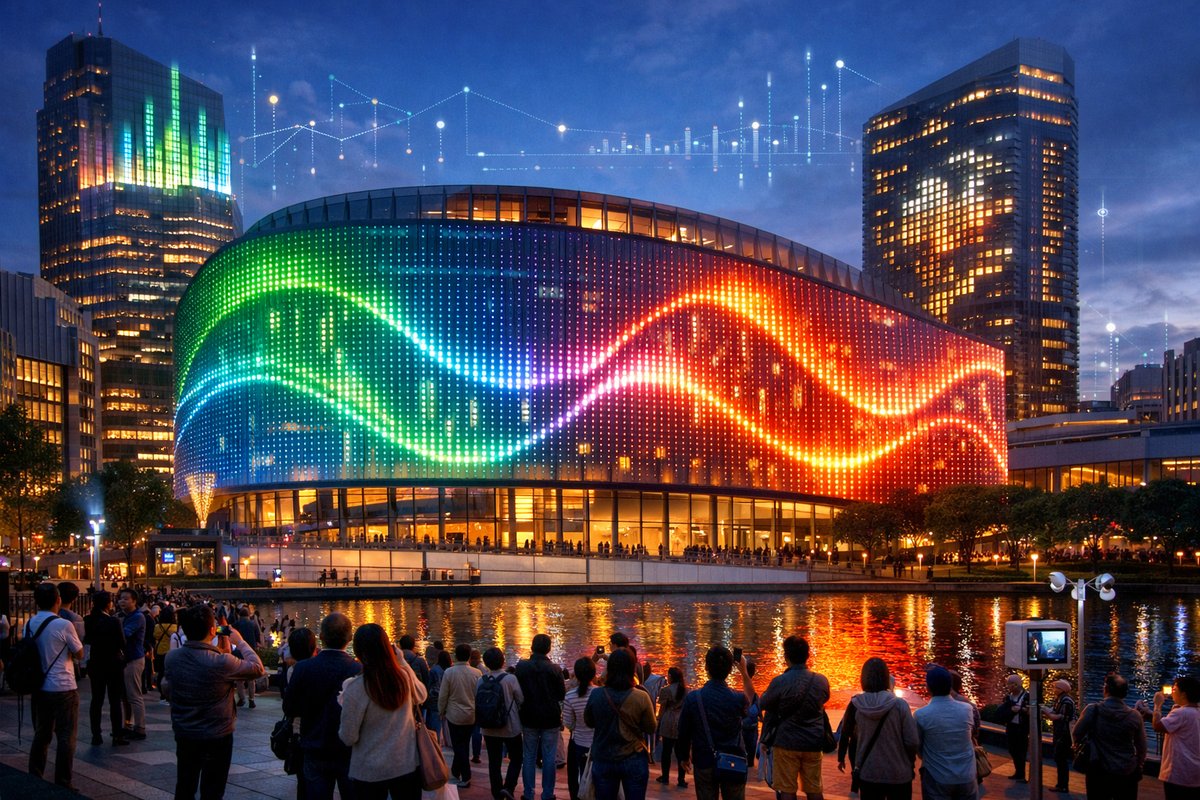

As dusk falls over the riverside promenade, the glass facade of a former warehouse pulses with color in time to passing foot traffic and river currents. Soft blues and greens rise and fall like tidal waves; sudden bursts of amber flicker in response to distant car horns. Spectators pause, smartphones at the ready, as data streams invisibly through sensors beneath their feet, then bloom into luminous patterns on the building’s skin.
This is “Flow Form,” a new public-art installation in European City X that harnesses real-time data feeds from air-quality monitors, traffic counters, and sound sensors to choreograph a constantly evolving light show. At its core lies a simple question: What happens when you make the imperceptible rhythms of urban life visible?
Designers have long toyed with interactive projections and static murals, but this generation of light architects is diving deeper: they weave live information into their sculptures, transforming cityscapes into responsive canvases. Instead of a solo artist’s brushstroke, the city itself becomes the creative partner. Every honk, every idle engine, every cyclist passing through a street node contributes to the work.
Behind the color shifts and pulsing beams sits a network of environmental sensors-tiny air-quality units measuring levels of nitrogen dioxide and particulates, acoustic microphones tuned to capture decibel spikes, and proximity detectors that count pedestrian flow. These feed into microcontroller boards hidden behind the building’s curtain wall. Custom scripts aggregate and normalize the data, then translate it into color values and motion patterns for addressable LED modules attached to the exterior surface.
Powering dozens of linear meters of low-wattage LED strips might sound energy-hungry, but many installations rely on solar-charged battery banks or tap into district heating waste-heat systems to offset their consumption. True to the sustainable design movement, components are modular and recycled wherever possible: scrap aluminum from local manufacturing, reclaimed lens modules from outdated street lights, and biodegradable diffusion panels that break down without leaving toxic residue.
“Our mission was to create something that felt alive but didn’t feel wasteful,” explains the project’s lead technologist. “We scavenged materials, optimized our power draw, and open-sourced the code so others can learn or adapt the system. It’s a toolkit for anyone who wants to illuminate data in public spaces.”
Across town, another collective is building a pop-up pavilion where visitors wear wristbands that capture heart rates and galvanic skin responses. As crowds explore, the pavilion’s inner walls flicker in iridescent pulses that echo the group’s emotional state-fear, calm, excitement-creating an improvised communal portrait of mood. Soon, a smartphone app will allow participants to tag favorite moments, adding a layer of crowd-sourced metadata to the evolving artwork.
Residents and tourists alike have gathered nightly to watch these installations come alive. For many, it’s more than eye candy. By making air-quality alerts visible-turning spikes in pollution into sudden red flares-designers hope to cultivate environmental awareness. By mapping foot traffic in gentle ripples, they encourage people to consider how their movement shapes shared spaces. The works serve as playful reminders that data isn’t just numbers on a chart; it’s a living, breathing record of our collective choices.
Running a sensor-driven installation in an open urban environment comes with engineering headaches. Rain and dust can foul air sensors, unexpected Wi-Fi interference can disrupt data streams, and curious passersby sometimes try to tamper with wiring. Teams have learned to ruggedize electronics in sealed enclosures, add battery-powered mesh networks for redundancy, and design quick-swap modules for easy field repairs. The more a system is built to fail gracefully, the smoother the nightly performance.
Looking ahead, artists are exploring deeper integrations: augmented-reality overlays that visitors can view through glasses, 3D-printed façade tiles embedded with RFID triggers, and machine-learning models that predict crowd moods so the installation can shift from reactive to proactive. Open datasets on energy usage, water consumption, and transit ridership are waiting on the horizon to expand the palette of possibilities.
At its heart, this trend blurs the line between functional infrastructure and public art. Buildings are no longer inert boxes; they become active participants in city life. Data streams are repurposed as aesthetic materials. Communities engage not just by looking, but by breathing, moving, and living around the installations.
For designers and city planners eager to explore this intersection, the entry barrier has never been lower. Basic sensor kits can be purchased off the shelf, microcontrollers programmed with beginner-friendly software, and LED strips daisy-chained in any pattern you like. Local makerspaces often host workshops where novices can learn to solder, code, and project-but nothing beats field testing your own data-driven sculpture on a small scale before scaling up.
As “Flow Form” winds down its several-month residency on the riverfront, plans are already in motion to tour it to neighboring towns. The hope is to spark a network of responsive facades that speak the same data language-each one tuned to local conditions but sharing code, best practices, and open documentation. Soon, a city’s visual identity could rewrite itself every night based on the invisible metrics of life. In that future, art and data don’t just coexist; they compose symphonies together, inviting anyone who passes by to listen in.