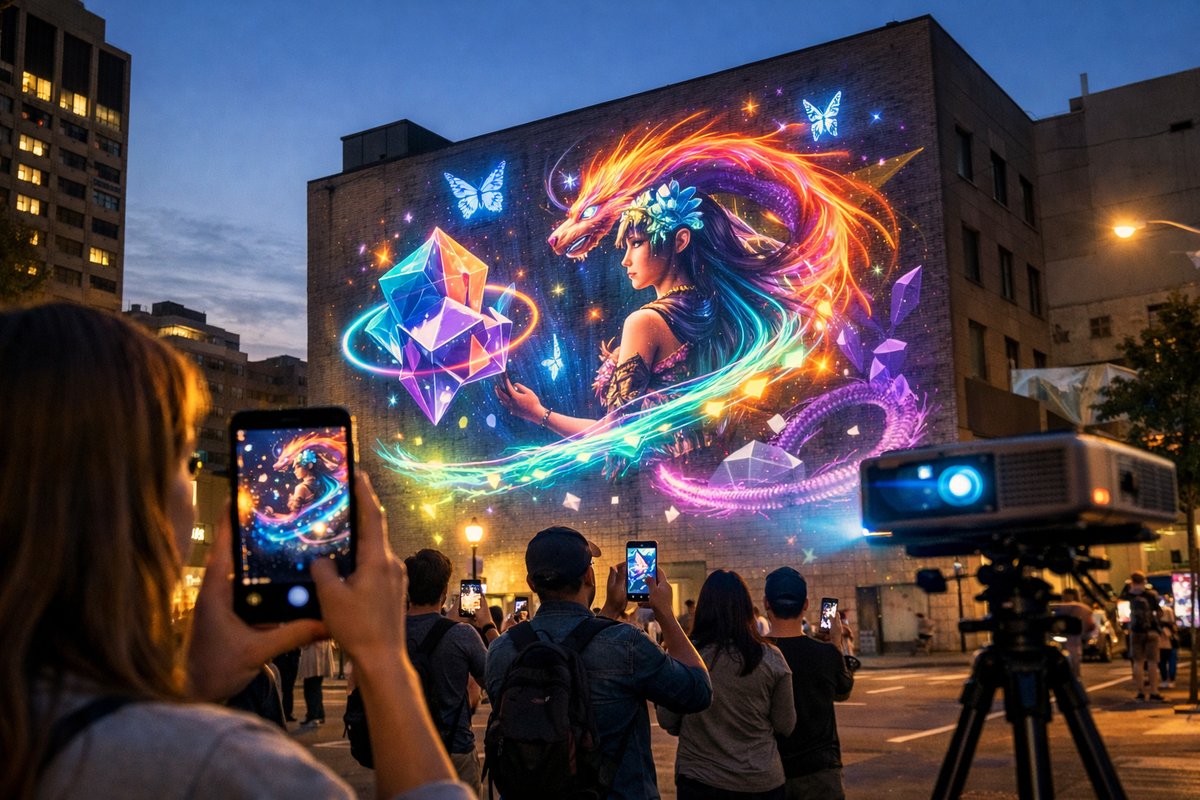

Walk past an alleyway in downtown districts around the globe and you might glimpse an ornate dragon twisting around a corner, or a kaleidoscope of shifting patterns dancing across a brick wall. Yet if you look again without your phone’s camera, there’s nothing but weathered masonry. This is the paradox of augmented reality street art: a burgeoning form of public creativity that materializes only when viewed through a digital lens.
Early AR art experiments were limited by bulky headsets or desktop-bound projection systems. Today’s smartphones boast fast processors, high-resolution cameras and AR toolkits baked into their operating systems. Combined with free or low-cost apps, these devices let artists place 3D sculptures, animated characters and interactive narratives onto the urban canvas. Viewers with the same app walk through the city, unlocking hidden installations and leaving virtual tags for the next user.
One of the most visible platforms is a browser-based AR map where artists upload geo-anchored artwork and specify the GPS coordinates that align virtual forms with physical structures. In 2023, a major tech festival commissioned a dozen AR murals across its host city, encouraging attendees to hunt down each piece via a scavenger-hunt interface. Each mural revealed a short animated film about the city’s cultural history, narrated by local elders and rendered in a graffiti-inspired style.
Beyond static markers, some creators are experimenting with real-time data feeds. An AR sculptor in Berlin tapped into local air-quality sensors so that smog readings would alter the color and opacity of a digital tree installation. On days with high pollution, the foliage turned smoky gray; when air quality improved, vibrant greens appeared. These dynamic overlays fuse public art with environmental advocacy, inviting communities to visualize invisible threats and engage in collective stewardship.
Platforms originally developed for gaming have found new purpose in creative expression. Open-source AR software forks from popular game engines now feature simplified 3D model import, real-time lighting adjustments and easy mesh-collision tools. Artists can sketch on a tablet, export models in common formats and fine-tune them in a visual editor before pinning them to a street corner. The entire pipeline can run on a mid-range laptop or even a powerful tablet, making the barrier to entry surprisingly low.
Collaborative AR graffiti crews are forming in cities from São Paulo to Seoul. In one weekend-long workshop, participants learned how to capture a decaying wall texture, convert it into a 3D mesh, and paint characters on top with a digital stylus. By the end of the session, teams had spawned a shared virtual mural stretching three city blocks, complete with hotspots that triggered soundscapes recorded by local musicians. Future passersby can trigger ambient beats as they explore the layered artwork.
Public reception has been mixed. Enthusiasts rave about the novelty and interactivity, while some residents complain of digital “tagging” that feels as permanent as spray paint. Municipal authorities are grappling with new questions: should virtual art require the same permissions as physical installations? How do you regulate a gallery that flickers in and out of existence based on device settings? A handful of forward-looking cities have drafted policies that treat AR murals like temporary public art, requiring artists to register their works and remove them after a set period.
Technical glitches occasionally break the illusion. Misaligned anchors can make sculptures float a foot off the pavement. Lighting mismatches between the virtual and real world result in jarring composites. To smooth the experience, developers are incorporating on-device machine learning models that analyze ambient light, surface geometry and viewer perspective in real time. These advances promise tighter integration of virtual layers and physical contexts, making AR artworks appear as if they’re truly painted on the wall.
For gallery owners and curators, AR street art offers a lifeline in an era when foot traffic has shifted online. By hosting a digital “version” of a district alongside physical shows, galleries can attract remote visitors who navigate a mapped route of AR installations before arriving for the real-world exhibit. This hybrid approach boosts engagement metrics and opens new revenue streams, such as limited-edition NFTs tied to a specific virtual mural or time-based access passes that let users unlock special content on select dates.
Despite the digital veneer, many AR artists draw deeply from traditional techniques. Muralists skilled in spray paint and brushwork sketch detailed concepts on paper before recreating them in 3D. Sculptors accustomed to welding metal or carving stone translate their spatial sensibilities into virtual clay. The most compelling projects fuse these analog roots with digital flexibility, resulting in creations that oscillate between tangible and phantom.
Community-driven projects are emerging outside major art hubs as well. In a small seaside town, local volunteers collaborated with an AR collective to honor fishermen lost at sea. Using recycled wood pallets as physical totems, they attached QR codes that triggered an animated memorial: ghostly silhouettes drifting across the docks at dusk. Residents reported a renewed sense of connection, as the invisible ceremony became part of their daily commute.
The economic footprint of AR street art is still nascent, but early indicators point to a growing ecosystem. Startups offer white-label platforms for marketing agencies looking to sponsor hidden experiences. Specialty hardware makers are designing compact devices that blend projection and depth-sensing for glitch-free installations. Educational programs at art schools are incorporating AR modules into their core curriculum, teaching students both the aesthetics and the underlying code.
One trend to watch is the convergence of AR street art with wearable tech. Lightweight AR glasses could liberate viewers from screen-based interfaces, allowing artworks to appear seamlessly in the periphery. Haptic bracelets or gloves might add tactile feedback when users “touch” a virtual sculpture. When these devices become affordable and unobtrusive, the boundary between digital and physical art will blur even further.
Sustainability is another emerging focus. While digital murals leave no chemical residue on walls, they rely on energy-intensive servers and consumer electronics. Forward-thinking artists are championing local edge-compute nodes that cache AR assets, reducing data transfers and carbon emissions. Some are packaging their projects alongside public charging stations powered by solar panels, marrying urban renewal with interactive storytelling.
As the technology matures, questions around ownership and preservation will intensify. Virtual artworks can be copied or relocated instantly. Archivists at civic museums are experimenting with decentralized ledgers to timestamp and authenticate AR pieces, ensuring that the original artist’s intent is credited even as the work travels across time and geography.
For curious onlookers, the simplest way to dive in is to download a free AR art app, follow local artists on social media and explore mapped routes in your neighborhood. For aspiring creators, a modest setup of a smartphone, a stylus-enabled tablet and access to an open-source AR toolkit can unlock endless possibilities. As more artists adopt these tools, expect city streets to become layered stages where physical architecture and digital imagination coalesce.
Phantom canvases are no longer science fiction. They’re cropping up in alleys, courtyards and underpasses, waiting to be discovered by anyone with a compatible device. In the dance between the concrete and the coded, augmented reality street art invites us to reimagine the city as a living, breathing gallery of infinite possibilities.