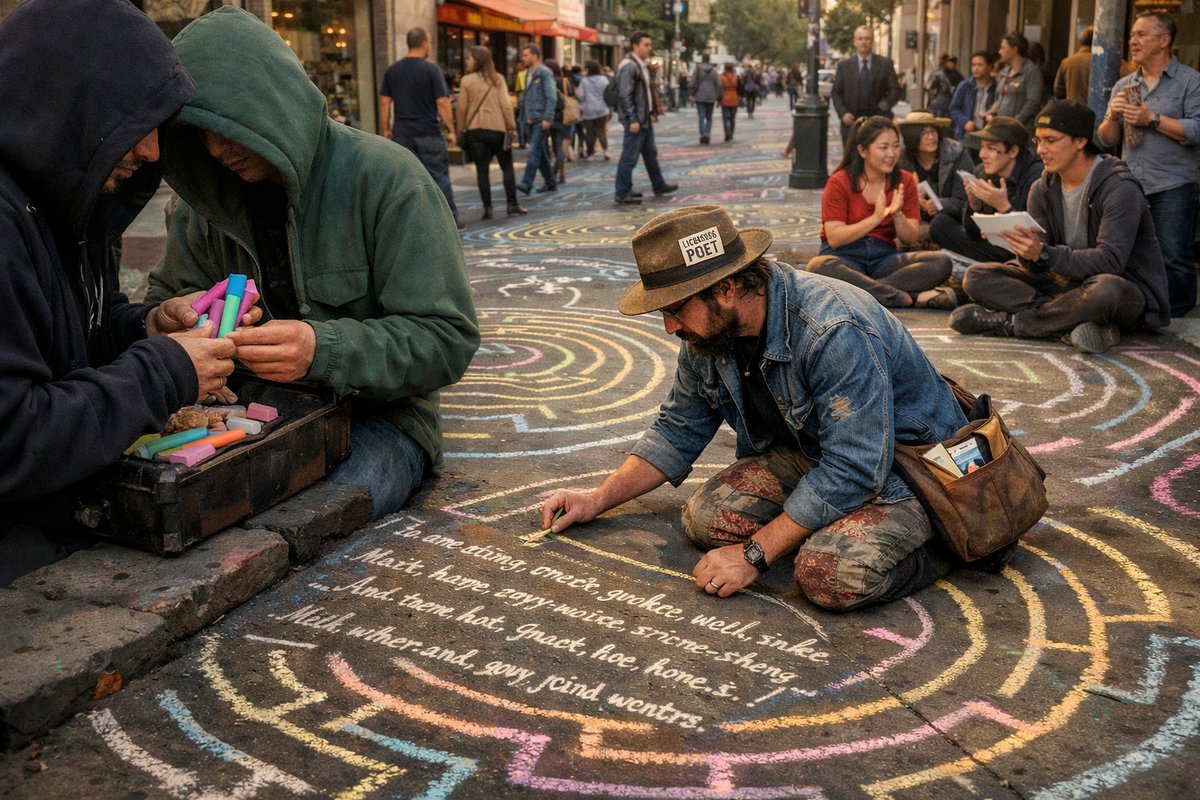

The morning sun peeked over Avenue D, illuminating a network of pastel sonnets sprawled across every crack and crevice of the newly chalked sidewalks. Under the Town Council’s recent edict, no citizen may chalk a single line of verse without passing the rigorous Rhyme and Meter Proficiency Exam administered by the Chalk Poetic Credentialing Commission. What began as a harmless attempt to blend performance art with urban beautification has mutated into a full-blown pedestrian poetry crisis.
Licensed street poets-each sporting a reflective safety vest embroidered with a quill and a rhyme scheme-have supplanted sidewalk artists, and citizens are greeted at every block by sweeping couplets that demand both interpretation and applause. Maryanne Fletcher, holder of a gold-leafed chalk permit, was arrested last Tuesday for uttering a limerick in unauthorized crimson chalk. “They confiscated my pastel emerald box,” she lamented to a reporter, “and charged me with unauthorized enjambment.”
Crosswalks have transformed into interactive stages: travelers must recite the final line of the existing chalk poem before stepping off the curb. Failure to do so results in a polite but firm reminder from a nearby verse marshal stationed in a folding chair. Bystanders report lines like “O commuter, tarry not on this mortal coil; cross swift lest your patience spoil” appearing unbidden beneath taxi tires.
Local merchants quickly adapted by offering “Poetry Pit Stop” coffee stands at major intersections, complete with rhyme consultants to coach hurried shoppers through iambic footwork. One café owner installed a speaker system that blared tips on meter and metaphor whenever someone purchased an espresso. The catchphrase “Your latte with a side of spondee” has become the unofficial municipal slogan.
As demand for chalk soared, shortages emerged. Neon pink and chartreuse pastel chalks sold out within hours of the decree’s announcement, spawning an underground economy. Vendors in alleyways now hawk bootleg 12-stick packs, wax-sealed with “Third Circle Quality” stamps. Black market chalk has been linked to several minor skirmishes, including a turf war over possession of a rare lavender-scented chalk infused with micro glitter.
Local law enforcement established the Chalk Patrol, an elite squad of meter-trained officers who patrol hotspots armed with spatulas to scrape unauthorized verse off the pavement. “Our mission is to preserve municipal rhyme integrity,” proclaimed Chief Sonnet Bauer. “We will not tolerate unlicensed free verse defacing our thoroughfares.” City Hall even floated the idea of installing chalk-resistant asphalt, but public outcry over losing poetic sidewalks forced a quick retreat.
Commuters lament the new normal. Buses run late as drivers navigate tightrope walks across meter-laden mosaics. Cyclists swear they’ve seen entire haiku villages bloom under lampposts. One retiree claims she spent twenty minutes solving a sestina near City Hall before realizing she’d blocked three lanes of traffic.
Proponents argue the measure has sparked a renaissance in community engagement. Neighborhoods once dull and drab now burst with collective creativity. Families treat Sunday strolls like performance art expeditions, pausing to film interpretive dance routines in front of four-line stanzas. Even local historians appreciate the ephemeral nature of chalk verse, likening it to ancient murals destined to fade-unless someone re-chalks them in canary yellow.
Still, skeptics wonder if the program has gone too far. Elderly pedestrians speak of simpler days when crosswalks were merely black and white stripes, not epic sonnets in free verse. A growing contingent of citizens has petitioned City Hall to introduce “silent sidewalks” zones-strips of pavement where chalk is forbidden, allowing people to walk without reciting dactylic hexameter.
In a fitting twist of irony, the Council’s ambitious creative funding has strained municipal coffers. Licensing exam proctors demand hazard pay for chalk dust inhalation, and the Chalk Commission has requested a budget increase to install ultraviolet lights that reveal hidden “ghost” rhymes. Cost estimates for maintaining the chalked cityscape now rival those for road resurfacing.
Late last night, a clandestine group calling itself the Blank Canvas Brigade claimed responsibility for wiping an entire block clean in the dead of night. Three unsuspecting poets awoke to find their meticulous couplets replaced by smudged white streaks. “It’s a statement on transience,” declared a masked spokesperson via social media. “Art belongs to everyone, not just the credentialed elite.”
Mayor Winslow Patterson issued a statement promising to review the policy, while local paper editorialized that true art neither seeks permits nor worships meter. Meanwhile, the poetry continues to flourish under moonlight, as rhymesters armed with pocket-sized chalk kits hit the streets in solidarity.
Perhaps the true legacy of this experiment will be a renewed awareness of how we use communal spaces-and an appreciation for the simple, borderless joy of drawing on the pavement. Until then, be sure to bring your poetry license every time you step outside. And if you haven’t perfected your anapest? Best to stick to the bicycle lane and leave the odes to the licensed quill-bearers.
Either way, the sidewalks have never been more alive, if only to remind us that art and absurdity are closer than we think-just a stick of chalk away from turning a stroll into a sonnet.