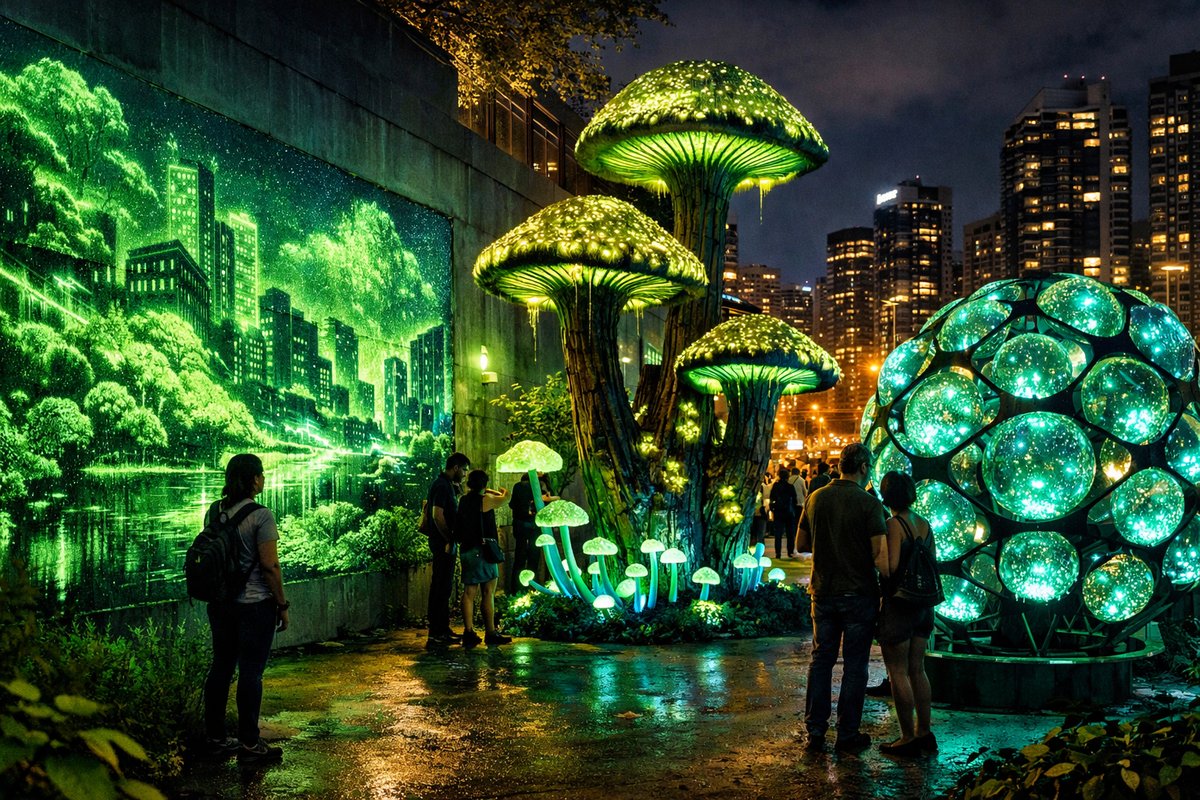

In a dimly lit underpass beneath a busy metropolitan thoroughfare, commuters pause not for the usual rumble of passing trains but for a soft, otherworldly glow creeping up the concrete walls. The source of the light? Billions of microscopic algae that emit a cool, aqua-hued luminescence when gently agitated by passing feet or passing cars. This isn’t science fiction-it’s the latest public art initiative transforming neglected urban spaces into living canvases.
Over the past year, a handful of forward-thinking artists and designers have teamed with microbiologists and sustainability experts to pioneer bioluminescent street art. By incorporating living light-organisms that naturally emit photons-into large-scale installations, these creators are challenging traditional notions of graffiti, projection mapping, and static murals. The result is a form of interactive design that thrives on the unpredictability of living systems.
At the heart of this movement is the belief that public art can foster ecological awareness as well as aesthetic wonder. “When you see these walls glowing, you’re reminded that life exists in surprising forms all around us,” says one curator involved in the recent “Glow Underway” exhibit. “It’s playful, but it also raises questions about human impact, habitat restoration, and our relationship with the natural world.”
One of the most ambitious experiments took place in a former rail tunnel near the riverfront district. For three nights, residents and tourists followed a path of bioluminescent markings that pulsed gently whenever someone stepped close enough to disturb the algae’s fluid substrate. Sensors measured vibrations and sent low-voltage currents through transparent tubing, encouraging the creatures to glow brighter. Visitors described the experience as “walking through a living light nebula”-a phrase that soon reverberated across social media and local news outlets.
Another installation explored fungi-based illumination. Sculptural columns made from biodegradable resin were inoculated with a species of luminous mushroom. Over several weeks, the mycelial network spread through the form, gradually generating a soft green glow once night fell. By tapping into the natural growth processes of fungi, the artist demonstrated how living materials can replace energy-intensive neon or LED setups.
Many of these projects rely on open-source protocols, allowing DIY enthusiasts to replicate experiments at a smaller scale. Homemade bioreactors-constructed from repurposed plastic containers, tubing, and air pumps-keep algae cultures happy and healthy. Nutrient mixes are carefully balanced to encourage steady light emission without rapid die-off or algae blooms that could pose ecological risks if released into local waterways.
Municipal authorities have taken note. City planners in several locations are exploring pilot programs to light pedestrian bridges and park underpasses using living organisms rather than grid-powered LEDs. The appeal is obvious: reduced electricity consumption, reduced light pollution, and an ever-changing display that fosters curiosity and conversation.
Aside from technical hurdles-maintaining ideal temperature, pH, and nutrient levels-artists must also navigate regulatory frameworks around living signage and public health. Safety reviews include testing for potential allergens, containment protocols to prevent inadvertent release, and guidelines for disposing spent cultures. In most cases, installations run for short durations-weeks rather than months-before cultures are recycled or composted.
At a recent panel hosted by an international public art foundation, experts from environmental science, urban planning, and fine art discussed the future of “bio-arts.” Proponents argued that living installations represent one path toward regenerative cities-urban environments designed not only to minimize harm but to actively restore natural cycles. Critics cautioned against romanticizing microorganisms, pointing out that maintenance costs and logistical complexities could limit large-scale adoption.
Nonetheless, early public feedback has been overwhelmingly positive. Community workshops-where participants learn to grow their own bioluminescent specimens-sell out quickly. Several parents noted that the novelty of glowing petri dishes sparked their children’s curiosity about microbiology and ecology in ways a flashlight or chemical glow stick never could.
Artists are already imagining next-generation experiments. Some propose combining living light with augmented-reality overlays, so virtual patterns appear layered over bioluminescent surfaces when viewed through a smartphone. Others are exploring genetic pathways to engineer algae that change color in response to air quality metrics, turning a glowing installation into a real-time pollution monitor.
One university lab is collaborating with a design studio to embed carbon-capturing bacteria into 3D-printed street furniture. When deployed in public plazas, benches and planters could gradually convert volatile organic compounds into harmless byproducts, with faint luminescence as a visual indicator of ongoing carbon sequestration.
While still in its infancy, the living light movement signals a larger shift in how we think about public art and urban design. Instead of relying solely on inert materials and fixed energy sources, artists are weaving biological processes into the fabric of our cities. The payoff isn’t just an Instagram-friendly spectacle-it’s an invitation to reconsider the artificial divide between the built environment and the living world.
As dusk falls tonight over the city’s neglected back alleys, keep an eye out for an ethereal glow that seems almost too delicate to be real. It might be the work of a local art collective, a crowd-sourced science club, or simply a handful of hobbyists experimenting with the secrets of bioluminescence. Wherever it appears, one thing is clear: urban darkness is no longer a blank canvas, but a stage for living light.
Have you encountered a glowing street art piece in your city? Share your photos and observations on social media with the hashtag #LivingLightArt and join the conversation on how biology and design are reinventing public space.