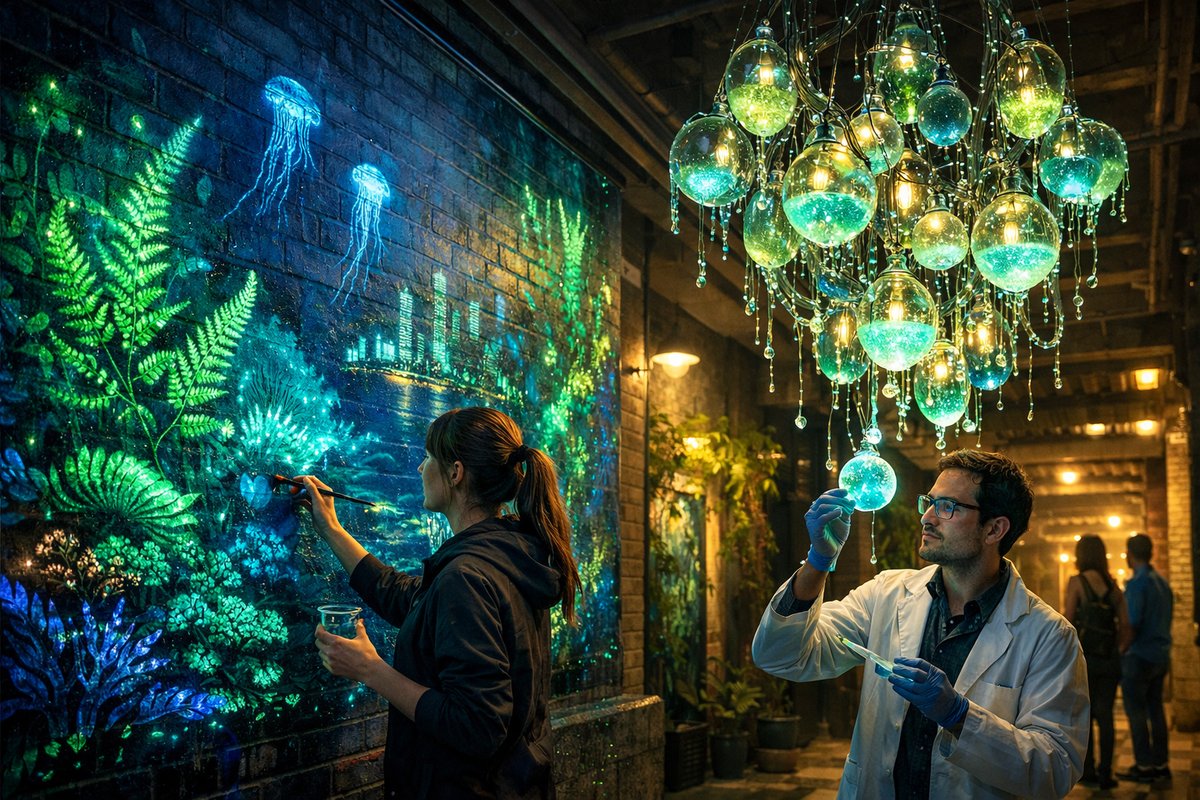

In galleries and public spaces around the world, a subtle glow is rising from petri dishes, installation walls, and even interactive theatre pieces. Bioluminescent art-creations that literally shine with living light-has leapt from the fringes of speculative design into mainstream exhibitions. Innovators in bio-art labs and artist collectives are harnessing the natural glow of organisms like dinoflagellates, bioluminescent bacteria, and genetically modified yeast, coaxing them to reveal intricate patterns and narratives in the dark. This phenomenon redefines the role of the audience, inviting viewers to witness living systems in a state of flux and to consider the fragile boundary between technology and nature.
Early experiments in bioluminescent art drew inspiration from biologists cataloguing glow-in-the-dark marine life. Today’s artists go further, employing genetic tools to amplify light production, scaffolding transparent substrates into sculptural forms and embedding microfluidic channels that deliver nutrients in real time. In one recent urban installation, titans of design teamed with a local science institute to paint a 50-foot wall with a living pigment: a dense film of light-emitting bacteria suspended in biodegradable polymers. At nightfall, the mural pulsed gently, responding to ambient temperature and humidity. Passersby described the effect as “breathing architecture,” a living organism bridging the gap between city and ecosystem.
Another notable project unfolded inside a repurposed train car in a museum courtyard. Patrons boarded individually for a guided ”glow tour” through narrow chambers lined with shelves of transparent culture vessels. Each vessel contained engineered yeast that produced distinct hues-emerald greens, electric blues, warm amber-activated by infrared sensors triggered by movement. Subtle sound cues directed visitors from one chamber to the next, creating a multisensory journey in which living light danced in response to human presence. By blurring the lines between spectator and participant, the work sparked conversations about agency in synthetic life: Who controls the glow, and what stories unfold when art literally takes on a life of its own?
Behind these spectacular installations lie technical and ethical challenges. Maintaining living cultures requires precise control of temperature, pH, and nutrient flow. Curators must partner with biosafety experts to ensure that engineered organisms remain contained and waste is disposed of responsibly. Some artists embrace the uncertainty: small deviations in environmental conditions can yield unexpected color shifts or gradual dimming, reinforcing the idea that living art is never static. Yet others opt for more controlled formats, embedding freeze-dried bioluminescent proteins into hydrogels that reactivate under gentle heat. This compromise retains the illusion of living light while reducing the complexity of upkeep.
In parallel with high-end exhibitions, a grassroots movement has sprung up among DIY bio-art enthusiasts. Community labs are offering weekend workshops where participants learn to culture harmless marine plankton that glows faintly in the right conditions. Attendees practice plating procedures on transparent film and project with handheld UV lights to reveal hidden patterns. The focus is on accessibility and sustainability: agar is sourced from plant-based extracts, and nutrient media is formulated from low-cost grocery ingredients. These pop-up studios foster collective learning and spark new creative visions for how biology can become a medium for expression.
Academic institutions have taken note, integrating bioluminescent art into interdisciplinary curricula. Design students collaborate with molecular biologists to explore new classrooms of living ink, studying applications from medical imaging to environmental monitoring. By encoding data-such as urban air-quality readings-into luminescent sequences, these projects demonstrate how art can visualize invisible processes. One prototype robotic arm can deposit living pigment in intricate patterns, enabling real-time murals that track pollution spikes. The result is an aesthetic and informational overlay on cityscapes: glowing indicators of environmental health woven into everyday life.
Sustainability remains both a promise and a challenge. Bioluminescent organisms consume energy and require nutrients; scaling installations to larger dimensions demands careful resource planning. Some artists address this by integrating closed-loop systems: wastewater from the installation is filtered and returned to the freshwater tank housing the microorganisms. Solar panels power pumps and sensors, closing the energy loop with renewable sources. This approach foregrounds ecological responsibility, transforming art into a living demonstration of circular design principles.
Critics of synthetic biology sometimes warn of unintended ecological impact if engineered organisms escape containment. Most bioluminescent art projects mitigate this risk through built-in kill switches-genetic circuits that trigger cell death outside lab-grade conditions. Others prefer nonliving alternatives, such as embedding purified bioluminescent proteins into durable resins or polymers. While these inert materials lose the self-repairing qualities of living cells, they remain vivid without constant maintenance.
Beyond the technicalities, bioluminescent art taps into a deep human fascination with light. For centuries, societies have harnessed fire, lanterns, and electricity to ward off darkness. Living light brings a poetic resonance: it is at once ephemeral and persistent, a reminder that even the smallest organisms can fill a space with wonder. In gallery lounges after dark, guests linger beneath suspended vessels of glowing algae, sharing hushed reflections on nature’s hidden marvels. Children press their faces against acrylic windows to watch microbial ripples unfold in slow motion.
Looking ahead, practitioners envision large-scale public works that integrate thousands of culture vessels into urban architecture-living facades that shift color with air quality or visitor flow. Advances in 3D printing will allow the embedding of channels for nutrient delivery directly into building panels. Augmented reality layers may guide viewers to hidden bioluminescent hotspots, combining digital overlays with physical glow. As computational design algorithms optimize patterns for maximum luminosity and energy efficiency, the frontier between code, biology, and craftsmanship will continue to blur.
Ultimately, the surge of bioluminescent art reflects a broader shift in creative practice: an embrace of the living world as both collaborator and canvas. It challenges us to consider our role as stewards of ecosystems and invites dialogue on how technology can amplify, rather than override, nature’s own brilliance. In the gentle glow of these installations, we glimpse not only scientific innovation but also a rekindled sense of wonder at the hidden rhythms illuminating our world.
Letting living light take center stage may be the most human response of all-a collective exhale that reimagines darkness as an open invitation to create.