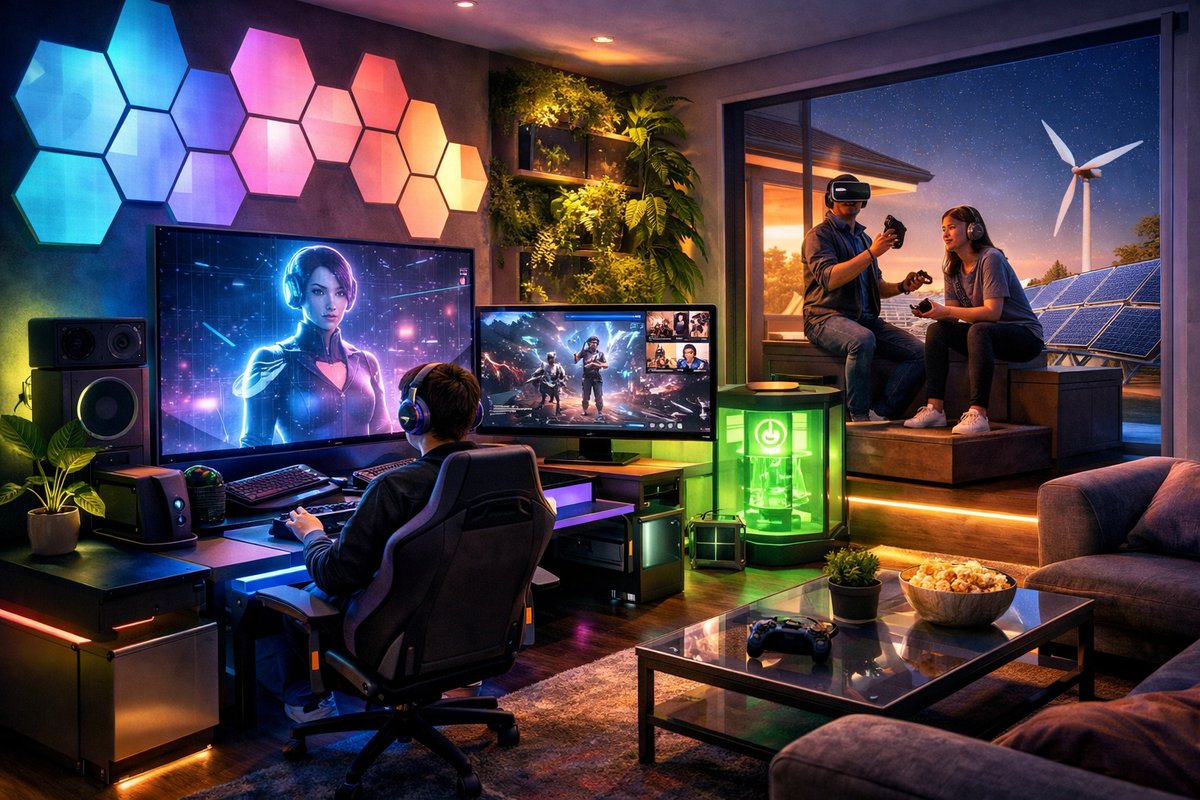

Home gaming has always been a canvas for creativity, but a recent surge in accessible AI tools, modular hardware and eco-minded gear is rewriting the rules. What started as dual-monitor battles and neon backlit keyboards has evolved into entire rooms that respond to player actions, shift atmospheres on cue and even host remote guests through cloud-synchronized experiences. This article explores how the latest wave of interactive playrooms is blurring the line between living space and adventure zone.
It began in unexpected corners: a handful of indie developers launched open-source AI dungeon masters that could narrate tabletop adventures without human oversight. Gamers quickly saw potential to scale that concept from tabletop RPGs to fully scripted digital landscapes. By integrating voice recognition modules with streaming software and ambient lighting controllers, these AI engines now craft dynamic story beats based on live player input. Early demonstrations at regional gaming expos showed virtual worlds that reshaped themselves in response to natural language prompts, setting a foundation for more complex sensory integration.
Meanwhile, modular hardware startups unveiled interlocking LED panels, magnetic speaker mounts and snap-together decor pieces designed for rapid room transformations. Instead of painting walls or hauling bulky furniture, players can install tile-style light boards that shift color and pattern in sync with in-game events. When a boss appears on screen, the panels flash red; when a serene forest is discovered, the walls glow emerald green. This ecosystem of plug-and-play accessories is expanding to include smart floor mats that vibrate with virtual explosions and fold-away projection screens that roll up into the ceiling at a button press.
Remote social gaming is getting a makeover, too. Hybrid platforms now allow local hosts to broadcast video and spatial audio to invited participants anywhere in the world. Visitors log in via cloud-streaming apps and see the playroom’s layout in real time, complete with interactive overlays that replicate the host’s lighting and sound queue. Turn-based board games, live-action role-plays and even puzzle hunts can embrace a geographically dispersed crew, forging the intimacy of a physical meetup without travel logistics.
Sustainability advocates have taken notice of the power demands in these hyper-immersive environments. Low-power computing sticks paired with energy-efficient LED strips and eco-friendly modular furniture are becoming mainstream. Solar-charged battery banks now feed bench-mounted lighting pods and network hubs, ensuring that a midday blackout doesn’t kill the final boss fight. Some DIY enthusiasts have even repurposed reclaimed wood and recycled fabric to craft custom gaming desks and chair cushions, marrying performance with planet care.
A key driver in this shift is accessibility. No longer do gamers need a multi-thousand-dollar rig to join a next-gen playroom. Cloud-streamed AI engines handle complex physics on remote servers, while local devices manage only rendering and I/O tasks. This offloads heavy processing and slashes entry costs. Combined with subscription-free open APIs, aspiring hosts can build dazzling environments with affordable components, then monetize or share their work without locking players into proprietary ecosystems.
At a recent regional tech gathering, a pop-up interactive playhouse showcased an all-in-one kit: collapsible wall modules, battery-powered spotlights, environmental audio nodes and a compact AI hub. In under 30 minutes, volunteers transformed an empty garage into a cyberpunk dojo complete with glowing grid floors and reactive soundscapes. Attendees could step in, pick from a library of AI campaigns and play instantly. The kit’s success underscored a growing appetite for turnkey solutions that marry creative freedom with ease of assembly.
Not all innovation is digital. Tabletop enthusiasts are bringing object recognition and mini-projectors to board gaming, turning physical tokens into smart pieces that trigger animations and secret clues. One prototype used RFID-embedded meeples that, when moved across a sensor mat, activated localized lighting effects and ambient sounds. While still in beta, these experiments hint at a future where plastic figures usher in cinematic spectacles, preserving the tactile joy of analog play while layering in digital surprise.
Professional venues are taking inspiration from these home systems. Arcade operators and escape-room founders are collaborating with tech makers to kit out pop-up experiences that travel to festivals, campus events and private parties. These mobile arcades lean heavily on compact, modular gear and solar-assist power packs to stay nimble. They promote sustainability by minimizing on-site setup trucks and using reusable lighting fixtures that fold down to carry-on size.
As with any techno-trend, community building is a crucial ingredient. Open forums and social channels dedicated to DIY playroom design are thriving. Gamers share blueprint files for 3D-printed light mounts, code snippets for AI narration loops and recipes for low-cost sound dampening panels. Peer reviews and collaborative livestream workshops accelerate refinement, ensuring that hacks become polished features in the next wave of kits.
Looking ahead, experts predict deeper sensory integration. Haptic gloves that convey texture, smell-emitting diffusers linked to in-game scenes and biofeedback monitors that tune difficulty based on player stress levels are all under active development. While mass adoption may be years away, home labs are already experimenting with wearable sensors that measure heart rate and galvanic skin response to dynamically alter game pacing and narrative arcs.
For creators and players alike, this renaissance offers a rare moment to shape the interactive environments of tomorrow. Whether it’s a city apartment converted into a sci-fi command center or a suburban basement transformed into a fantasy tavern, the marriage of AI, modular hardware and green tech is empowering personalized adventures. As more enthusiasts embrace open-source tools and sustainable setups, the boundary between craft and code, imagination and reality, will continue to dissolve-inviting everyone to step into the game on their own terms.
In a world where play is serious business, these next-gen playrooms are more than a hobby. They’re a testament to human ingenuity, the social bonds we forge and our collective desire for wonder. The future of home gaming is bright, adaptive and greener than ever-ready for anyone to join the adventure.