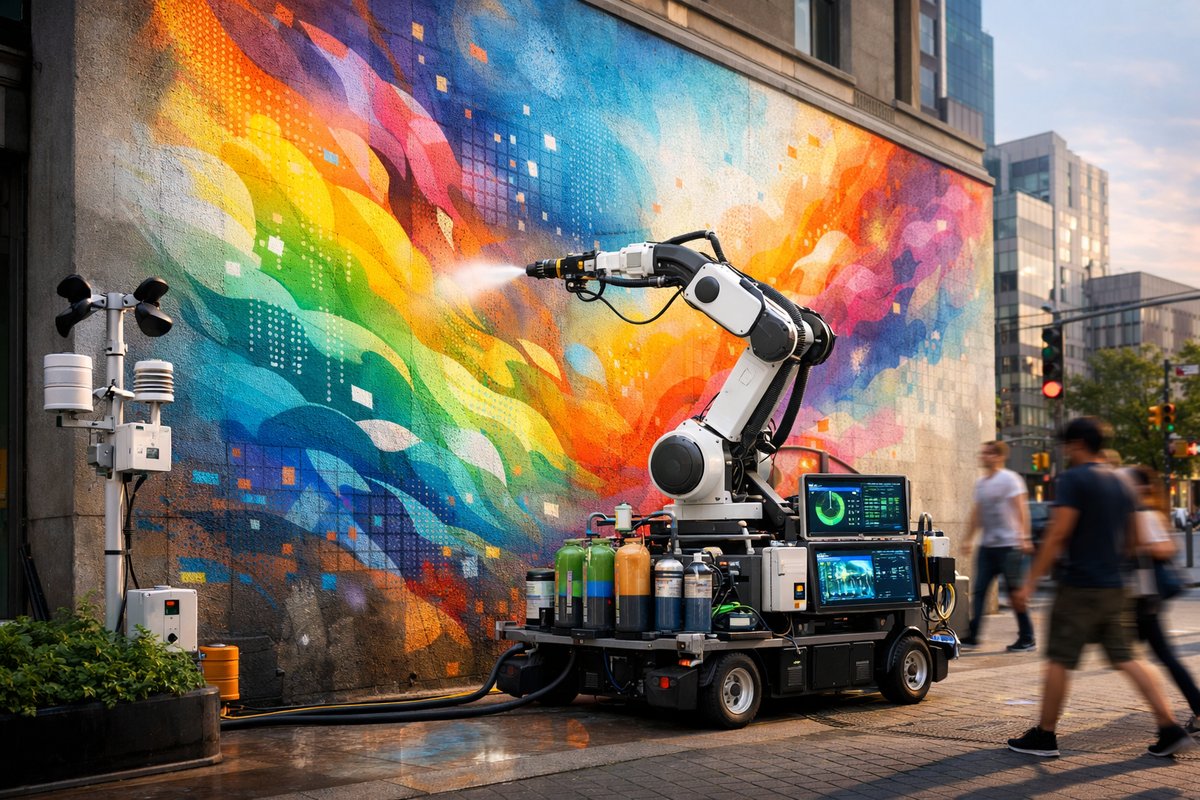

On a once-blank concrete wall in Berlin’s Kreuzberg district, a fleet of six legged robots whirred to life at dawn. Each machine carried a paint reservoir and a retractable nozzle, poised to interpret streams of environmental data as strokes of color. Over the next eight hours, they worked in concert: one bot laid down sweeping swaths of teal where air monitors detected higher nitrogen dioxide levels, another filled organic shapes in coral when humidity rose above 60 percent, while a third traced delicate outlines to reflect nearby foot traffic patterns. As onlookers gathered with cups of coffee, the ever-evolving mural emerged as a kinetic portrait of the city’s invisible forces.
This installation, titled “Breathing Walls,” represents the latest frontier in urban design, where programmable robotics meet sustainable art materials and real-time sensing. Rather than static paint and brushes, these autonomous creators rely on machine learning models trained on years of environmental data, combined with on-site sensor modules that record air quality, temperature and motion. Their goal is twofold: to foster deeper public awareness of local ecosystems, and to redefine the very act of painting as an ongoing, collaborative process between human designers, intelligent machines and the urban environment itself.
At the heart of “Breathing Walls” is a custom open-source control platform, developed by a collective of engineers and street artists under the banner of UrbanFlux Labs. Using a microcontroller board fitted with wireless connectivity and GPS, each robot continuously polls a network of air quality sensors hidden in lampposts, park benches and waste bins. A central server ingests the data stream, runs it through a trained neural network that maps numerical values to a palette of biodegradable water-based dyes, then sends stroke coordinates back to each robotic arm. The result is a living canvas whose colors and patterns shift gradually throughout the day.
“We wanted to move beyond the notion of a mural as a frozen snapshot,” says a project lead from UrbanFlux Labs. “Cities breathe, people ebb and flow, air quality pulses with traffic and weather. Our system translates those invisible rhythms into paint, giving passersby a constantly shifting mirror of their surroundings.” The choice of eco-friendly paints ensures that any runoff harmlessly breaks down in rainfall, and the robots themselves run on rechargeable battery packs topped up via rooftop solar panels installed during a recent building retrofit.
While Berlin’s project has drawn headlines for its scope and technical ambition, it is far from an isolated experiment. In Tokyo’s Shibuya ward, a similar system called “Pulse Walls” launched earlier this spring, coupling spray-nozzle drones with motion-tracking cameras to create graffiti-style motifs that chase skateboarders through pedestrian plazas. In Chicago, a community arts center is trialing models that incorporate sound sensors-when ambient noise crosses a threshold, splashes of warm yellow erupt across brick walls to visualize the city’s acoustic footprint.
These pioneering initiatives share an emphasis on sustainability and interactivity. Traditional muralists often rely on solvent-based paints and heavy scaffolding, but the new wave of robotic artists favors biodegradable pigments, low-power electronics and modular drive systems that can be installed quickly and disassembled when projects end. The robots’ ability to adjust their brush width, stroke pressure and color mixing ratios also allows for a level of precision and variation difficult to achieve by hand, especially on large-scale works that cover several thousand square feet.
For multimedia designer Renata Liu, whose studio helped coordinate the Chicago pilot, the appeal lies in the intersection of technology and craft. “We’re not replacing artists with machines,” she explains. “We’re co-creating with them. Robots excel at repetitive, precise motions; humans excel at conceptual leaps and emotional nuance. When we fuse those strengths, we unlock new possibilities for scale and responsiveness.” Liu’s team recently experimented with a dynamic color-swapping algorithm that taps into local social media feeds-hashtags related to wellness, cycling and organic markets shift the mural’s hues toward greens and violets, for example, celebrating community trends in real time.
As the robots refine their strokes, however, technical and ethical questions arise. Who owns a constantly evolving mural? If the underlying algorithm changes, does the art still belong to the original collective? What happens when sensors malfunction or data streams are interrupted? In response, many project founders emphasize transparency: all code, hardware schematics and sensor calibration files are released under permissive licenses, and each site includes an on-wall plaque with QR codes linking to live data dashboards.
Public reaction has been broadly positive, though some graffiti purists see the machines as invasive. A small activist group in Madrid recently staged a protest, spray-painting the word “Hands” over one robotic mural to assert the primacy of human touch. UrbanFlux Labs responded by inviting community volunteers to co-paint sections of the wall alongside the robots, fostering dialogue about technology’s role in public art.
Beyond the aesthetic impact, environmental advocates highlight the potential of data-driven murals to raise awareness of urban health issues. In neighborhoods with chronic air pollution problems, these installations can spotlight spike events-such as sudden peaks in particulate matter during rush hour-by switching to bright reds and oranges. Local schools have begun incorporating visits into their curricula, asking students to record visual changes as part of science projects. A pilot program in São Paulo even enables remote schools to access a live feed and vote on color schemes, turning a single installation into a global classroom.
The economic footprint of robotic mural programs is also growing. Small businesses near installation sites report increased foot traffic, as residents come to check live updates on color shifts. Some property owners are commissioning private versions of the system, adapting it to corporate branding or seasonal themes. Event planners have used the technology for pop-up festivals, programming robots to spray ephemeral designs on shipping containers that double as stages and art stands.
Looking ahead, developers are exploring ways to make the robots more autonomous. Solar-charging roofs could eliminate the need for manual battery swaps, while advanced onboard computer vision systems might let robots adjust to changing wall textures or obstacles without human intervention. There’s even talk of equipping machines with simple AI-recognition tools so they can respond to individual passersby-subtle brush flourishes triggered when someone pauses in front of a panel, for instance.
In a world where digital screens dominate public space, robotic murals offer a tactile counterpoint: they bridge bit and brush, pixel and pigment, machine precision and human imagination. By embedding living data streams into the walls that shape our daily routes, these projects redefine how we perceive and interact with the urban environment. And as the robots continue to learn, adapt and co-paint alongside people, the line between artist and audience, coder and curator, humankind and machine may grow ever more fluid.
A Fresh Palette for Future Cities
As cities evolve, so do the tools we use to capture their spirit. Autonomous painting robots remind us that art is not a static relic but a living conversation-one that embraces technology without losing sight of human creativity. In paint, data and movement, they forge a new kind of public canvas, where every breath of wind, every passing footstep and every shifting cloud invites us to look again.