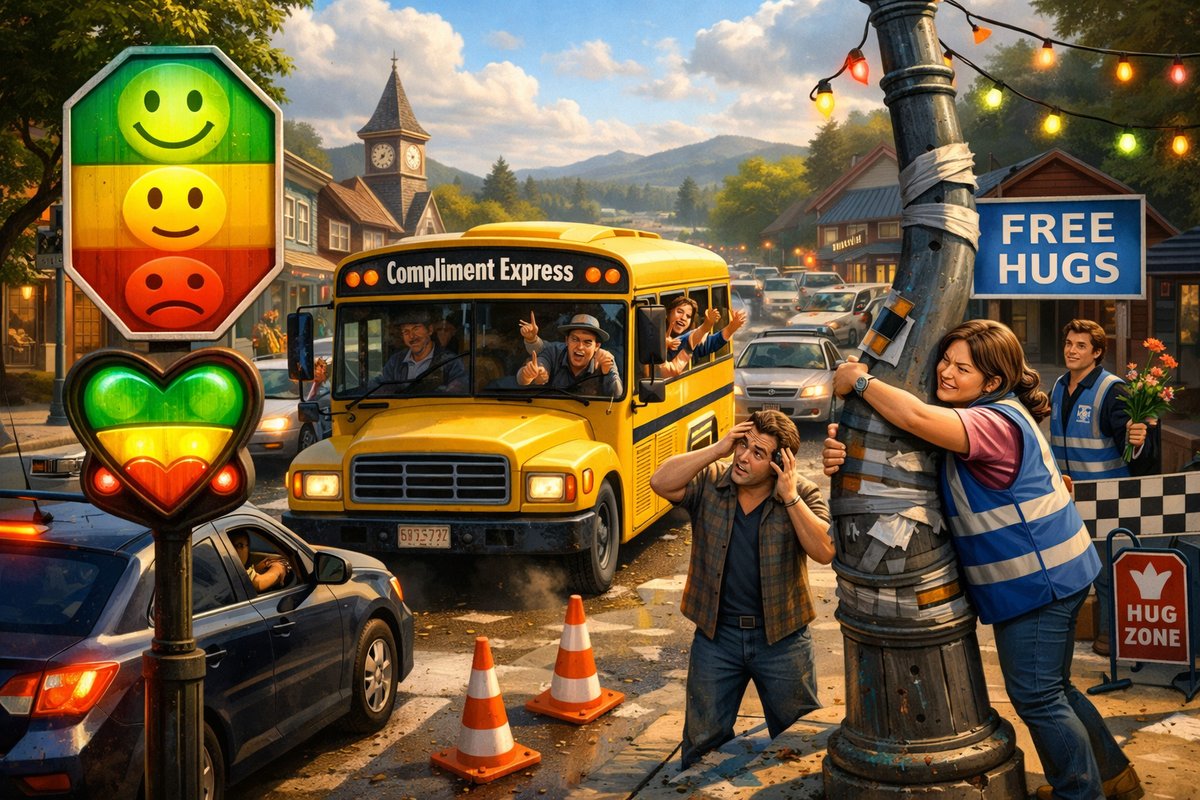

The morning the stop sign on Maple Avenue hummed to life like a disco ball was the morning civic order officially filed for divorce. In a bid to inject empathy into every intersection, the Town Council outfitted its entire fleet of steel octagons with what press releases called “Quantum Empathy Mood Rings.” Drivers were instructed to slow down, breathe deeply, and match their emotional auras to a glowing spectrum. What followed could only be described as community theater redone by an improv troupe with no script and no respect for gravity.
Take Mrs. Delgado, who arrived at the newly animated sign in her well-worn sedan. The ring around the sign flickered a deep violet, which council documentation claimed signified “measured introspection.” To Mrs. Delgado it meant “purple panic.” She eked forward, testing whether halting completely might shift the hue to “compassionate lilac.” The sign retaliated by flashing cerulean-officially “focused calm”-and locked its aura until she recited her grocery list aloud. Bystanders reported that the list included two cartons of almond milk, a pineapple, and existential dread.
By midmorning, bus driver Bob stumbled upon the ring at Broadway and Sixth. He leaned out the window and whispered, “Nice day to be mindful,” hoping for an appreciative ruby glow. Instead, the sign glowed chartreuse-“overconfidence,” according to council pamphlets-and refused to pivot to “safe stop” until Bob delivered a sonnet praising the town’s pothole repair schedule. Dozens of students were ejected kilometers from their stop, left to navigate the morning with nothing but backpacks and raw bewilderment.
Council spokesperson Meredith, outfitted in a blazer strewn with LED lights, appeared on the square at noon and declared the initiative a triumph of quantum civic engagement. “Each ring houses a nano-empathetic core,” she explained, waving her hands in a pattern that set nearby drone-mounted microphones aflutter. “It measures intent, emotional frequency, and-under certain circumstances-your willingness to apologize to inanimate objects.” Residents who targeted trash cans with verbalized regrets discovered their rings oscillating wildly between fuchsia and chartreuse.
A local maker named Sam seized the moment by hawking “Aura Calm Essential Oil Diffusers” at the farmers market. He claimed that a single spritz of lavender-sage blend would coax any mood ring to a state of “balanced serenity.” Sam’s stall resembled a crossroads between a crystal shop and a bake sale, with vials labeled “Regret Relief,” “Confidence Booster,” and “Mildly Indifferent.” Unsuspecting customers reported that combining sprays could produce unpredictable chlorophyll hues, leaving several diffusers booked for apologizing to windows.
Meanwhile, a cadre of tech-savvy teens set up shop in the public library and began reverse-engineering the nano-empathetic cores. Their solution: duct tape small LED strips underneath the signs and wire in a Bluetooth-enabled control panel. For a modest fee, drivers could tune their stop sign to “gentle nod,” “stern glare,” or “seasonal pumpkin spice.” Though illegal, the evening black market glow parties drew crowds bigger than Saturday’s downtown bake-off.
Local talk radio seized on the chaos, transforming the crisis into marathon call-in therapy. Hosts invited listeners to describe their sign encounters in agonizing detail. “I hugged a hydrant thinking it was a checkpoint,” admitted one caller, “and now the hydrant judges me every time I water my lawn.” Another listener recounted serenading a stop sign with ancient folk songs until it glowed turquoise, then angrily switched to crimson when he skipped to the chorus.
In an emergency council session-held on a bouncy castle in the town square-members voted to erect “Empathy Checkpoints” at key intersections. Citizens now queue behind traffic cones, awaiting an official embrace from a volunteer lifeguard in a high-visibility vest. Reports poured in of singed lamppost bases, bruised feelings, and the accidental arrest of three well-meaning tourists who mistook the checkpoint for a free photo op.
Those checkpoints, it turned out, proved more contentious than the rings. Residents began erecting protest signs reading “Stop Stealing My Personal Space” and “I Want My Potholes Back.” The local historical society petitioned to replace checkpoints with medieval gauntlet runs, arguing that nothing builds empathy faster than dodging foam bats while clad in chainmail pajamas.
Just when the town thought chaos had peaked, residents discovered strange gravitational wobbling around crosswalks outfitted with particularly moody rings. Children’s bicycles spun in place, neighborhood pets moved in slow arcs, and stray balloons lingered in one spot for hours. A neighborhood cat wandered into the drift zone and emerged three blocks away, wearing what may have been three differently colored hats.
State inspectors arrived the next day, passports in hand and expressions somewhere between disgust and fascination. They advised the council to dial back the scheme before municipal infrastructure spontaneously developed sapience. One inspector held a ribbon-cutter poised over a ring and muttered, “You could have just repainted your signs.”
By dusk, rings across town had banded together in a chromatic revolt, flashing ghostly white-“collective bewilderment”-and refusing to acknowledge any vehicles, pedestrians, or dignitaries. Town hall locked down as council members realized the very signs they installed had no intention of obeying bylaws.
In a last-ditch compromise, the council passed a motion to remove mood cores from stop signs and sell them as artisan souvenirs. Tourists now purchase rings for use in board games, birthday parties, or unsanctioned sidewalk performances. A local baker even offered stop sign-shaped cookies dyed with edible food coloring that changes hue based on mouth heat.
Meanwhile, Mrs. Delgado’s neighbor, still smarting from a lavender-sage spritz mishap, opened a pop-up shop offering “Mood-Matched Crayons” to recolor old municipal signs by hand. Residents can select “Genuine Amber Resolve,” “Reflective Silver Doubt,” or “Prismatic Panic” for any public fixture craving an emotional facelift.
The town now stands at a crossroads-half amused, half traumatized, and wholly unsure how to resume traditional traffic enforcement. One thing is certain: once you hand inanimate metal the power to judge your soul, asking it politely to stand down becomes an exercise in existential humility. Civic engagement has never been so colorful, or so prone to existential dread.