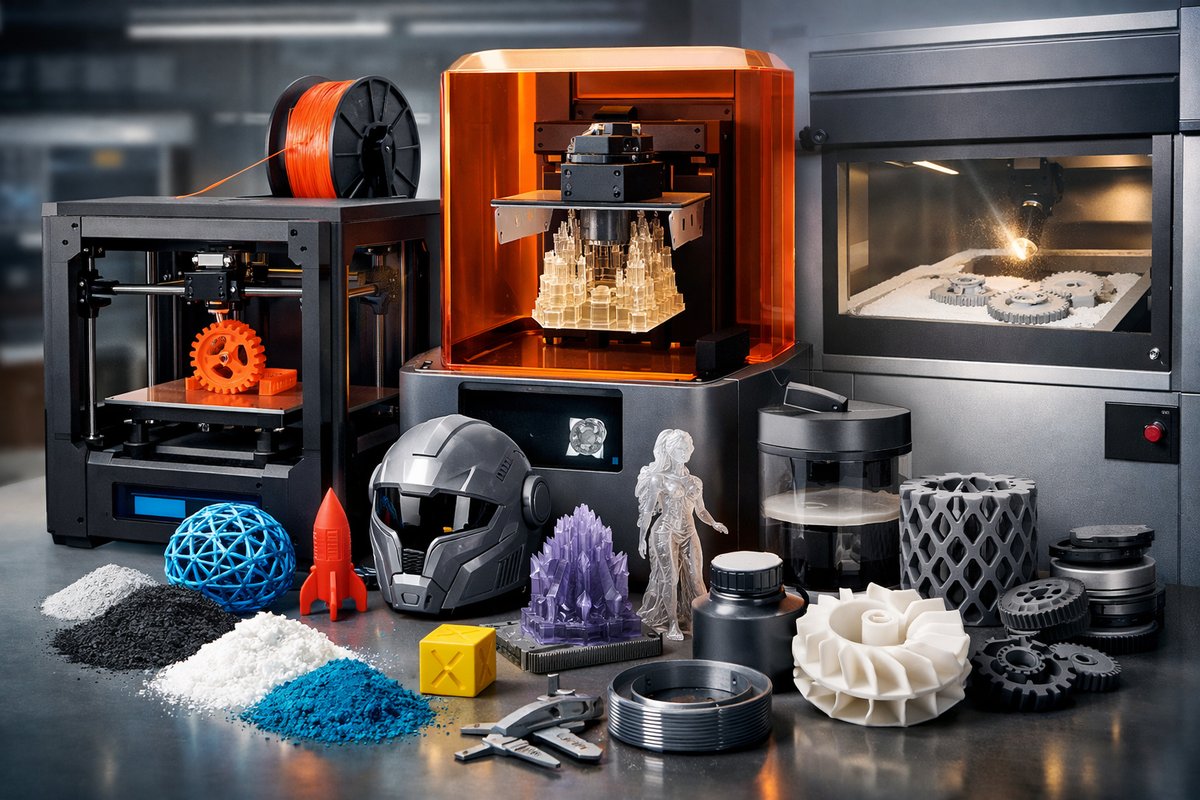

In the past decade, 3D printing has evolved from a niche prototyping tool to a mainstream manufacturing option for hobbyists, startups, and industrial users alike. The core promise remains the same: turn a digital model into a physical object, layer by layer. Yet behind that promise lies a web of costs and technical hurdles that can make or break a project’s feasibility. Today’s breakthroughs are focused on minimizing waste, optimizing machine uptime, and leveraging smarter materials-so that anyone with a spark of curiosity and a printer can embark on reliable, budget-friendly builds.
Cost pressures start with hardware. A basic fuseddeposition-modeling (FDM) printer can be had for just a few hundred dollars, but accessories and parts upgrades quickly add up. Advanced models with heated chambers, multi-material heads, or enclosed resin vats may cost thousands. Meanwhile, raw materials-filaments, resins, or powders-drive recurring expenses. Add post-processing supplies, maintenance tools, and power consumption, and even simple prints can become surprisingly pricey. The latest wave of innovations tackles each of these areas with a focus on accessibility and circularity.
On the filament front, recycled and composite blends have arrived at scale. Post-consumer PET bottles are turned into high-quality PLA or PETG filament via pellet extrusion, cutting material costs by up to 30 percent while reducing plastic waste. Composite filaments infused with wood flour, metal powders, or carbon fiber deliver specialized strength and aesthetic effects without the premium of pure metal or exotic polymers. Temperature-stable PLA variants now rival ABS for toughness, allowing users to avoid heated chambers and still achieve reliable layer adhesion. As more filament manufacturers adopt rigorous quality controls and ISO-grade feedstocks, the era of random diameter fluctuations and brittle spools is fading fast.
Resin printing, long prized for high resolution but criticized for expense and post-processing mess, is also seeing key upgrades. Fast-cure photopolymer formulas cut layer times in half, while low-odour, plant-based resins improve workshop comfort. Disposable vat liners and reusable resin filters streamline cleanup and extend resin lifespan by trapping cured particles. New LED matrix lighting systems reduce energy draw and heat generation compared to older mercury-arc lamps. Combined with open-source software to precisely dial in exposure settings, these refinements boost first-print success rates and lower resin waste.
Meanwhile, powder-based processes once limited to industrial labs are migrating to desktop footprints. Binder jet and selective laser sintering (SLS) systems now appear in small workshops, using polymer powders that sinter at lower temperatures to save on energy costs. Modular powder handling units with vacuum-assisted recycling recover un-fused particles for future prints, cutting material loss. As prices for compact laser modules and inert gas systems decline, even metal printing via direct energy deposition is inching toward small-business budgets.
Beyond materials and machine hardware, intelligent slicing and workflow software play a leading role in cutting both time and filament. Cloud-based slicers harness GPU farms to calculate optimized toolpaths and support structures that use 15-20 percent less material than traditional slicers. AI-driven algorithms can predict weak points under load, automatically reinforcing key sections without manual intervention. Custom profiles shared in online repositories let users download fine-tuned settings for a given printer-filament combination, eliminating trial-and-error loops and reducing the number of filament-wasting test prints.
For those who like to tinker, modular upgrade ecosystems are booming. Swappable extruders and hot ends allow quick transitions between flexible thermoplastics, standard PLA, or abrasive carbon fiber blends. Heated beds with magnetic or flexible build plates make part removal painless, saving hours of scraping and reducing the risk of bed damage. Multi-material upgrade kits add dual-extrusion capability, enabling soluble support materials or two-colour prints without buying a whole new machine. Thanks to standardized mount points and open-source firmware, many upgrades install in under an hour and cost less than one hundred dollars in parts.
Uptime and reliability have historically plagued desktop printers, but integrated monitoring systems are bridging the gap with industrial workflows. Small camera modules stream live video of each print, while cloud-connected sensors track nozzle temperature, filament feed tension, and bed adhesion in real time. Automated alerts can pause or abort prints at the first sign of a clog or under-extrusion, saving hours of wasted machine time and material. Remote control apps let operators adjust temperatures or re-start failed prints from anywhere, turning idle hours into productive ones.
Design for additive manufacturing (DFAM) principles are another key to success. By orienting parts to minimize support structures, designers can save up to 50 percent on support material costs and post-processing time. Lattice infills and hollow geometries reduce weight and lab time while preserving structural integrity. Smooth transition zones and rounded corners avoid stress concentration, making printed parts more durable under real-world loads. Public libraries of DFAM templates help newcomers learn best practices without starting from scratch.
Sustainability remains a north star. Community-built filament extruders let makers convert printer scrap and failed prints back into usable filament, maintaining a closed-loop material cycle. Chemical recycling techniques are emerging for PLA, breaking it down into its lactic acid monomers for repolymerization. Researchers are exploring soy-based and algae-derived resins to replace petrochemical formulas. As more makers embrace circular workflows, the plastic footprint of small-scale 3D printing continues to shrink.
Open collaboration drives many of these gains. Online forums and social-media groups share calibration profiles, print-farm management tips, and even step-by-step upgrade guides. Makerspaces and local labs host monthly hack nights where participants swap hardware mods or test new materials side by side. This peer-driven model accelerates problem solving and spreads cost-saving hacks that otherwise might remain hidden in proprietary vendor silos.
Consider a small design studio that needed custom fixtures for a series of prototypes. By switching to recycled PLA filament, sourcing a modular dual-extruder upgrade, and leveraging an AI-powered slicer profile from a public repository, they cut their printing budget by nearly 40 percent. Another example: a micro-dentistry practice invested in a compact resin printer, low-odour dental resin, and an automated vat filtration system. Their chairside model turnaround time dropped from days to hours, unlocking same-visit patient consultations.
Of course, challenges remain. Multi-colour ceramic and metal printing are still several price tiers above plastic processes. Supply chain disruptions can affect specialized powders or resins. And while AI-driven workflows promise material savings, they require reliable data inputs and occasional manual validation. Yet momentum favors continued democratization: as more makers adopt low-cost blades for powder recycling or DIY filament extruders, economies of scale and community know-how push the price floor ever lower.
In the meantime, curious makers have more tools than ever to experiment, iterate, and fabricate functional objects without breaking the bank. Whether you’re crafting custom tools, one-off art pieces, or small-batch production runs, implementing these cost-cutting strategies will help you print smarter. Layer by layer, the future of accessible, sustainable manufacturing is being built-one optimized workflow and one recycled spool at a time.
Ready to explore? Start by sourcing high-quality recycled filament, upgrading your build plate system, and tapping into AI slicing tools online. Embrace modular hardware, share your results with the community, and watch how each small improvement compounds into bigger savings and higher print success rates. The next breakthrough layer is just a print away.