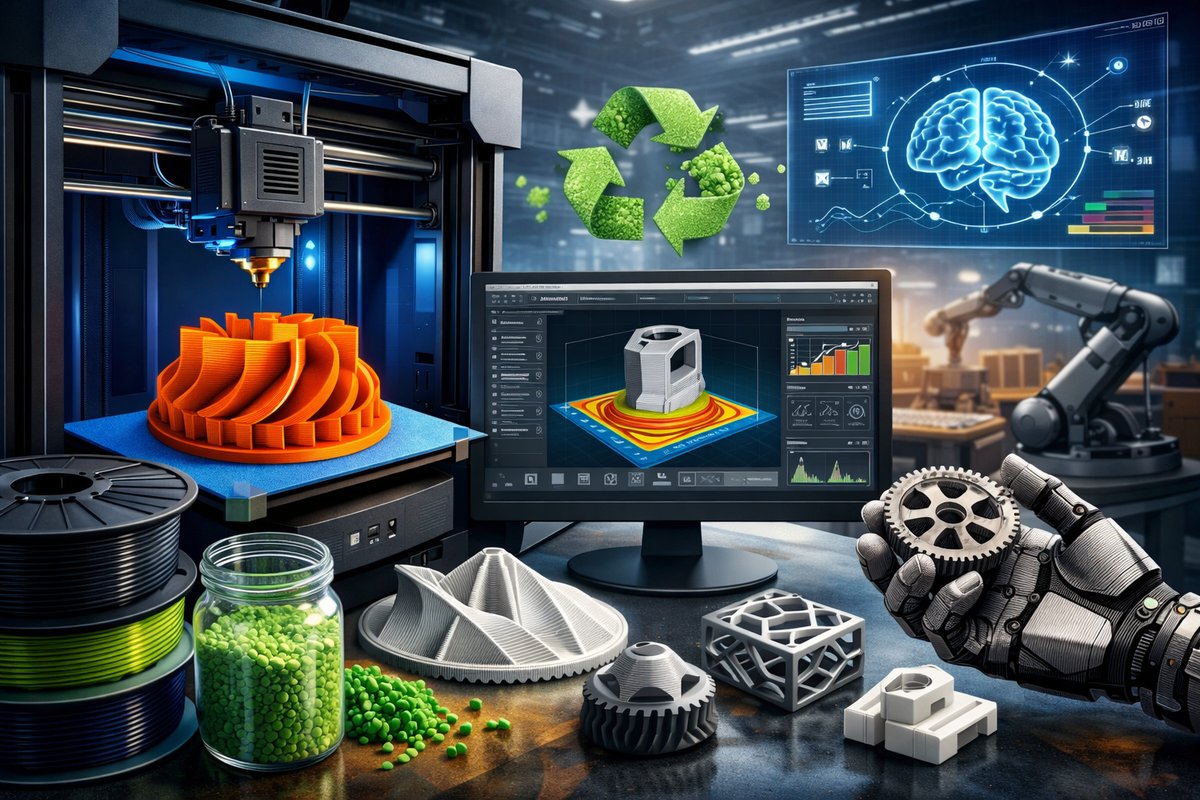

3D printing stands at the crossroads of creativity and engineering, promising anything from bespoke miniatures to functional mechanical components. Yet the path from digital model to finished part often faces a familiar hurdle: cost. Whether you’re a hobbyist testing new shapes or an entrepreneur tooling up for small-batch runs, every layer comes with material, energy, and time investments. Fortunately, a wave of innovations is driving down these barriers, making reliable, affordable printing not just possible but practical. This overview explores material breakthroughs, hardware upgrades, software smarts, production strategies, and emerging tech that together form a toolkit for anybody looking to maximize success without overspending.
Material Matters
For many makers, filament costs add up fastest. Traditional PLA and ABS remain staples, but specialized blends and recycled options now rival them for price and performance. Recycled PETG filaments sourced from plastic bottles can be up to 30 percent cheaper than virgin materials while offering similar strength and clarity. On the bio-based front, PLA blends infused with wood fibers, bamboo flour, or even coffee grounds provide unique aesthetics at a modest premium. Tough PLA formulas with impact modifiers deliver durability nearly on par with ABS but eliminate the need for an enclosed build chamber. Flexible TPU variants have also dropped in price, allowing the creation of gaskets, seals, and wearable prototypes without sacrificing cost control.
Pushing resin printing into budget territory, larger-batch bottles of standard photopolymer resin now come with improved resins optimized for low-wattage UV sources. These formulations cure faster under generic 405-nanometer LEDs, slashing energy consumption and reducing failed layers. Water-washable resins avoid isopropyl alcohol purchases and cut cleanup waste. In small-batch jewelry or dental modeling, gray resins with high detail can be sourced at bulk prices that undercut premium brands by 20 percent or more.
Upgrading the Hardware
The golden age of open-source FDM designs has driven down entry-level printer prices while improving precision. CoreXY architectures, once the province of DIY enthusiasts, are now available as out-of-the-box kits with rigid aluminum frames and belt-driven carriages. These machines achieve faster print speeds without sacrificing accuracy, meaning less time per part and lower energy bills. For even distribution of heat, interchangeable heated beds using silicone mats and uniform tooling-grade aluminum plates reduce the risk of warping on large prints.
Resin printers have likewise democratized. Large-format SLA machines are now affordable enough for home labs, boasting build plates that can handle multiple small parts in one go. Detachable vat systems speed resin swaps and prevent cross-contamination between formulations. Automated liner-change modules extend the life of the FEP film at the bottom of the vat, reducing replacement costs.
Investments in multi-nozzle extruders unlock simultaneous printing with different materials or colors, cutting assembly steps and glue usage. Swappable hot ends designed for both abrasive composites and high-temperature filaments let you stretch one machine across many use cases without buying multiple printers.
Software Smarts and Process Optimizations
A critical frontier for cost reduction lies in the digital realm. Advanced slicing engines now support adaptive layer heights, placing thinner layers only where curvature demands it and thicker layers on flat surfaces. This reduces overall layer count, shaving hours off long prints without noticeable differences in quality. AI-driven support generation automatically places dissolvable supports only where absolutely needed, cutting post-processing labor and wasted material.
Firmware enhancements like linear advance and pressure advance smooth filament flow, preventing oozing and the need for reprints. Open-source platforms allow tweaking acceleration and jerk settings to optimize throughput for specific models rather than relying on one-size-fits-all factory profiles. Cloud-based slicing services offer pay-as-you-go rendering for complex models, avoiding costly local workstation upgrades.
For resin workflows, automated rinsing stations paired with programmable LED curing chambers ensure consistent post-print processing. By standardizing rinse times and cure cycles, wasteful trial-and-error diminishes, and each batch finishes with predictable mechanical properties.
Leveraging Hybrid and Multi-Stage Manufacturing
For items requiring both additive detail and subtractive smoothness, hybrid approaches merge CNC milling with 3D printing. Print-then-mill processes deposit rough geometry layer by layer before a tiny spindle refines critical surfaces. This workflow excels in producing injection-mold-worthy masters with minimal tooling expenses. Powder bed fusion systems are also evolving to accommodate recycled powder reuse and more efficient laser strategies. Manufacturers can reclaim up to 70 percent of unfused powder for subsequent runs, dramatically reducing material outlay compared to single-use thermoplastic granules.
Printer Farm Models and On-Demand Services
Small businesses and makerspaces are adopting printer-farm models where dozens of identical machines queue up hundreds of jobs overnight. Automated bed-leveling probes and remote monitoring cut the need for onsite oversight, converting capital investment into a semi-autonomous production line. Print farms can subsidize equipment costs by offering on-demand printing services via online platforms, where clients upload models and pay by part volume or print time. This approach shifts some risks to end users, while farms spread operational expenses across many customers.
Success in the Field
Hobbyists report printing jigs and fixtures for home workshops using tough PLA blends, cutting assembly times in half and reducing reliance on off-the-shelf brackets. Entrepreneurs in small towns use budget resin printers to prototype custom phone grips, issuing preorders with 3D-printed molds. At veterinary clinics, surgeons leverage affordable SLA models to map unusual bone fractures, improving surgical outcomes at a fraction of the cost of traditional prototyping.
Practical Tips for Stretching Every Cent
Consistent calibration remains the linchpin of cost control. Investing in a set of quality digital calipers ensures precise model measurements and helps detect filament diameter fluctuations that translate into wasted material. Upgrading to spring steel or PEI build surfaces boosts first-layer adhesion across diverse filaments, cutting failed prints. Printing draft shields or z-hop routines isolates models from ooze, avoiding salvage operations. Reusing isopropyl alcohol for multiple resin rinses and storing bottles under inert gas caps improves solvent lifespan.
Emerging Horizons
Continuous liquid interface production, which uses an oxygen-permeable window to create a perpetual resin cure zone, promises prints in seconds rather than minutes. Multi-material jetting systems can deposit support polymers that dissolve in mild solvents, eliminating tedious breakaway tasks. Binder jetting of sand and ceramics for large-scale architectural models is gaining traction at research labs, offering eco-friendly powders that can be reclaimed and processed locally. As these technologies mature, we’ll see more distributed, low-cost manufacturing closer to the point of need.
Layer by layer, 3D printing is shedding its reputation as a hobbyist toy and solidifying its role as a cost-effective prototyping and small-batch production tool. By combining smarter materials, versatile hardware, optimized software, and hybrid approaches, makers of all stripes can transform a simple idea into a functional part without breaking the bank. The revolution in making is silent, precise, and modular-and it starts with your next single layer.
-
eSUN 6KG Bundle PETG Basic Filament 1.75mm, High Toughness ...
... Spools of 1KG(2.2lbs) PETG 3D Printer Filament, General Colors Bundle. 3 ... Global Recycled Standard (GRS) certified products contain recycled content ... -
Amazon.com: Digital Caliper Measuring Tool, Stainless Steel ...
【ACCURATE MEASUREMENT AND ZERO SETTING】This digital caliper glides smoothly. Measuring range: 0 -6" / 0-150mm; Accuracy: ± 0.001"/ 0.02mm; Resolution: 0. 0005 ...