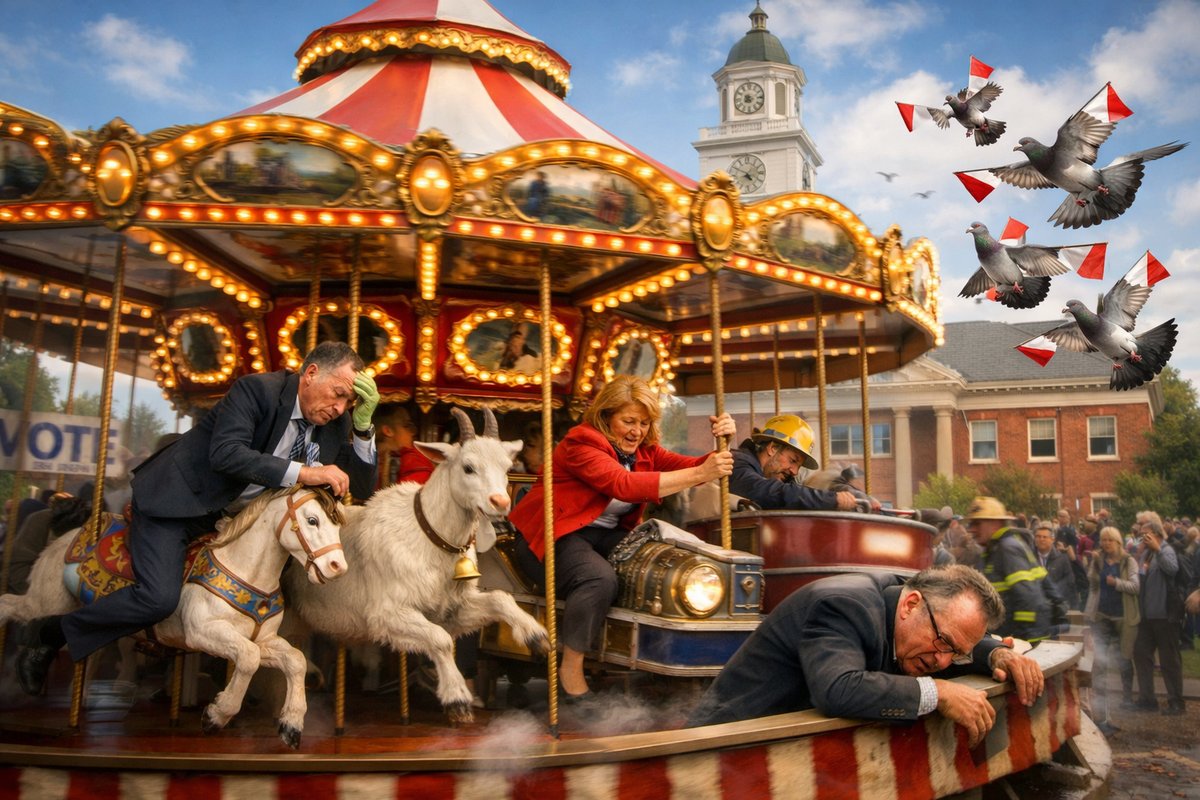

On an overcast Wednesday morning, the Riverbend Town Council unveiled its most ambitious civic experiment yet: a full-size, color-splashed carousel imported from a fading seaside amusement park, installed smack in front of Town Hall. Banners proclaimed “Spin for Your Voice,” as if democracy itself were a dizzying game of chance. Residents lined up, alternating between curiosity and mild nausea, awaiting their turn to ride a painted white horse toward local policy decisions.
No one was quite sure who proposed the idea first-some claim it was Councilmember Blanca Northridge, fresh from a community theater workshop on “participatory governance”; others insist it was Mayor Thornwick, whose afternoon nap had been mysteriously interrupted by the phrase “elected by the people, one gallop at a time.” Either way, the wheels started turning faster than usual one fateful morning when the carousel arrived, complete with mirrored poles, flickering lanterns, and an accompanying kazoo quartet.
At precisely 9:03 a.m., the first spin launched Councilmember Javier Mukunda, still clutching his policy brief on water-conservation zoning, onto a lavender mare with silver tack. The carousel rotated, the kazoo quartet played a reckless glissando, and the mare came to rest opposite the “Yes” panel painted beneath a cloud of glitter. The crowd erupted in hesitant applause. It was democracy in motion-quite literally.
Within minutes, the novelty morphed into chaos. Young families cheered, while local retirees waved oversized foam hands that read “SPIN THE VOTE.” Motion sickness swept through participants at an alarming rate; by noon, three councilmembers disembarked clutching ginger candies and swearing off participatory art forms for life. Social media lit up with livestreams titled “Carnival Council Gone Wild” and “Will Someone Please Find the ‘No’ Panel?”
Just as the council began to salvage its dignity-fruit punch and stale funnel cakes in hand-a rival faction known as the Libertarian Goat Enthusiasts (LGE) staged an unscheduled intervention. Under cover of a kazoo solo, they replaced three carousel horses with actual goats decked in harnesses. The unsuspecting public mounted these beasts, only to have the goats, evidently unimpressed by civic duty, chew through paper ballots, graze ornamental shrubs, and bolt into a nearby koi pond. The mayor, mid-spin, was splashed head to toe in carp water.
Pandemonium reigned. The kazoo quartet wilted under goat-fueled cacophony. Councilmember Mukunda tried to restore order by proclaiming a recess for interpretive dance, but even the most nimble community theater veterans couldn’t outpace a bleating goat. Shouts of “Meh!” and “Onward to semaphore!” echoed through the soggy town square.
By the following morning, Riverbend’s civic process lay in ruin: ballots had been digested, a rideshare of goats was rampaging inside City Hall, and the carousel platform itself had tilt-shifted off its foundation. The council convened an emergency session in the parking lot, perched on soggy folding chairs and clutching coffee cups stamped with the words “Stay Calm and Spin Again.” It was then that Councilmember Northridge, bearing last night’s scribbled napkin doodles, proposed a radical alternative: pigeon-powered semaphore.
Hush fell over the crowd as she described the vision. Instead of spinning or bleating, elected officials would don striped waistcoats and plaster their arms with color-coded flags. A small flock of homing pigeons, outfitted with message capsules, would whizz overhead, delivering architectural plans and zoning ordinances to each council seat according to avian flight paths. The direction of the winds, Northridge argued, was a more trustworthy arbiter of public will than goat caprice.
Facing fecal hazards and public outcry, the council agreed to dismantle the carousel-though the goats had to be gently herded away with slices of watermelon-and prepare for pigeon trials. Volunteers surrendered paintbrushes to hand-paint 360 semaphore instructions. A local bird-trainer booked six budget hours on a smoke machine to create “atmospheric conditions” conducive to avian governance.
A week later, the newly christened “Council of the Wing” took flight from a refurbished pigeon loft behind City Hall. Residents crowded the perimeter, wearing earplugs to muffle cooing and brandishing safety goggles against unexpected guano. The first motion-whether to allocate funds for streetlamp repairs-was signaled by three pigeons. They whizzed northward toward Councilmember Mukunda’s platform, peeled off mid-air, and dropped their capsules in gleaming brass holders. Mukunda raised his red and orange flags in triumphant semaphore: the motion passed.
This time, the process earned polite nods rather than raucous applause. Motion sickness rates plummeted, and goats were nowhere in sight. But when the pigeons spooked by an ill-timed fire-drill and scattered into the tree line, councilmembers improvised by linking arms and chanting policy limericks. It was not what anyone had planned, but it was at least a coherent form of local rule-if slightly barked at by stray dogs.
At press time, the carousel horses are rumored to be retrofitted as public art installations-some repainted into psychedelic llamas-while the goats enjoy honorary council seats in the town petting zoo. The pigeon semaphore system continues to hold sway, though suburban residents have petitioned for a digital backup, just in case the birds unionize.
Riverbend’s journey from ballot box to brass ring stands as a testament to community imagination, tenacity, and a certain willingness to embrace dizziness. True, a few policy briefs ended up in koi ponds, and the kazoo quartet is still seeking therapy. Yet in a year stuffed with gridlock and stale rhetoric, these bizarre civic theatrics managed to remind everyone that democracy can be unpredictable, messy, and occasionally goat-ridden-and that sometimes the best way to hear one’s voice is to spin, scribble, or flap it out in full technicolor.