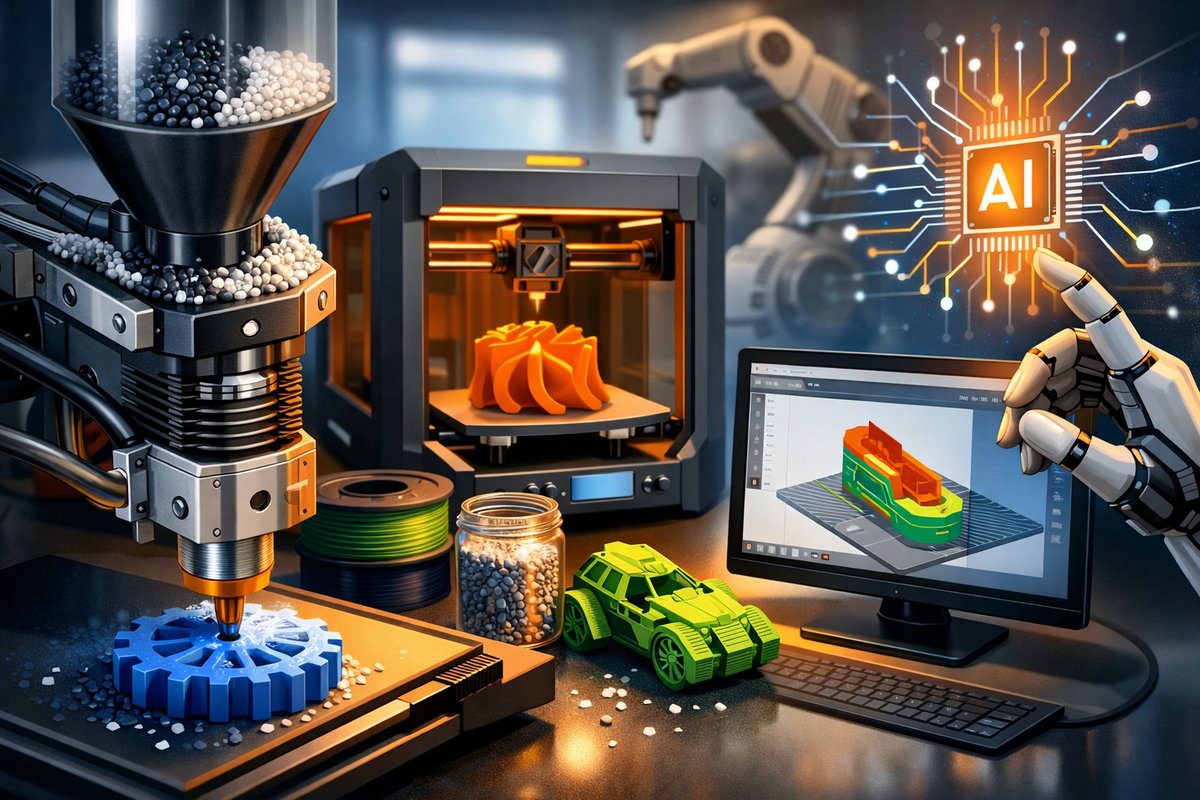

The world of 3D printing is undergoing a quiet revolution. Recent technology refinements are driving down barriers to entry while improving quality, repeatability, and sustainability. What once required hefty investments and specialized skills is now within reach for makers, small businesses, and educational programs. By embracing clever material solutions, modular hardware upgrades, and software-guided workflows, printers of all sizes are churning out prototypes, end-use parts, and art installations on budgets that would have been unthinkable just a few years ago.
At the heart of this transformation lies the drive toward lowering material costs. Traditional filaments like PLA and ABS remain popular, but their commodity nature has opened the door to bulk pellet alternatives. Pellet extruders retrofit onto desktop machines, enabling printers to process plastic pellets at a fraction of the cost of spooled filament. Some users report material savings up to 80 percent, making large-volume prints and experimentations economically viable. The extra work in calibrating temperature and flow pays off quickly when operating budgets stretch thinner.
Alongside pellet systems, recycled and bio-based filaments are gaining traction. Ecosourced PLA blends offer consistent print performance and reduced environmental impact. Compressed PET pellets derived from post-consumer bottles deliver toughness and chemical resistance, rivaling engineering-grade plastics. This circular approach not only cuts costs but aligns with growing sustainability commitments in education, manufacturing, and the maker community.
Hardware improvements are moving in lockstep with material innovations. Smart extruders now incorporate closed-loop sensors that monitor torque and temperature in real time. Rather than relying on fixed stepper motor commands, these systems adjust feed rates on the fly to maintain consistent extrusion. The result is fewer under-extrusion jams, smoother surfaces, and higher dimensional accuracy. For many, installing a sensor-equipped hot end is now a weekend upgrade rather than a multi-day engineering project.
Another major advancement is adaptive slicing. Instead of printing every layer at a uniform thickness, modern slicers analyze part geometry and apply variable layer heights. Areas with gentle curves or low detail get thicker slices to speed up printing, while high-detail regions are printed with finer layers. By optimizing layer distribution, users enjoy faster prints without sacrificing resolution. Some AI-driven slicing packages even predict structural stress points and adjust infill patterns for maximum strength with minimal material.
On the subject of infill, honeycomb, gyroid, and other lattice structures have become go-to patterns for balancing weight, strength, and print speed. Generative design tools take this concept further by computing material layouts that position plastic only where it’s structurally necessary. Though originally the domain of expensive engineering software, lightweight free and open-source plugins now offer simplified topology optimization for hobbyist printers. The end result is parts that look organic yet perform like solid beams, often using 30 to 50 percent less filament than conventional infill schemes.
Multimaterial printing is also reaching new levels of affordability. Affordable mixing extruders allow users to blend filaments on demand, creating custom color gradients or combining functional plastics-like flexible TPU with rigid PLA-in a single build. While dual-nozzle setups once meant twice the maintenance headaches, modern single-nozzle mixing heads minimize oozing and alignment issues. For artists and designers, this unlocks seamless transitions between textures and colors without the high price tag of industrial colorjet or polyjet machines.
Resin printing, long prized for capturing ultra-fine details, is experiencing its own cost revolution. Low-cost photopolymers formulated for high print speeds reduce exposure times dramatically. Bulk resin systems now offer fill-and-go cartridges that clip into tabletop machines, bringing down per-milliliter expenses. Combined with affordable UV-curing stations that use an array of LED diodes instead of mercury bulbs, hobbyists can field-test hundreds of small casts without breaking the bank.
For those juggling fleets of machines, centralized management software has become indispensable. Cloud-based slicer services let users upload models and queue prints across multiple printers, tracking progress via webcam feeds and automated notifications. This hands-off approach maximizes uptime and makes overnight or weekend prints plug-and-play. Small production houses can treat desktop machines like a digital factory floor, scaling output while keeping headcount lean.
Quality control has also benefited from smart camera integrations. Machine vision kits mount near the build plate to detect first-layer adhesion issues before a print goes off the rails. If a corner lifts or the extruder skips steps, the software pauses the job and alerts the user. This proactive monitoring saves hours of wasted material and frustration, especially on high-cost filaments or resin prints where failed builds can rack up substantial losses.
Post-processing may not be as glamorous as slicing or printing, but refinements here are driving user satisfaction over the finish line. Budget-friendly vapor smoothing rigs use controlled solvent baths to polish ABS parts to a factory sheen, sealing in layer lines and improving moisture resistance. For resin builds, rotating LED curing cabinets ensure even polymerization without hotspots. Sanding and painting kits designed for 3D prints provide everything from metal-filling primers to flexible topcoats that adhere to plastic substrates without cracking.
Calibration still matters, of course. Digital calipers and dial indicators are among the most cost-effective investments for any printing workshop. Checking nozzle offsets, verifying bed flatness, and measuring part dimensions early and often can prevent reprints and misaligned assemblies. Many printers now ship with quick-mount sensor mounts that let even novice operators perform bed leveling and gantry calibration with minimal fuss.
One of the most exciting trends is the rise of modular printers. Instead of buying one monolithic machine, users can assemble a base frame and swap in tooling options: filament extruders, resin vats, UV curing modules, CNC router heads, or laser engravers. This versatility reduces capital outlay by allowing a single platform to tackle multiple tasks. As budgets tighten, this flexible approach provides the greatest return on investment for makerspaces and small businesses.
The economics of spares and maintenance have improved, too. 3D printing farms now source compatible low-cost replacement parts and wear items from global suppliers. Third-party nozzles in hardened steel or ruby-tipped for abrasive composites extend print life, while silicone bed pads and magnetic plates keep adhesion reliable across hundreds of cycles. Subscription-free firmware updates from vibrant open-source communities ensure critical security patches and new features without recurring fees.
Across industries, the growth of localized manufacturing is accelerating. Medical clinics use desktop resin printers to produce surgical guides and dental aligners on demand. Small architecture firms construct scale models in PLA within weeks rather than outsourcing to distant service bureaus. Engineers iterate through functional prototypes in a day, slashing development timelines. And hobbyists bring their dream sculptures to life in living rooms worldwide, armed with consumer-grade machines that deliver professional results.
The path ahead holds even more promise. Experimental pellet extruders designed to handle recycled waste plastics could turn local trash streams into raw material sources. AI algorithms are edging toward fully autonomous calibration routines, reducing setup time to minutes. Open hardware movements are collaborating on affordable mini SLS (selective laser sintering) modules that promise powder-based printing at sub-$3,000 budgets.
Ultimately, the shift toward economical, feasible, and successful 3D printing is powered by community collaboration as much as by hardware specs. Online forums, video tutorials, and peer-reviewed case studies share best practices for cutting costs, troubleshooting tricky prints, and repurposing salvaged components. This collective intelligence ensures that innovations spread rapidly, benefiting everyone from classroom makers to industrial research labs.
Whether you’re fine-tuning an open-source pellet extruder, experimenting with new biodegradable filament blends, or orchestrating a fleet of networked printers in a converted garage, the future of additive manufacturing is one of accessibility and continuous improvement. By prioritizing sustainable materials, smart software, and modular hardware, the next generation of makers will push the boundaries of creativity without breaking the bank. The quiet revolution of making layer by layer has only just begun.