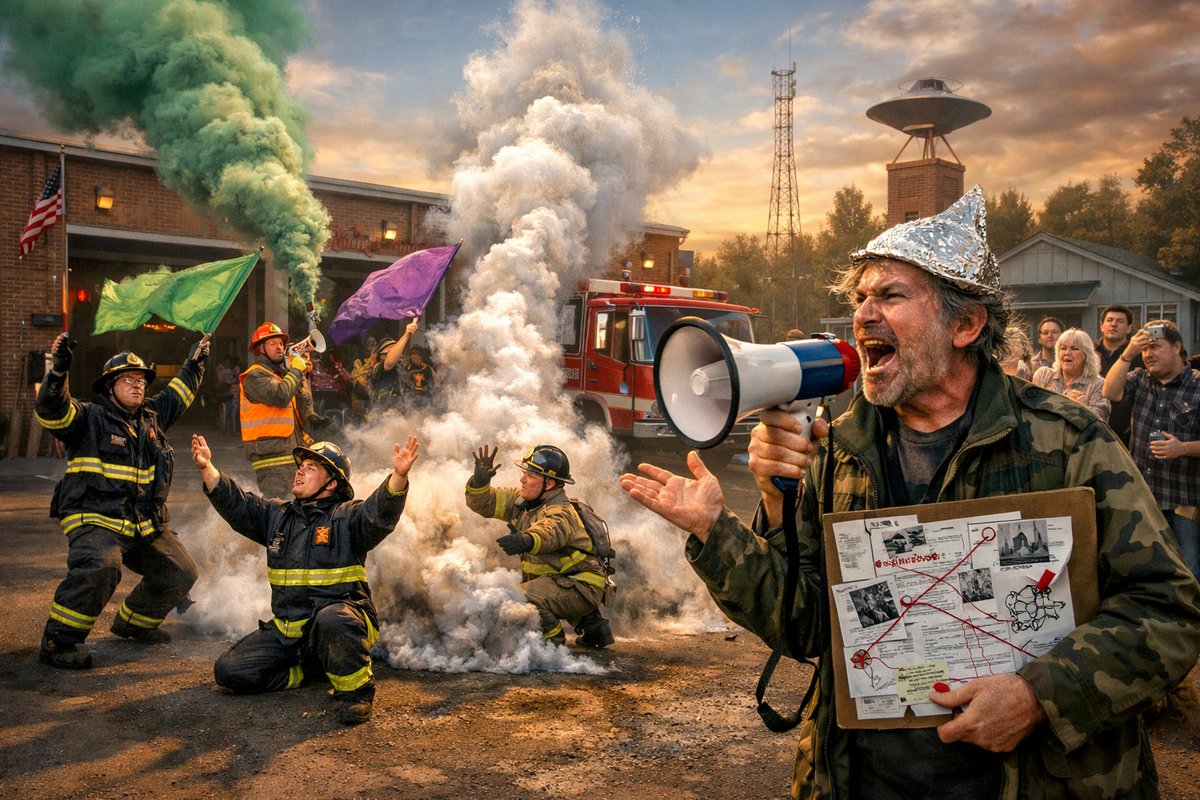

In an unprecedented move that residents describe as “hilariously alarming,” the Oakridge Volunteer Fire Department announced last month that it had invited Stanley “Truthseer” Barnes-an adamant conspiracy theorist and backyard UFO investigator-to design and lead its quarterly fire safety drill. The stated goal was to make emergency preparedness “engaging and eye-opening.” Instead, the experiment produced a series of theatrical catastrophes so absurd that nearby townsfolk still recount them with wide-eyed wonder.
Barnes, known locally for building homemade radio towers in his attic and decoding supposed secret messages in weather forecasts, arrived at the firehouse armed with a stack of yellowed notebooks, a collection of old megaphones, and a theatrical fog machine purchased online “for authentic smoke signals.” According to newly sworn-in Fire Chief Maribel Torres, the department had wanted to break free from stale procedures-dull evacuation routes, predictable alarm beeps, uninspiring exit signs. They believed a dose of unconventional thinking might shake the cobwebs from safety habits.
On the day of the first drill, community members gathered in the parking lot, clutching coffee and looking up at cherry-picker lights while firefighters in turnout gear eyed the fog machine warily. Barnes kicked off the proceedings with a ten-minute monologue, delivered through three separate megaphones, warning of “shadowy entities hiding in the embers of complacency.” His speech climaxed with a call for volunteers to don theatrical masks and reenact the “Ritual of the Everlasting Ember,” an interpretive dance meant to simulate the life cycle of a campfire.
Confusion rippled through the crowd when the smoke machine sputtered, then roared to life in bursts of purple and green haze. With fire trucks repositioned as stage props, masked volunteers flailed across parking stalls in slow motion, limbs outstretched as if warding off unseen cosmic forces. Dozens of parents shielded their children’s eyes while some teenagers livestreamed the spectacle, streaming overlays proclaiming “END OF DAYS DRILL.”
Moments later, a volunteer in a reflective cone-shaped hat blew a warning call on an antique brass horn, signaling the onset of a “Code Orange Eclipse.” Lights dimmed dramatically as Barnes instructed firefighters to form a ring around a lonely hydrant, chanting a creed about “unmasking institutional flames.” By the end of the chant, half the participants were drenched in overenthusiastic hoses, while others cowered behind the fire engine, convinced that the “institutional flames” had become self-aware.
Local businesses watched the spectacle from storefront windows. The bakery owner, alarmed by the color-shifting haze, closed shop early, fearing both contamination and a sudden shift in customer demographics toward extraterrestrial enthusiasts. Across the street, a coffee shop offered “Emergency Blend” lattes with whipped cream curlicues meant to mimic flickering flames. Even the municipal library reportedly checked out copies of old stage-production scripts, just in case the next drill required more dramatic flair.
By the third attempt to streamline the process-dubbed “Operation Ember Enlightenment”-traffic cones had been replaced with meditation cushions, while volunteer firefighters recited pre-drill affirmations about harnessing their inner phoenix. The fire chief, standing nearby, frequently consulted a tattered pamphlet titled The Subterranean Truth of Carbon Monoxide, wondering if any of it applied. Observers noted that one of the firefighters, mid-affirmation, muttered, “I just want to learn where exits are.”
Amid the chaos, a local building inspector approached the makeshift ring and quietly slipped a printed evacuation map into Barnes’s notebook. According to witnesses, Barnes peered at it suspiciously, muttered something about “urban planning conspiracies,” then tossed it into a box labeled “Top Secret: Flame Matrix.” The inspector shrugged and walked away, kicking at a stray roll of caution tape.
One ten-year-old resident, Emily, described the drill as “cool, but also terrifying.” She said she loved the colored smoke but got lost twice when the ring of dancers blocked her view of the nearest door. Her father, meanwhile, filed a complaint demanding that future drills include “something normal, like a siren.” Neighbors drafted a petition asking the firehouse to occasionally revert to the old beep-and-evacuate method, citing concerns over potential injuries from overenthusiastic hose sprays.
As the drills continued, the conspiracy theorist unveiled new features: cryptic banners emblazoned with the words “Extinguish the Invisible Government,” a segment in which participants decoded smoke symbols using a homemade UV flashlight, and a finale involving a papier-mâché phoenix that caught fire and promptly collapsed into soggy pulp. Fire Chief Torres finally halted the program after a volunteer sprained an ankle dancing between hoses and an elderly onlooker complained of respiratory distress from inhaling theatrical fog.
Seeking expert intervention, the department reached out to a nearby community college’s emergency preparedness program. A team of serious-minded instructors arrived, clipboard in hand, rummaging through Barnes’s props. They respectfully removed the fog machine, horn, and the so-called “Phoenix Effigy,” replacing them with standard-issue evacuation signs, battery-powered lights, and simple floor decals outlining exit routes.
Despite the department’s return to conventional drills, the conspiracy theorist’s influence lingers. Fire Chief Torres admits she secretly treasures her personal copy of the “Flame Matrix Cipher,” and occasionally experiments with color-changing smoke in controlled settings. The volunteer firefighters, having survived months of interpretive chaos, report heightened alertness-for if the next drill were ever to incorporate glow-in-the-dark hieroglyphs, they now feel prepared.
Community reaction remains split between nostalgic longing for the psychedelic haze of Code Orange Eclipse and relief that future evacuations will once again involve practical steps like “turn off the stove” rather than “chant at the ceremonial hydrant.” Local bloggers have coined the term “Emberpunk” to describe this fleeting subculture, predicting that in a few months, vintage footage of purple smoke drills will surface on video-sharing sites with captions like “Oakridge’s Forgotten Art Movement.”
Meanwhile, Barnes has moved on to his next project: redesigning the municipal water fluoridation schedule using sacred geometry diagrams. He’s already secured a permit to stage a downtown ritual involving synchronized Hula hooping around a fire hydrant. Fire Chief Torres, juggling scheduling conflicts, laughs nervously and prepares to enroll in conflict-resolution training-just in case the next safety protocol calls for “collective astral projection.”
Whether this marriage of performance art and public safety will inspire other towns or serve as a cautionary tale remains to be seen. What’s clear is that in Oakridge, fire drills will never feel the same-and that sometimes, the scariest blaze is the one fueled by human imagination.
Coda: Amidst the charred remains of the papier-mâché phoenix, someone nailed up a small handwritten sign: “In the ashes of absurdity, we learn to find real escape routes.” It’s unclear who wrote it, but on drill days, dozens of residents pause to read it-just before they sprint to the nearest exit.