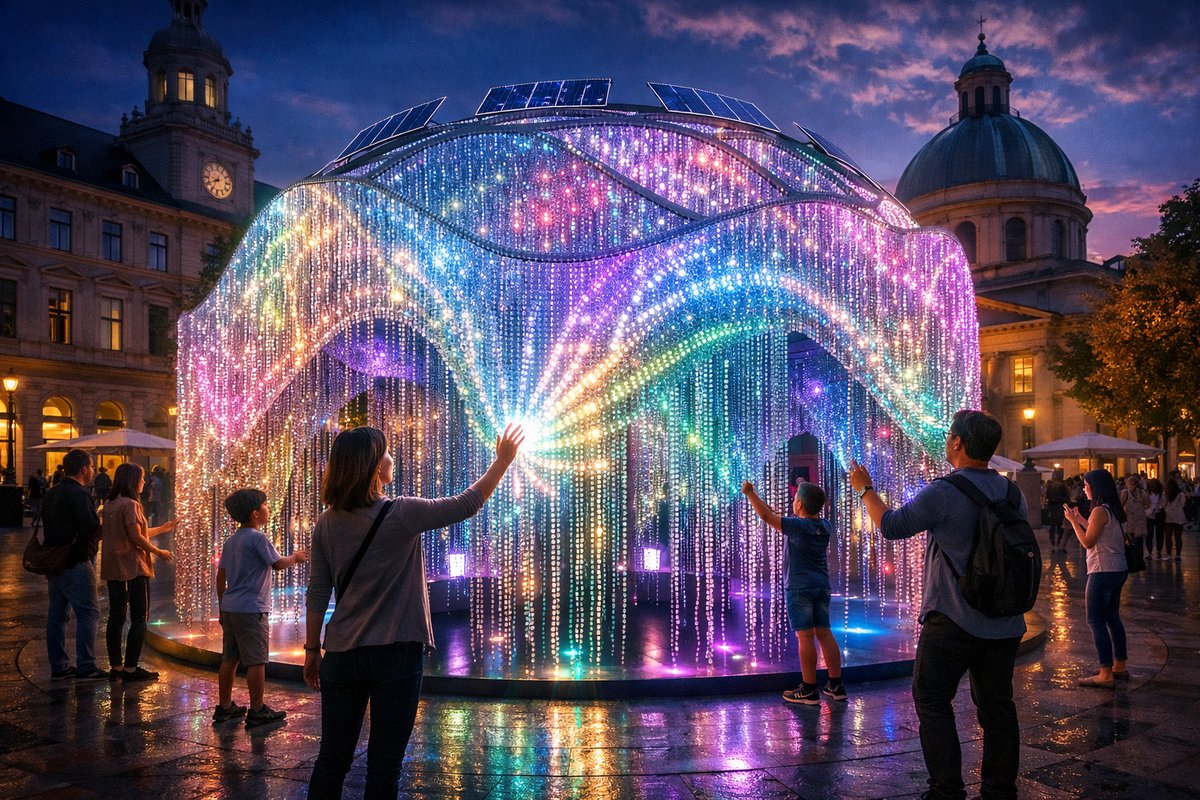

A sweeping glass-and-light tapestry has emerged in the heart of a bustling city plaza, inviting onlookers to become active collaborators in a luminous performance. Titled Glass Reverie, the installation combines thousands of repurposed glass beads, addressable LEDs, gesture sensors, and portable solar panels to create an ever-shifting matrix of color and form. Since its unveiling last week, the piece has drawn crowds of children, commuters, and tourists, all drawn in by the installation’s playful interactivity and sustainable ethos.
Conceived by an interdisciplinary collective of designers, engineers, and environmental advocates, Glass Reverie aims to redefine the boundaries between art, technology, and ecological responsibility. The structure itself is a 30-foot-wide framework of powder-coated steel cables strung with translucent glass beads sourced from post-industrial recycling facilities. Hidden within the framework, clusters of LED nodes pulse with life, their brightness modulated by motion and proximity sensors embedded at ground level. When visitors approach, steps and gestures trigger waves of light that cascade across the tapestry, forming ephemeral patterns that dissolve as quickly as they appear.
Behind the scenes, a network of gesture control modules translates human movement into digital commands. Infrared sensors detect the arc of a hand or the stomp of a foot, relaying this data to a microcontroller development board tucked inside a weatherproof enclosure. Custom software maps these inputs to predefined light sequences, but also incorporates machine-learning routines that adapt over time, prioritizing gestures that elicit the most vibrant responses. The result is an installation that feels alive, gradually learning the movement vocabulary of its audience and cultivating an ever-growing repertoire of visual expressions.
Sustainability sits at the core of Glass Reverie’s mission. Every glass bead was diverted from landfill streams, while the LED fixtures boast low-energy consumption and long lifespans. A set of portable solar panels draped over adjacent canopies harvest sunlight by day, charging a bank of high-capacity batteries that power the sculpture through the night. These components were chosen for their minimal environmental footprint and the ability to be repurposed for future projects, ensuring that no single element becomes obsolete.
Fabrication of the piece demanded meticulous planning and cross-disciplinary collaboration. During prototyping, the team tested multiple wiring schemes to achieve seamless integration between the LEDs and the glass beads without compromising structural integrity. Material engineers developed custom resin coatings to shield sensor connections from moisture, while textile specialists experimented with tension patterns in the steel cables to optimize light refraction through the beads. The final assembly process took place in a local makerspace, where volunteers helped thread beads and solder connections under the guidance of lead designers.
The plaza itself underwent a subtle transformation to host the installation. Concrete pavers were milled to embed sensor plates flush with the surface, ensuring that visitors can interact safely without tripping hazards. Cable pathways were routed beneath ground level, allowing maintenance crews to access the system without dismantling any visible components. At night, low-glare walkway lights ensure that the tapestry remains the star attraction, its diaphanous glow floating above a field of subtle ambient illumination.
Public reception has been enthusiastic. Families gather after work to experiment with new gestures; dancers choreograph short routines to test the installation’s dynamic feedback; and local artists sketch the ever-shifting patterns, inspired to develop their own multimedia projects. Nearby cafés report increased foot traffic as spectators linger longer, drawn by the communal energy radiating from the piece. City officials note that such interactive works have the potential to revitalize public spaces, fostering social connection and neighborhood pride.
Beyond its immediate setting, Glass Reverie signals a broader trend in contemporary public art: the convergence of tactile materials, sustainable practices, and responsive digital technologies. This hybrid approach reimagines the role of outdoor installations, shifting from passive monuments to living canvases that evolve with their environment. By opening a feedback loop between audience and artwork, designers spark curiosity and invite participants to reflect on the interplay between light, movement, and memory.
Educational programs have sprung up around the installation. Workshops for students explore the basics of gesture sensors and microcontroller programming, encouraging hands-on experimentation. Ecology seminars dovetail with tours of the solar array and recycling processes, highlighting how creative reuse can reduce waste. In partnership with local universities, the collective will host monthly hackathons where participants propose new interactive modules or software enhancements, ensuring that Glass Reverie continues to grow and adapt long after its initial debut.
Critics praise the piece not only for its technical ingenuity but also for its emotional resonance. The transparent glass beads catch the warm glow of sunset, evoking memories of stained-glass windows, yet the shifting pixels remind viewers of digital media’s fluidity. This duality of tradition and innovation prompts conversations about how communities can honor cultural heritage while embracing forward-looking design. The sculpture becomes a metaphor for collective memory-fragile yet resilient, anchored in place but constantly reinterpreted through individual experiences.
Looking ahead, the design collective plans to tour Glass Reverie to other cities, refining its components for diverse climates and cultural contexts. Future iterations may incorporate soundscapes triggered by environmental data or biometric inputs such as heart rate monitors, further deepening the dialogue between humans and their surroundings. The modular nature of the installation allows for quick assembly and disassembly, enabling pop-up experiences in festivals, museums, and temporary urban interventions.
For city planners and design professionals, Glass Reverie offers a compelling blueprint for next-generation public art. It demonstrates how compact electronics, sustainable materials, and open-source software can converge to create immersive experiences that resonate across age groups and cultural backgrounds. By prioritizing adaptability-both in technology and narrative-the installation remains agile, ready to respond to new insights or community-driven modifications.
At its core, Glass Reverie reminds us that public spaces can be more than thoroughfares and gathering spots; they can become interactive stages where art and daily life intersect. In an age often defined by screen-mediated interactions, the installation reclaims the physical realm, blending analog textures with digital flair. As the last rays of sunlight fade and the glass tapestry ignites in a cascade of color, visitors are invited to step forward, wave a hand, and witness how a single gesture can transform an entire cityscape.
In the weeks since its launch, Glass Reverie has proven that sustainable public art can be dynamic, inclusive, and deeply engaging. It stands as a testament to what happens when architects, environmentalists, technologists, and community members unite around a shared vision: to illuminate not just a plaza, but the creative potential of every passerby.
As cities worldwide seek new ways to foster civic engagement and celebrate collective imagination, installations like Glass Reverie offer a guiding light-one that shimmers with possibility and beckons us all to join the dance of light and form.