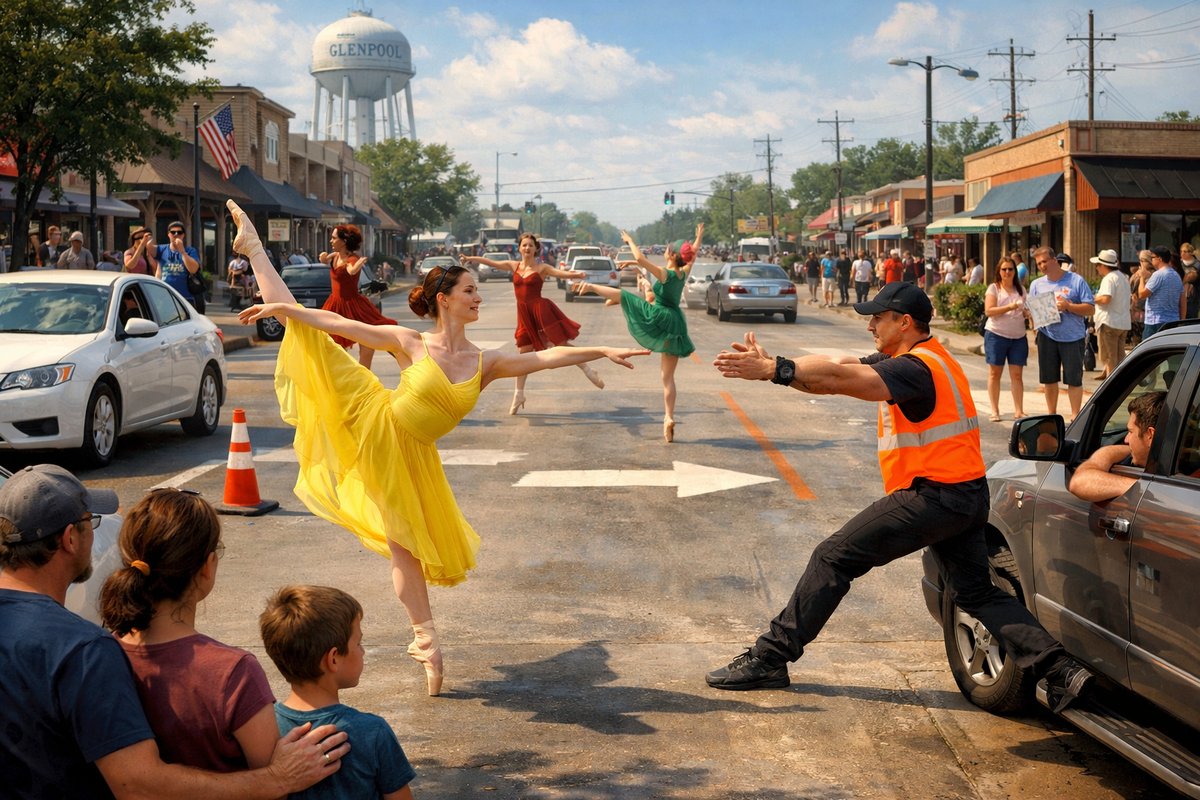

At dawn on a sleepy Thursday, drivers in Glenpool expected the usual rumble of coffee trucks and bleary commuters. Instead, they encountered a trio of high school dancers in neon tutus spinning and lunging in the middle of Main Street. Their mission: signal that the next left turn was imminent. The town council had voted 5-2 to replace all directional signs with interpretive dance performances, reasoning that “motion conveys meaning better than static metal.” Within hours, GPS voices nationwide registered their first existential crisis.
The idea emerged at last month’s budget meeting when Councilmember Patterson, fresh from a contemporary dance workshop, argued that civic direction lacked artistry. “People ignore speed limit signs,” she declared while demonstrating a grand jeté. “But no one can turn away from a perfectly executed arabesque.” The motion sailed through without debate, partly because the council chairs were distracted by popcorn being passed around by a local drama club.
Implementation required minimal bureaucracy and maximum jazz hands. Patterson appointed an official choreographer, who promptly drafted a 12-step dance manual for every traffic scenario: pointing waltzes for crosswalks, tap routines for speed bumps, and a dramatic solo for the dreaded four-way stop. The High School Dance Ensemble auditioned dozens of would-be performers, ultimately selecting troupes that combined enthusiastic flailing with an uncanny ability to hold defensive plies in gusty conditions.
The first morning of live dance signals triggered joy, confusion, and a minor fender-bender. Motorists stopped mid-interpretation to film pirouettes on their phones, while others executed impromptu U-turns after misreading a dramatic head tilt as a signal for a detour. One hapless delivery driver followed a dancer into a fountain, mistaking her dramatic backbend for the overflow indicator. Witnesses reported that at least one goose perched on the fountain’s edge, thoroughly unimpressed by the whole affair.
Pedestrians, once accustomed to boring crosswalk signs, now timed their sprints to a rhythm section of tap shoes. Local seniors formed walking groups to attend live performances, turning intersections into spectator stands. Coffee shops opened sidewalk cafés offering front-row seats. Someone even coined the term “dance lane etiquette,” sparking heated online debates over whether a triple-toe touch should count as a crosswalk clearance signal.
City hall quickly embraced the new cultural identity. Visitors received maps marking performance hotspots instead of landmarks, and local businesses advertised discounts for watching the 3 p.m. funnel-turn flourish outside the post office. Tour buses started parking two blocks away to allow tourists a leisurely stroll through the kinetic art gallery that was Glenpool’s streets.
But artistic ambition has its downsides. One afternoon, the choreographer introduced a complicated group lift to indicate a tunnel ahead. Twenty dancers attempted to hoist each other in unison just before a train passed beneath. The rumble sent the lift formation collapsing in a tower of flailing limbs, prompting a cascade of alarms and a momentary shutdown of the rail crossing. Critics labeled the stunt “unsafe performance art,” while supporters argued it was “logistically impressive given the acoustics.”
In the midst of growing tension, Gordon the crossing guard staged a one-man protest. Armed with a boom box and a vocal modulation device, he replaced the choreographers’ jazz hands with his own booming announcements. “Step left! Step left!” he bellowed like a sports commentator narrating a dance-off. His impromptu campaign for reinstating stop signs gained traction after officials discovered his decibels could be heard up to three blocks away.
Meanwhile, elderly dramatic arts enthusiasts seized the moment. Linda, a retired lifeguard turned flash-mob coordinator, taught a cardio dance class in the roundabout to signal a 360-degree loop. Participants spun like carousel horses as startled drivers circled in confusion. When asked if the new routine was safe, Linda replied, “Safety in numbers and rhythm-embrace the spin!”
The mayor entertained alternate proposals at an emergency session. Suggestions ranged from banjo solos at crosswalks to mime performances in the parking lot. At one point, a local improv troupe demanded that every bylaw be delivered in limerick form. After eight hours of spontaneous verse, the meeting dissolved into laughter, applause, and a unanimous vote to form a review committee made up of dance critics.
That committee’s report read like a modern-day manifesto: embrace live civic performance, but include safety nets of flashing lights and audio cues. Councilmember Patterson called it “the perfect pas de deux between artistry and public welfare.” However, not everyone agreed. A petition with two hundred signatures demanded the return of conventional signage. Submitted by drivers who reported spending more time learning choreography than focusing on the road, the petition argued that dance directives had turned morning commutes into interpretive art boot camp.
In a surprising twist, the town council compromised. They reinstated standard signs but reserved every third Thursday for a “Choreographed Commute.” Buses now announce upcoming moves with prerecorded beats, and commuters can opt in to free dance lessons held on the sidewalks. Enthusiasts can purchase season passes for front-row views and weekend masterclasses led by the original high school troupe.
Glenpool’s experiment remains a lesson in civic creativity. The town proved that public works need not be dull, and that a well-timed grand jeté can inspire community engagement-if you tolerate the occasional fountain dive. As for the GPS units, popular mapping apps recently issued an update promising interpretive dance translations as an optional feature. When asked about the irony, one developer quipped, “We just hope they don’t unionize.”
At last Thursday’s choreographed commute, a steady line of dancers performed a synchronized wave to signal a traffic circle. Onlookers cheered, drivers synced their step counts, and a lone GPS voice muttered in defeat: “At the next interpretive bridge, do a plié and proceed.” It seems technology can learn new moves-if only it remembers its place on the dance floor.