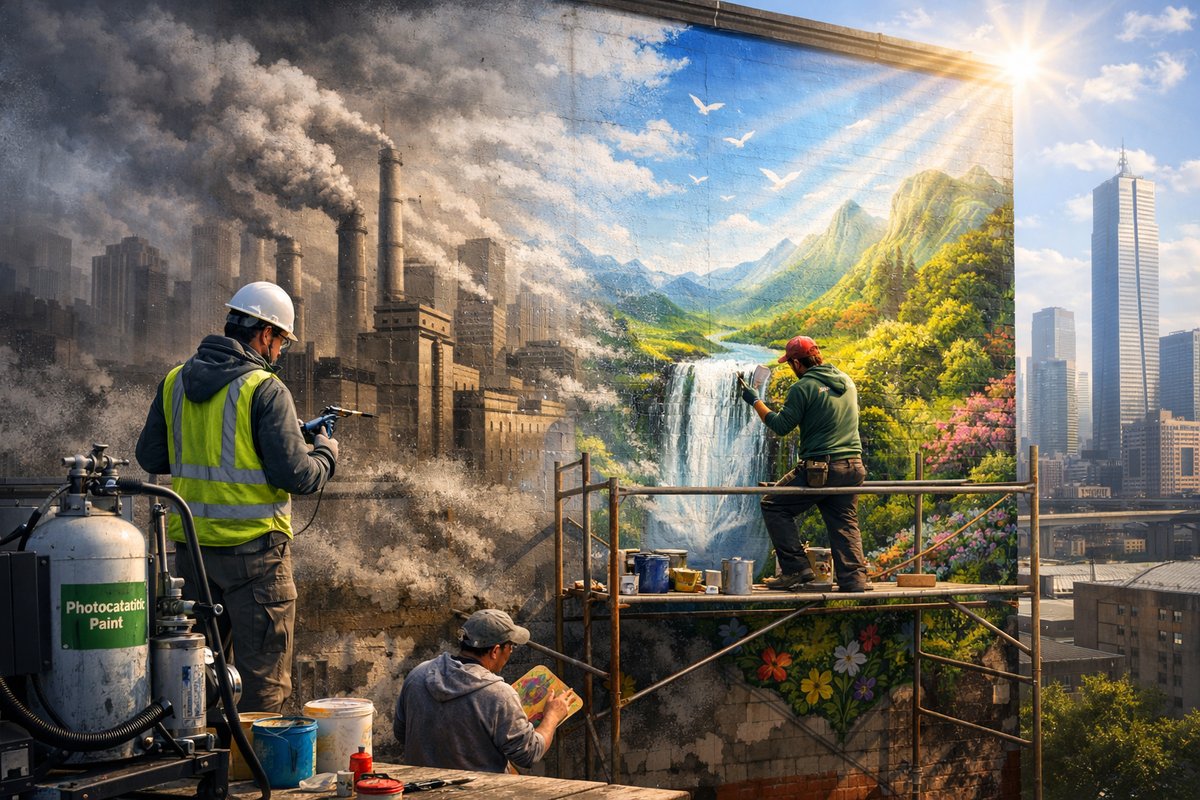

On a damp morning in Milan’s Navigli district, a sprawling mural glows faintly under soft overcast light. Painted with a pale, crystalline pigment, it looks at first glance like an elegant abstract-but it does much more than decorate. As scooters hum past and diesel buses hiss through narrow canalside boulevards, the mural’s surface is busily neutralizing nitrogen oxides and volatile organic compounds, converting them into harmless byproducts through the power of sunlight and a titanium dioxide catalyst.
This isn’t science fiction-it’s the emerging art of photocatalytic design. In recent years, a growing circle of artists, architects, and environmental engineers have begun harnessing cutting-edge coatings originally developed for self-cleaning windows and air-purifying facades. By turning giant wall murals into active pollution scrubbers, they are bridging aesthetic ambition with ecological necessity, proving that public art can serve a vital chemical function in addition to an emotional one.
One pioneering example is Beijing’s “Blue Heart,” which wraps a former industrial district in sweeping cobalt curves. As smog drifts in from the surrounding highways, the titanium-dioxide-infused paint splits pollutant molecules under UV light, transforming harmful compounds into water vapor and carbon dioxide. According to municipal data, the 500-square-meter mural removes roughly 3 kilograms of nitrogen dioxide from city air each day-almost as much as a small roadside grove of trees.
Meanwhile, in Los Angeles, the “Smog Eaters” project has enlisted local residents to help produce 150 square meters of photocatalytic panels installed on community centers and street furniture. Workshops taught participants how to mix the powder-coat pigments with specialized binders, emphasizing low-VOC formulas that align with the project’s sustainability pledge. As volunteers spray sections of exterior walls, they not only leave behind dynamic geometric patterns but also contribute directly to cleaner neighborhoods in the city’s most heavily trafficked districts.
Technically speaking, the magic lies in anatase-phase titanium dioxide, a mineral catalyst that gains oxidative power under ultraviolet radiation. When sunlight strikes the coating, electrons in the titanium-oxygen lattice become excited, generating reactive oxygen species that break down organic pollutants on the surface. Over time, the coating’s microporous structure even repels dust and grime, creating a self-cleaning effect that keeps the artwork looking fresh with minimal maintenance.
Though conceptually driven by environmental urgency, these murals also reflect an evolving philosophy of public space. In Lisbon’s riverside Cais do Sodré quarter, a recent installation named “Air Garden” weaves photocatalytic panels between living vines of climbing ivy. By combining biological and chemical processes, the artwork becomes a hybrid ecosystem, blending lush greenery with technological innovation. Passersby can feel the gentle breeze, admire bursts of emerald foliage, and know each inhalation is a bit cleaner thanks to the delicate green-and-white lattice overhead.
Such projects do more than reduce local smog-they inspire a new kind of civic stewardship. In Rotterdam, a citizen science initiative asked volunteers to measure air-quality readings before and after application of a series of pilot murals. Data collected via handheld monitors showed up to a 15 percent drop in particulate matter concentration within a 30-meter radius. Those numbers, relayed in real time on a public dashboard, sparked lively debate at community councils about expanding the program to schoolyards and bus shelters.
Of course, deploying photocatalytic art at scale presents challenges. The cost of specialized pigments and UV-resistant binders remains higher than conventional mural paints. Longevity can be compromised by heavy rain or abrasion from pollution particles themselves. And in cities with low UV exposure, the catalyst’s effectiveness dips unless supplemented by artificial lighting. Yet designers are already exploring hybrid solutions, such as embedding UV-LED strips into building cornices to boost nighttime activity, or combining photocatalytic coatings with hydrophobic layers that shed water and resist surface wear.
Artists are also experimenting with color palettes. Early photocatalytic paints were limited to stark whites and light grays, since darker pigments absorb heat and reduce catalyst efficiency. Now, innovative microencapsulation techniques allow for richer hues-pale blues that shimmer like glazed ceramics, soft greens that echo mossy stones, and even iridescent finches of violet that catch the eye without sacrificing air-cleaning power.
In Sao Paulo, a series of panels titled “Amazon Breathes” uses tinted photocatalytic paints to evoke rainforest canopies and river currents. The project’s vision is twofold: to symbolically reconnect urbanites with far-away ecosystems, and to abate the heavy smog trapped in the city bowl. Embedded sensors scatter across the installation, feeding data to a mobile app so residents can track how many micrograms of pollutants each square meter neutralizes. It’s part public art, part environmental dashboard, and part social experiment in collective responsibility.
Architects are beginning to integrate photocatalytic surfaces straight into building design. A cultural center in Tokyo opened this spring featuring an undulating façade clad in photocatalytic tiles. During peak hours, the exterior glows with sculptural shadows; at night, strategically placed near ultraviolet floodlights, the façade continues to combat tiny particulate emissions from nearby traffic. Inside, gallery walls echo the theme-close-up displays reveal cross-sections of photocatalyst particles and interactive exhibits invite visitors to wield handheld UV lamps against painted panels, watching as fluorescent dyes reveal pollutant pathways in real time.
As the field matures, public agencies are also taking notice. Grants from environmental trusts and sustainability funds are earmarked for pilot murals in school playgrounds and low-income housing blocks, where poor air quality often exacerbates respiratory conditions. For many community advocates, these colorful installations are more than an amenity-they’re a literal breath of fresh air for vulnerable populations.
Looking ahead, artists envision linking networks of pollution-eating canvases into sprawling citywide systems. Imagine corridors of treated façades guiding walkers along low-smog routes, or bus-stop panels paired with green roofs that trap heat while scrubbing exhaust. In festival settings, ephemeral installations might bloom overnight on temporary walls, leaving behind cleaner footprints than any single eco-intervention could achieve.
It’s worth pausing to reflect on how this convergence of art, chemistry, and civic design rewrites the role of public art in the 21st century. No longer confined to mere decoration or commemoration, walls and buildings become active participants in urban health. By inviting citizens to witness-and in some cases wield-the invisible chemistry unfolding on painted surfaces, these projects kindle wonder even as they yield measurable benefits.
From Milan’s canals to São Paulo’s avenues, photocatalytic art is reminding us that creative expression holds power beyond pure aesthetics. It can repair, cleanse, and protect. In an age of escalating environmental pressures, this fusion of pigment and science offers a hopeful vision: a cityscape not just made for us, but one that quietly labors on our behalf, scrubbing the air we share and transforming pollution into a palette for progress.
If pollution-eating murals are the vanguard of a new urban design philosophy, then the next frontier might be dynamic surfaces that react to changing weather patterns or integrate living elements like photosynthetic microalgae. Yet even now, hand-applied coats of titanium dioxide and UV light suffice to prove a simple truth: art can do more than move us. Sometimes, it can save us.