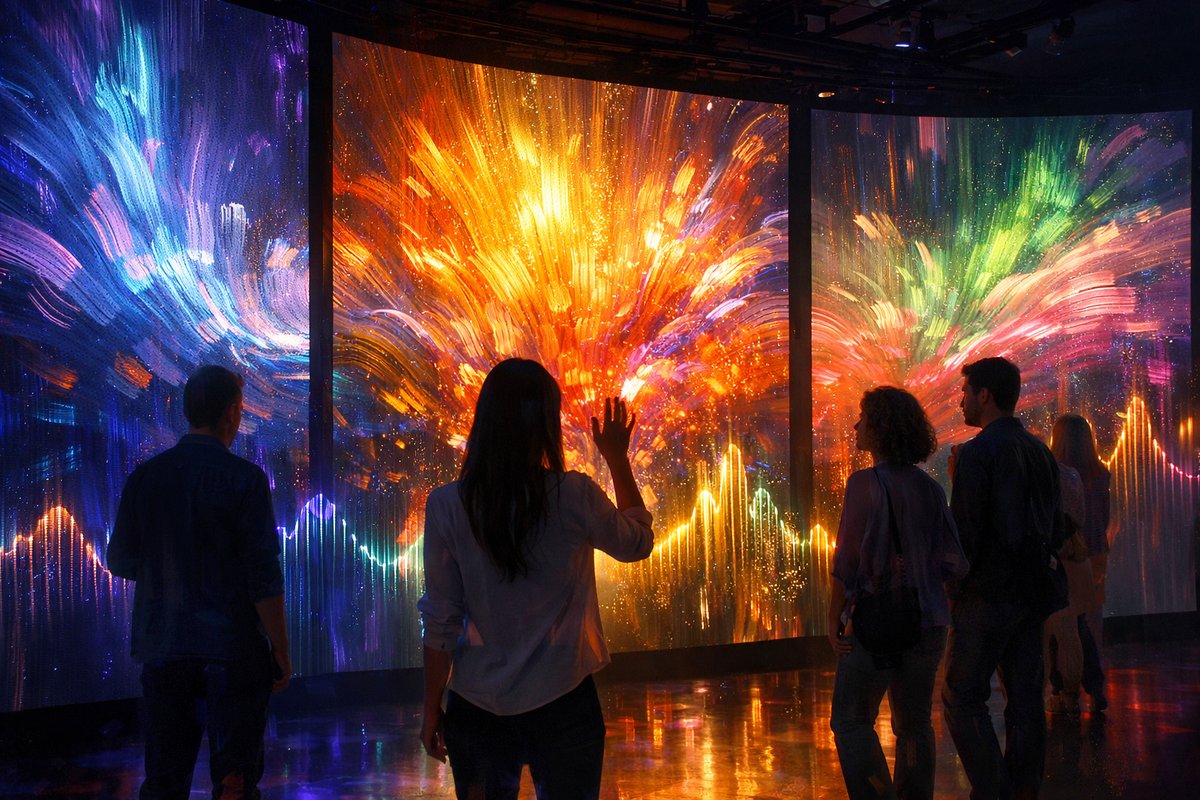

In a converted industrial loft, an ensemble of paintings has taken on a life of its own. Under the banner EchoCanvas, artists and engineers have collaborated to embed tiny microphones and light sensors beneath traditional canvases. As soon as someone steps inside the installation, every whisper, footstep, and ambient murmur is translated into cascading waves of color. The effect is part concert, part gallery, part experimental soundscape: a tapestry in flux that seems to breathe with the collective presence of its visitors.
EchoCanvas builds on a growing trend in multisensory art, where sight and sound intertwine beyond conventional audiovisual pairings. While projection mapping has long brought static architecture to life, and kinetic sculptures respond to wind and heat, this project flips the script by making the painting itself the stage. Each brushstroke now feels like an instrument string, vibrating when tapped by changes in sound pressure. The result is an evolving tapestry that subverts the boundaries between visual art, performance, and communal experience.
At the heart of the installation are off-the-shelf microcontroller boards programmed with custom signal-processing algorithms. Each canvas features a matrix of MEMS microphones, connected to simple analog-to-digital converters, that feed real-time data to tiny LED clusters woven behind the painted surface. As sound frequencies fluctuate, hidden circuits translate them into color values-warm reds and oranges for bass rumbles, cool blues and greens for higher pitches. Visitors see colors bloom and fade like flowers opening and closing in response to acoustic cues.
The artists behind EchoCanvas deliberately chose components that emphasize sustainability and accessibility. The canvases themselves are recycled organic cotton salvaged from local textile mills. Non-toxic pigments made from earth minerals and discarded ceramic waste provide the painted surfaces. Rather than relying on proprietary electronics, the team used open-source hardware platforms and 3D-printed sensor mounts crafted from biodegradable polylactic acid. Their goal was to demonstrate that high-impact interactive works can be built at modest cost and with minimal environmental footprint.
“We wanted to tap into the emotional resonance of sound without alienating traditional art-goers,” explains one co-creator. “By combining familiar materials-canvas, paint, light-with simple electronics, we invite curiosity rather than intimidation. People lean in, whisper, even test the boundaries with laughter or clapping, and then step back to watch the living painting respond. It becomes a form of dialogue.”
The underlying software employs basic Fourier transforms to break down incoming audio into amplitude maps across frequency bands. A central control hub calibrates each canvas so that soft tones trigger gentle glows, while louder bursts send ripples across the surface. These patterns are randomized within set palettes, ensuring that no two responses ever look the same. Over time, the installation accumulates a visual diary of the space’s sonic history, gently shifting toward pastel pinks or deep indigos depending on the building’s sound profile.
One of the most popular features is a free-form workshop tucked into a side alcove. Visitors can record short samples of their own singing or beatboxing, then watch as those audio snippets loop and layer across multiple canvases. This collaborative jam session blurs the line between creator and observer: people who arrived just to view the art soon find themselves co-authors of living murals. What begins as individual musical sketches transforms into a collective composition of light and pigment.
Beyond its gallery debut, EchoCanvas has found new life in public spaces. A portable version recently appeared in a renovated transit hub, where commuters’ passing footsteps and distant announcements became a kinetic symphony of color along concourse walls. Another variant tested in a hospital waiting area used calm, acoustic-responsive color schemes to soothe nerves and foster moments of respite. In every context, the core idea remains: to spark curiosity and harness emotional intelligence by letting environments speak through visual form.
Critics have noted that EchoCanvas aligns with broader shifts in urban design and public art. As cities look for ways to humanize sterile concrete plazas, technology-driven installations offer flexible, data-inspired experiences. By recycling materials and tapping everyday sounds-traffic hum, laughter, conversation-this project points toward a future where art adapts to its ecological and social context rather than imposing static monuments.
Some designers envision taking the concept further with remote livestreaming, allowing distant audiences to contribute sounds that animate canvases across the globe. Imagine a pair of sister installations-one in a coastal city, another inland-each feeding off the audio signature of the other. Low-frequency ocean swells from one locale might be visualized as glowing aquamarine waves thousands of miles away. Conversely, city street chatter could animate subtle coral hues on a canvas far from urban chaos.
Educational institutions are already exploring EchoCanvas as a hands-on STEAM tool. Students learn signal processing by building their own sensor arrays, experiment with color theory through programmable LED modules, and gain insight into sustainable sourcing when sourcing recycled fabrics and pigments. The open-source documentation invites remix culture, encouraging makerspaces to adapt the concept for theater backdrops, retail displays, or even interactive textbooks that breathe with student voices.
In a time when screens often mediate our interactions, EchoCanvas offers a tactile, human-centered alternative. It reframes painting not as a static window into an artist’s mind, but as a living organism that shares its pulse with anyone willing to be heard. For those who step across the threshold, the installation becomes a reminder that art and technology need not compete-they can co-compose new languages of wonder and connection.
As the last light shifts from warm sunset amber to deep midnight violet, visitors leave with more than a memory of images; they carry an echo of shared moments, audible only to the heart. EchoCanvas invites us all to speak in color, to listen in light, and to discover that every whisper has the power to paint a new horizon.