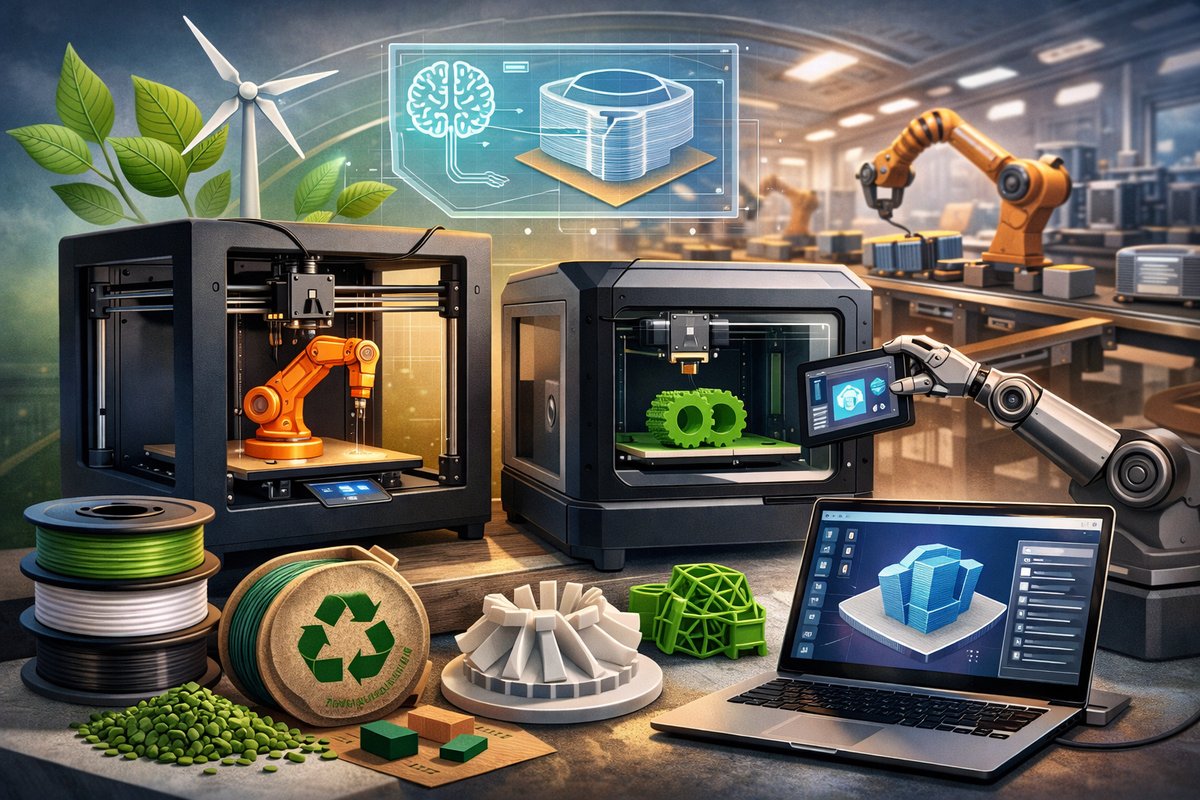

The quiet revolution of 3D printing begins with a single layer. What started as a niche prototyping tool has matured into a versatile manufacturing method embraced by hobbyists, engineers, medical professionals, and artists. Yet affordability and reliability remain critical challenges. New hardware architectures, material chemistries, and process innovations are converging to make additive manufacturing not only more accessible but also more repeatable and cost-conscious.
Across desktop and industrial machines, manufacturers are focusing on modularity. Swappable extruder heads now let users shift from thermoplastic filament to paste-based materials in minutes. Linear guide rails and CoreXY kinematics deliver faster movements without sacrificing precision, while enclosed chambers maintain stable temperatures for consistent warping-free prints. Open-source firmware upgrades, once the domain of tinkerers, are now formally supported on economically priced models, enabling automated bed leveling, remote monitoring, and customizable print profiles.
Hobbyists on a budget can build capable printers for under a few hundred dollars by sourcing standard rails, stepper motors, and electronics kits. Preconfigured control boards with silent drivers reduce noise while retaining torque. Many community-driven firmware distributions offer fine-tuned acceleration and jerk settings, cutting print times by up to 20 percent without blurring details. Users share optimized e-steps and PID values for popular filament types, reducing trial-and-error runs and material waste.
Material innovation has unlocked fresh cost savings. Beyond traditional PLA and ABS plastics, new composite filaments blend ground wood fiber, metal powders, or carbon fiber strands, delivering novel aesthetics and improved stiffness. Bio-based PLA variants derived from agricultural wastes or algae reduce feedstock costs and environmental impact. Even more radical: recycled PET from water bottles can be converted into filament at home using small-scale granulators and extruders, turning discarded packaging into usable material.
Advancements in resin printing mirror the filament world. Low-viscosity photopolymer blends cure in seconds under LED arrays, trimming layer times and reducing energy consumption. Multi-resin vat systems allow automated swapping between flexible, rigid, or castable resins mid-print. Resin recycling stations collect wash fluid, filter out uncured particles, and replenish photoinitiators, cutting waste by over 50 percent.
Software tools now shoulder more of the heavy lifting. AI-powered slicing engines analyze part geometry to generate topology-aware infill patterns that save up to 30 percent on filament without compromising strength. Automatic support generation algorithms place breakaway structures only where needed, minimizing post-processing time and resin consumption. Real-time print monitoring apps use computer vision to detect layer shifts or nozzle blockages, pausing the printer and alerting the user before hours of printing go to waste.
Workflow orchestration has also become leaner. Makers can queue multiple designs in a single build volume, nesting parts to maximize print bed usage. Batch print servers handle slicer settings per project, then distribute G-code to a farm of connected printers. Cloud integrations let teams in different time zones upload STL files, check estimated material usage, and schedule overnight prints for local pickup-all without stepping into the workshop.
Calibration and maintenance play a growing role in yield improvement. Affordable digital calipers and dial test indicators help users verify extrusion widths, layer heights, and feature tolerances down to fractions of a millimeter. Automated nozzle-cleaning routines and quick-release hotend assemblies minimize downtime. For resin setups, replaceable film vats and LED modules keep UV exposure consistent over hundreds of hours.
In production environments, predictive maintenance systems monitor motor currents, bed temperatures, and optical sensors to forecast part quality drift. When deviations cross thresholds, the system triggers self-tests-probing bed flatness, extruder gear slippage, or layer adhesion strength-and applies corrective firmware adjustments. These closed-loop controls shrink scrap rates and enhance first-pass success.
Real-world success stories illuminate the new economics of additive manufacturing. A small design studio cut prototype costs by 60 percent using recycled PETG filament and batch-printing fixtures. A dental lab now churns out custom surgical guides overnight by combining desktop resin printers with automated wash and cure stations. Even a group of educators assembled a dozen reliable FDM machines using open hardware designs, supplying local schools with affordable fabrication labs that fuel student creativity.
Despite all this progress, the heart of 3D printing remains playful experimentation. Makers swap filament blends to achieve marble-like veining or embedded glow powders for night-time illumination. Artists cast metal parts from 3D-printed ceramic molds, producing sculptures once too complex to carve. Engineers prototype wind-tunnel models in hours, iterating shapes that reduce drag on drones and electric vehicles.
Yet as accessibility broadens, sustainability emerges as the next frontier. Closed-loop recycling systems for both plastic and resin, printable compostable materials, and solar-powered print farms promise to shrink additive manufacturing’s environmental footprint. Community efforts to catalog recyclable hardware designs, share repair guides, and publish eco-impact data help align the maker movement with circular economy principles.
Layer by layer, the barriers to entry fall. Affordable hardware kits, AI-driven software, and green materials converge to make 3D printing more feasible than ever. As designs flow seamlessly from screen to solid object, new possibilities arise in education, healthcare, art, and small-scale production. The revolution truly begins with that first thin strand of molten or cured polymer.
Cultivating curiosity, respecting the planet, and leveraging open collaboration will be key to the next decade of additive innovation. Whether you’re building your first delta-style printer from a parts kit or scaling up a startup’s custom tooling operation, the tools and techniques are at your fingertips. Embrace the layered craft-because the next breakthrough may be just one print away.