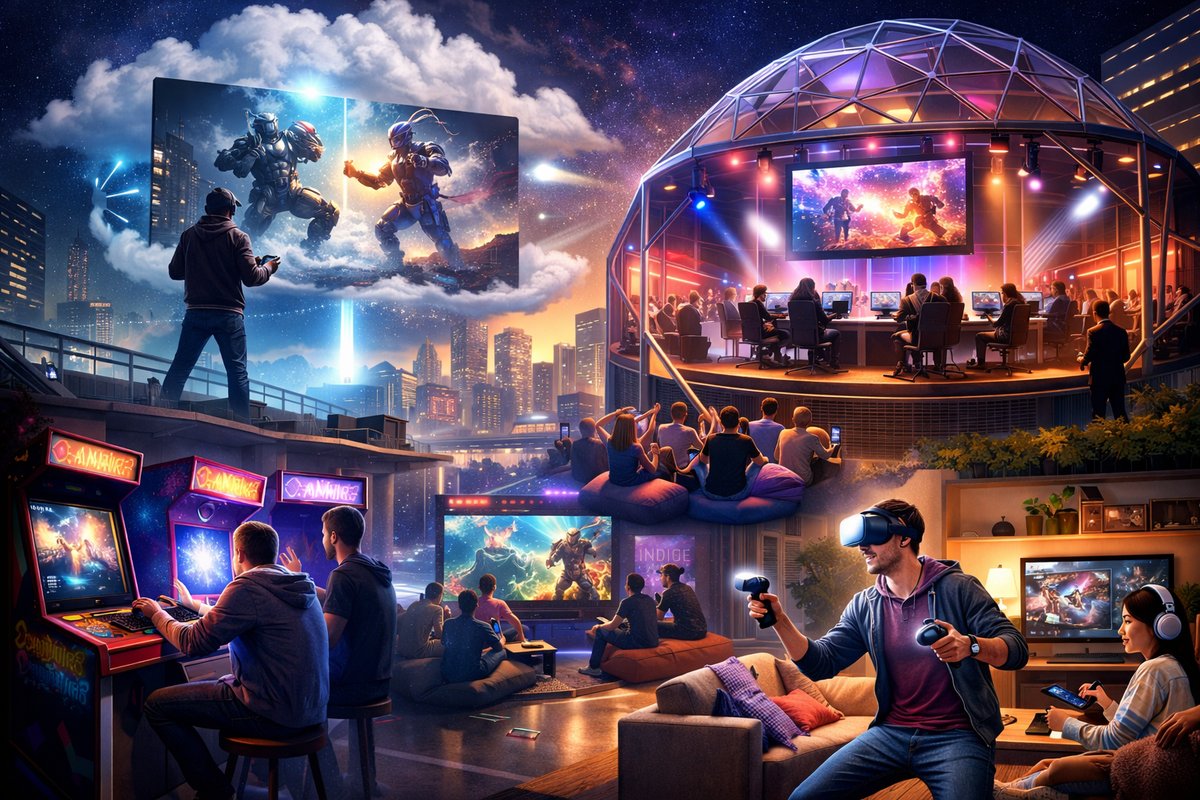

In the past few months, the gaming world has witnessed a flurry of innovations that extend far beyond the screen. Players are now wielding cloud-streamed titles on mobile devices, gathering in pop-up micro-arcades to test experimental hardware, and turning their living rooms into modular play hubs. As studios, hardware makers and event organizers race to break new ground, one thing is clear: adaptability has become the currency of modern play.
A recent report from a global networking analytics firm shows that cloud gaming subscriptions have surpassed ten million worldwide, up 35 percent year-over-year. This surge has coincided with the rollout of affordable high-speed internet in suburban and rural regions, widening access to AAA libraries on demand. Titles that once required specialized consoles now stream seamlessly to laptops, tablets and even handheld devices, bringing high-fidelity graphics to unexpected corners of the globe.
At the same time, the DIY ethos long associated with indie developers has spilled over into hardware. In New York, an open-source collective unveiled a prototype of a modular play station that snaps together like building blocks, letting users mix and match controller types, audio modules and display panels. The initial public demo drew crowds of gamers curious about swapping a classic joystick for a motion-sensing wand, or docking a detachable touchscreen that doubles as a secondary display for chats, maps and strategy guides.
Public venues have also embraced the new wave. In April, a micro-festival in Chicago dedicated itself entirely to cross-platform challenges: participants rotated through cloud-hosted rally races, local network-linked brawlers and experimental VR skirmishes. The festival’s organizers say it was the first time such a wide array of networked play formats shared the same floor. Attendees reported switching mid-match from a smartphone dock to a standing PC rig, stretching the definition of what a “tournament” could be.
Meanwhile, community meetups are taking shape online. A growing number of Discord-style channels now integrate voice-driven moderation bots and immersive spatial audio plugins, simulating the acoustics of real halls. Gamers report that these virtual lounges feel more like casual living-room gatherings than static chat rooms. Instead of a flat voice channel, players slip in and out of private conversations by simply moving their virtual avatars closer or farther from one another-an effect once exclusive to high-end VR suites.
Back at home, hybrid play setups are evolving into full-blown furniture lines. Modular shelving racks now come with integrated cable management, headphone stands, and mounting brackets for cameras and mics. Beneath LED light strips sits a magnetized rail system designed for sticky-back storage of small controllers, keycaps and earbuds. The goal: reduce clutter while keeping every accessory within reach for seamless roleplay sessions, speedruns or co-op raids.
Audio technology deserves its own spotlight. Spatial sound drivers, once confined to flagship headsets, are now offered as software packs for budget devices. Gamers using stereo earbuds report a dramatic improvement in positional awareness during competitive shooters and multiplayer exploration titles. The result is an uncanny sense that opponents or allies are actually moving behind or beside you, even through a pair of sub-$50 buds.
On the content side, narrative-driven titles continue to blur the lines between gaming and film. Some studios have released branching short films with interactive cues that let viewers temporarily take control of a character’s decisions. These experiments, delivered over streaming rental platforms, invite audiences to switch perspectives mid-story-evoking the choose-your-own-adventure books of yesteryear but with live-action footage and dynamic soundtracks.
Yet it’s not just about headsets and high-polygons. A surprising resurgence of tabletop gaming has emerged in tandem with the digital renaissance. Online storefronts offering print-and-play kits have seen a 42 percent uptick in orders, catering to players keen on crafting their own cards, dice and tokens. Enthusiasts are mixing 3D-printed miniatures with augmented reality overlays on phones, so that a painted figurine can trigger digital effects onscreen-flames, fog, or even animated expressions-bringing static board games into a hybrid realm.
Indie developers are leveraging all these threads to craft playful experiments. At a recent showcase, small teams demoed AI-assisted dungeon masters that generate encounters in real time, responding to voice commands and dynamically adjusting difficulty. Another booth featured a co-op puzzle game where each participant’s controller feeds data into an AI mediator that subtly shifts a shared environment-tilting platforms, shifting hazards, and unlocking hidden pathways tailored to group performance.
Sustainability has crawled into the conversation as well. Some pop-up arcades are outfitting rolling gaming pods with solar-powered batteries, allowing them to travel between parks and community centers with virtually zero carbon footprint. Others plan to test e-waste recycling stations on site, giving players the chance to drop off old cables, controllers and headsets for proper processing.
All of these advances point to a broader cultural shift: gaming is shedding its solitary stereotype and embracing adaptability at every level. Whether you’re chasing leaderboards on a cloud stream, hosting a hybrid tabletop session, or building your own modular setup at home, the emphasis is now on experiences that bend to players’ needs and social rhythms.
Looking ahead, the next frontier is likely to involve deeper integrations between physical and digital play. Expect more accessories that translate real-world gestures into in-game actions, or home furniture that doubles as a motion-tracking rig. We may even see collaborative story engines that let entire neighborhoods shape ongoing narratives through communal challenges or city-wide scavenger hunts.
Ultimately, the question is no longer which console or platform you choose-it’s how you tailor the experience to your own world. In this era of adaptive play, the game adapts to you, wherever you decide to play.
Eyes to the horizon, it’s clear that the line between gamer and designer, player and producer, is fading. As setups become more modular and experiences more fluid, everyone gets a chance to reimagine what a game can be-and that, more than any polygon count or frame-rate number, may be the most exciting evolution of all.