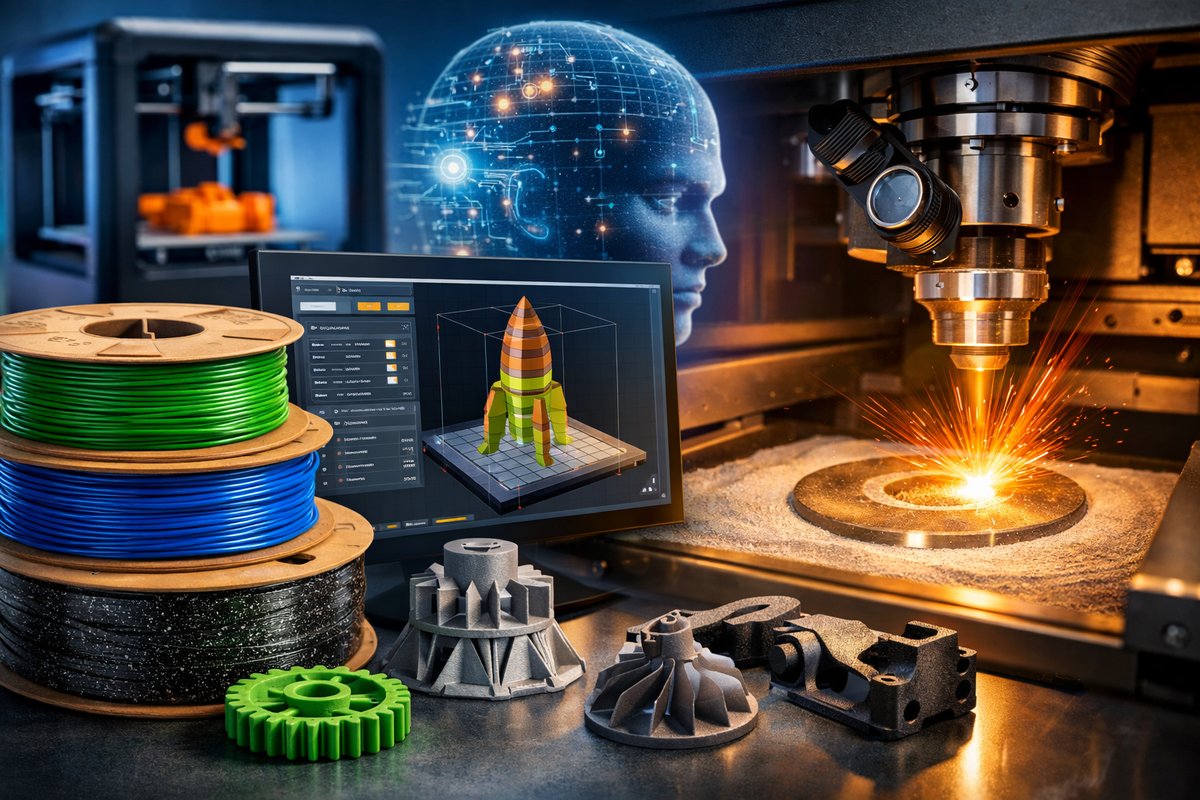

The art of additive manufacturing continues to reshape how ideas become tangible objects. From desktop garage workshops to professional labs, imaginative designs are built layer by layer. Modern 3D printers blend precision, speed, and cost efficiency in ways that were unthinkable a decade ago. Rapid prototyping has turned into rapid production for custom tools, functional parts, and artistic sculptures. As machines shrink costs and improve quality, the real revolution lies not only in what can be printed but how accessible the entire pipeline has become. This democratization of making invites hobbyists, educators, and engineers to collaborate on breakthroughs that bridge the virtual and physical worlds through layer by layer craftsmanship. Whether experimenting with a simple keychain or fabricating a custom prosthetic component, each project benefits from advances in hardware, software, and materials. Collaborative online communities and open source tools have driven cycles of innovation where printers learn from printers and designs share best practices. This coevolution of ecosystem and economy is creating an environment where living surfaces, wearable robots, and precision medical models all emerge from the same fundamental process. It all starts with a single layer of melting plastic, cured resin, or fused powder, weaving together imagination and engineering with every pass of the nozzle or laser.
Latest desktop FDM machines often use CoreXY kinematics combined with belt tensioners and hardened linear rails to deliver tighter tolerances. High torque direct drive extruders handle flexible and abrasive filaments with equal ease while dual gear systems maintain flow consistency at high speeds. Automatic bed leveling sensors like piezoelectric pads and inductive probes eliminate manual calibration, shrinking setup time to minutes. Modular nozzles supporting quick swaps between standard brass, hardened steel, and ruby tips offer resistance to wear and allow experimentation with composite materials. Some systems incorporate filament runout detection and power loss recovery so long prints can resume even after outages. Enclosures with thermal control and air filtration enable printing with high temperature materials like polycarbonate and nylon. Affordable sensor packages monitor extruder pressure and feed rates in real time, flagging anomalies before they become failed prints. Even at budget price points under a few hundred dollars, these advanced features ensure reliability and repeatability in low volume manufacturing.
On the software side, slicing engines have embraced artificial intelligence and machine learning to optimize print paths dynamically. Adaptive infill algorithms adjust density based on predicted stress points, reducing material usage while preserving structural integrity. Layer height modulation techniques automatically vary layer thickness to smooth curves and fine details without sacrificing print speed. Tree support structures and dissolved interface layers minimize waste and simplify post-processing, cutting cleanup time by up to half compared to standard block supports. Cloud based slicing platforms allow collaborative editing and version control, enabling teams to refine complex assemblies in real time. Open file formats and API integrations let custom scripts automate tasks like orientation optimization and toolpath balancing, accelerating the journey from design to finished object.
Material innovation continues to expand the palette of printable options. Recycled PLA and PETG filaments derived from post-consumer waste now rival virgin resins for consistency and strength, shrinking carbon footprints without hiking costs. Composite blends infused with wood fibers, metal powders, or conductive additives push the boundaries of texture and functionality. Bio based resins formulated from plant oils offer renewable alternatives for UV cured prints while biodegradable PHA materials gradually degrade after use. Specialty filaments such as carbon fiber reinforced nylon achieve stiffness comparable to aluminum alloys at a fraction of the weight. These breakthroughs make it economically feasible to explore prototypes with mechanical properties tuned for specific applications, from drone frames to robotic grippers.
In resin based printing, masked stereolithography (MSLA) and digital light processing (DLP) systems are moving beyond hobbyist status into high throughput production. Advanced UV LED arrays combined with pixel shifting techniques boost XY resolution to microscopic scales, capturing intricate lattice structures in minutes. Low viscosity resins tuned for rapid cure cycles reduce layer times and improve interlayer adhesion. Reusable resin vat liners made from durable polymers resist project cracking and eliminate frequent replacement. Dynamic exposure control extends service life of light sources by adjusting intensity per layer based on print geometry. Paired with efficient rinse and cure stations, these developments streamline post processing workflows and shrink turnaround from model to finished part.
Powder bed fusion techniques like selective laser sintering (SLS) are stepping down from industrial floors to desktop labs as new low power fiber lasers and precise powder recoating systems enter the market. Binder jetting for polymers and metals, once confined to large service bureaus, now finds prototypes in startup garages thanks to compact pneumatic powder delivery systems. Metal powders pre-alloyed for improved flowability reduce clumping and power requirements, enabling small scale direct metal laser sintering (DMLS) for stainless steel and aluminum. Hybrid machines combining milling and laser sintering produce parts with tight tolerances, eliminating separate machining steps. By reclaiming unused powder and recycling build supports, shops can achieve near zero waste at smaller batch volumes.
End to end digitization of the printing process accelerates iteration cycles and elevates quality control. Internet of Things sensors embedded in extruders and build chambers log temperature, humidity, and vibration data for every print. Cloud connectivity provides remote monitoring and automated alerts, allowing makers to intervene before a build goes off track. Integration with open source electronics and microcontrollers lets users script custom calibration routines, triggering error correction routines on the fly. Some platforms even incorporate machine vision to inspect layers in real time, pausing or adjusting prints when anomalies appear. This growing ecosystem of smart tools turns hobbyist printers into intelligent manufacturing cells capable of unattended operation.
Sustainability practices are reaching new maturity, moving beyond recycled filament spools to closed loop ecosystems. Filament recyclers grind failed prints and convert them back into new spools, cutting raw material costs by over 30 percent. Solvent recovery systems capture and purify used isopropyl alcohol from resin washes, reducing chemical waste and expense. Community tool libraries and maker spaces share high end machines and bulk materials, lowering the barrier for single users to access professional grade equipment. Some local hubs even host swap events where users trade surplus filament and resin by the pound, fostering circular economies around shared digital inventories and material stocks. These collaborative models are pioneering low cost manufacturing with near zero environmental impact.
Real world applications highlight the impact of these cost cutting and efficiency boosting strategies. A home based jeweller now uses high resolution resin prints to create molds for castings, reducing material waste and manual carving time. A small robotics startup leverages filament composites to produce end effector grippers that withstand repeated use while keeping prototype budgets in check. Dental labs print patient specific surgical guides overnight using bio compliant resins, slashing lead times from days to hours. Education programs integrate affordable desktop SLS printers to teach students design for additive manufacturing, equipping a new generation with practical skills. Even artists use multi material setups to combine translucent and rigid elements in kinetic sculptures, transforming conceptual ideas into tactile experiences.
Looking forward, on demand manufacturing powered by distributed networks of printers promises to shrink supply chains and localize production. Multi material heads capable of mixing filaments or resins in flight will enable gradient properties within a single build. Large format systems with automated material exchanges will print entire furniture pieces or architectural models in one go. Digital twins driving closed loop feedback between virtual designs and their physical counterparts will refine performance through real time data. As hardware, software, and materials co converge, 3D printing is poised to become an integral part of sustainable, flexible, and personalized manufacturing across industries and at every scale. The quiet revolution of making continues, one layer at a time.