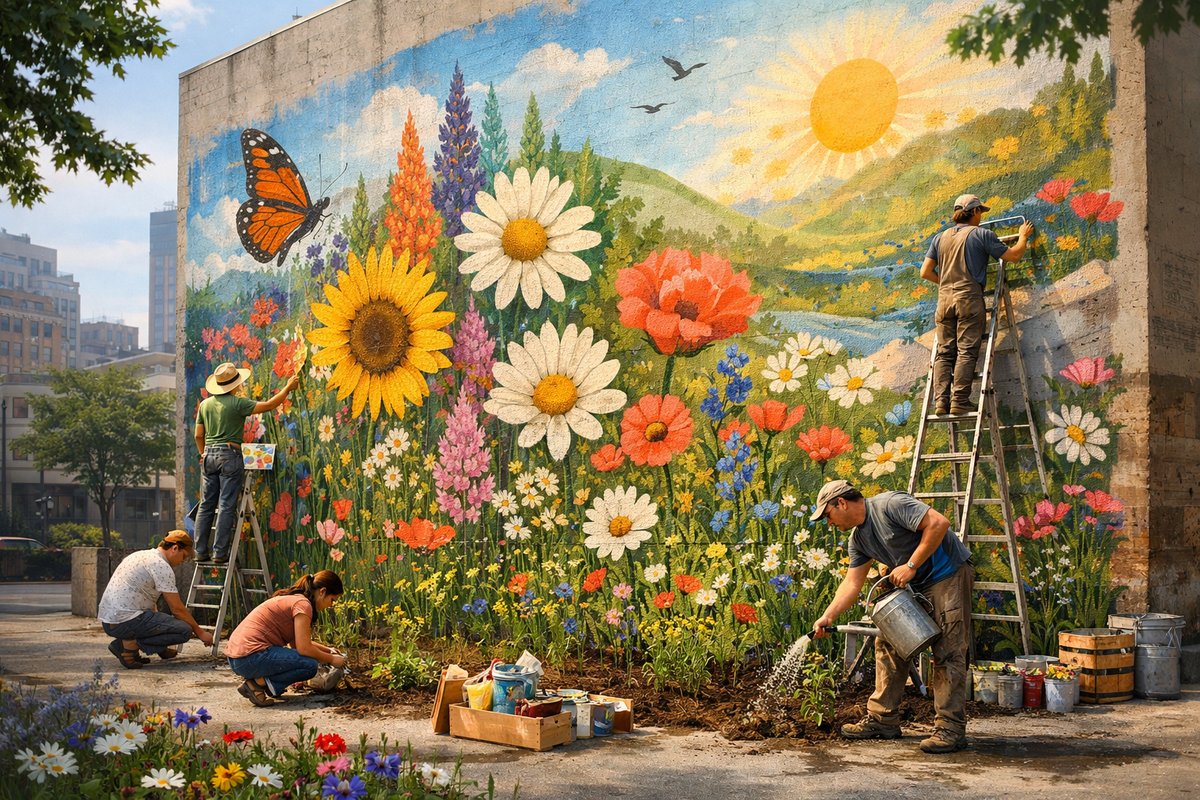

When an artist’s brushstroke carries the promise of wildflower blooms, public space shifts into a catalyst for ecological renewal. In several cities around the globe, collectives of painters, gardeners, and environmental activists have launched a movement centered on murals crafted from seed-infused paint. The pigments contain wildflower seeds, microbe-rich carriers, and sustainable binders. As rain seeps into the wall’s porous surface, seeds germinate in cracks and crevices, turning once-monochrome façades into patchworks of living greenery.
The genesis of seed-based mural projects often begins during community workshops, where volunteers learn to mix paint bases with curated seed blends. Common combinations include native meadow flowers, pollinator-friendly blooms, and resilient ground covers. Instead of conventional acrylic binders, participants work with biodegradable gels derived from algae or plant starches. These binders hold seeds in place long enough to allow adhesion but gradually decompose under natural moisture, freeing the seeds to take root.
One pilot project launched last spring on the exterior wall of a former warehouse, now repurposed as a youth center. The mural’s design illustrates local flora-poppies, daisies, and clover-rendered in vibrant greens and yellows. After painting, organizers applied a thin layer of porous plaster loaded with extra seed packets, effectively turning the building into a vertical seed bank. Residents reported spotting green shoots within two weeks of seasonal rains, and within eight weeks, the wall bustled with tiny blooms.
Environmentally minded city councils are beginning to take notice. By integrating seed-based murals into revitalization plans, urban planners hope to enhance biodiversity corridors between parks. Rather than vast green belts or costly rooftop gardens, a network of seed-activated walls can create stepping stones for pollinators across dense neighborhoods. Early results show increased bee and butterfly activity near test sites, suggesting these art-ecology collaborations can support urban ecosystems.
The process requires some technical know-how, especially when adapting traditional paint recipes for seed compatibility. Artists must balance pigment intensity with seed viability: too much UV-resistant additive can damage delicate embryos, while overly dense color loads may block sunlight. Trial-and-error led several studios to adopt low-heat drying techniques and natural clay extenders, preserving seed life and ensuring adhesion on rough masonry.
In one case study documented by the Journal of Applied Ecology, researchers tracked germination rates on experimental walls in a temperate climate. Blue lupine and black-eyed Susan seeds achieved up to 60 percent sprout success, outperforming test plots in garden beds. Scientists attribute this resilience to the protective microenvironment within the paint’s gel matrix, which retains moisture and shields seeds from overheating on sunlit façades.
Beyond technical outcomes, the human story has resonated powerfully. In neighborhoods with limited green space, children have been invited to collect sprouted seedlings and plant them in window boxes. Local gardeners maintain QR codes embedded in murals, linking passersby to tutorials on seed harvesting and planting. Word of mouth spread rapidly via social media, inspiring other cities to host seed-paint festivals and mural swaps.
“The idea that art can grow itself and give back is deeply inspiring,” says one muralist, who prefers to remain anonymous to keep the focus on collective impact. “We’re blurring boundaries between canvas and soil, artist and gardener. When someone pulls up a tiny rosette of clover from the wall, they feel a sense of ownership over that moment of life.”
At a recent urban art symposium, design firms presented prototypes for biodegradable spray bottles filled with pre-mixed seed paint. These handheld dispensers allow artists to tag abandoned buildings with bursts of living color, while waste canisters flush back into compost streams. Attendees speculated about integrating sensors that signal optimal germination windows based on humidity and temperature, further optimizing the sprouting process.
Critics caution that seed-based public art must address potential downsides, including the risk of introducing invasive species or uneven germination that leaves unsightly patches. To mitigate these issues, project crews collaborate with ecologists to select regionally appropriate seed varieties and frequently monitor test sites. When germination fails, volunteers replace seed bursts with alternative designs or refill the bio-gel mix.
In regions prone to drought, artists experiment with xeriscape seed mixes-drought-tolerant grasses and succulents that can sprout in minimal moisture. Combined with light-reflective pigment formulations, these murals can reduce building heat absorption and soothe urban heat islands. Some architects envision façades that switch between decorative art and living vegetation, responding to seasonal rainfall patterns.
The movement also raises philosophical questions about permanence in public art. Traditional murals can endure for years; seed-based works evolve, fade, and sometimes disappear entirely as plants complete their life cycles. For some, this ephemerality underscores a profound truth: art, like nature, is transient and ever-changing. Digital archives and time-lapse videos preserve each mural’s lifecycle, while seed packets ensure its story can be retold elsewhere.
Looking ahead, partnerships between community centers, universities, and nonprofit groups aim to scale seed-painted installations across highways and transit stations. A consortium of horticulturalists is developing region-specific starter kits, containing local seed varieties, mixing guides, and application tools. Such kits promise to democratize access to living art, allowing anyone with a roller and a bucket to sow blooms on concrete canvases.
For those intrigued by hands-on experimentation, workshops are popping up at design schools and makerspaces. Participants can try mixing pigments, test sprouting rates under grow lights, and refine techniques for long-lasting adhesion. As the practice gains traction, a new generation of eco-artisans may emerge, skilled in both aesthetics and environmental stewardship.
By turning walls into seed banks and paint into soil, this movement reimagines public art as a participatory act of cultivation. More than murals, these creations function as living reminders that creativity and ecology can grow hand in hand. When an urban canvas bursts into bloom, it suggests that beauty and biodiversity need not exist in separate realms-they can flourish on the same surface, one brushstroke at a time.