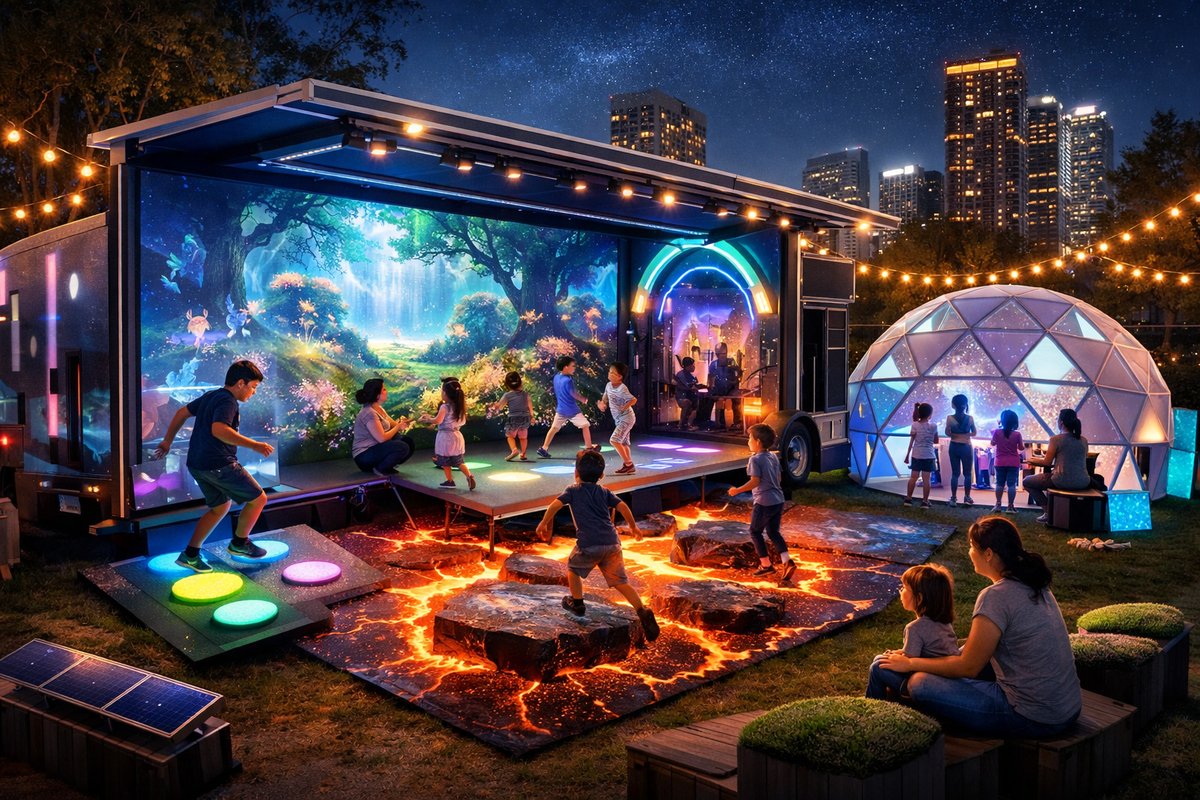

A diesel-green retrofitted van rumbles into a town square just after dawn. Panels unfold like petals, revealing a modular stage where projections dance across recycled wood walls. Families gather around picnic tables under fabric canopies, curious about the interactive puzzles that materialize on the surface of a custom game table. This is no ordinary pop-up arcade. It’s the latest entry in a wave of mobile immersive gaming platforms that are redefining the boundaries between digital and physical play.
Behind the wheel of this wheeled wonder sits a small team of designers and technologists who believe play is serious business. They’ve welded together augmented reality projectors, haptic sensors and biodata interfaces to craft experiences that adapt in real time to players’ decisions. One minute you’re navigating a haunted mansion rendered in ambient sound and light; the next you’re commanding a fleet of pixelated drones in a cooperative tower defense challenge. Every element of the setup-from the stage floor’s pressure sensors to the LED-lit seating pods-has been optimized for intuitive interaction and slick transitions.
The project’s founder first sketched out the concept at a community hackathon focused on urban revitalization. She saw abandoned parking lots and empty storefronts as blank canvases for collaborative storytelling. By equipping a vehicle with off-grid power and modular walls, her team could bring high-end gaming experiences directly to neighborhoods often overlooked by larger entertainment venues. Instead of waiting for local theaters or arcades to update their offerings, residents can host a session in their own backyard, schoolyard or town plaza.
At the heart of each deployment is a multi-node projection system that features low-latency tracking. The tech stack includes short-throw projectors that cast images onto nearly any flat or curved surface, motion sensors that detect gestures even under bright afternoon light, and small battery units powered by portable solar panels. When dusk arrives, a second set of full-color LED spots and a cloud-based sound mixer transform the site into a 360-degree playground. Players speak to in-game avatars through spatial audio, immersing themselves in worlds that respond to their voices and body movements.
Sustainability was a key design principle from day one. The entire rig runs on renewable energy whenever possible. Solar panels mounted on the roof feed into a bank of deep-cycle batteries, and energy-efficient LEDs cut power consumption during evening shows. Materials come from local recyclers; flooring is made from reclaimed gym mats, while seating benches are crafted from refurbished shipping pallets. Even the tents that shield gear from rain are composed of repurposed awning fabric.
When the team rolled into a small coastal town eager to combat off-season tourism doldrums, they partnered with local artisans to host a seaside mystery adventure. Players solved riddles embedded in augmented reality murals painted by residents, then unlocked a treasure chest hidden behind driftwood sculptures. In an industrial suburb, they staged a cooperative spaceship bridge simulation using handcrafted station consoles and directional sound pods. Each story adapts to the unique character of its host community.
Such events often spark lasting collaborations. A handful of volunteers might learn the projection mapping workflow and go on to host their own micro-festivals. Schools integrate the mobile arena into STEAM curricula, combining coding lessons with hands-on design workshops. Library branches book afternoon meetups where seniors and teens team up to explore generative art installations. All the while, feedback loops feed performance data into the next software update, ensuring new modules feel fresh and responsive.
Bringing this vision to life hasn’t been without challenges. Logistics can be a headache when narrow roads and historic districts limit van access. Weatherproofing sensitive electronics requires constant tinkering, especially during sudden downpours. And maintaining players’ privacy is critical-facial recognition is explicitly disabled, and biometric data stays encrypted onsite, never stored in the cloud. Yet the team’s commitment to transparency has earned trust in each community they visit.
Looking ahead, the roadmap points toward even more adaptive storytelling. Developers are building AI-driven narrator bots that read players’ emotions and recalibrate difficulty on the fly. Integration with next-generation 5G networks promises near-instantaneous content downloads and multiplayer sync across city blocks. Virtual reality headsets could join the mix, offering optional deep-dive sessions for those craving full sensory immersion. Through partnerships with local cultural institutions, future tours may feature original museum-quality exhibits reimagined as playable narratives.
For curious players and community organizers alike, getting involved is straightforward. Interested groups can book a slot online or reach out via social channels to request a neighborhood activation. Most setups require only a flat area of under an acre and a power hookup for supplementary gear. Mobile support crews train host teams on basics like scene switching and crowd facilitation. Local sponsors often chip in refreshments or venue space, fostering a sense of collective ownership.
This mobile platform’s success speaks to a larger trend: people crave shared experiences that blend physical presence with digital magic. In an era of screens and isolation, rolling gaming showcases offer a fresh antidote-one where spectators become co-creators and public spaces transform into living playgrounds. As the line between devices and reality blurs further, the age-old thrill of exploration returns in pixelated, solar-charged glory.
The next time you spot a van covered in circuit-pattern decals pulling into your town square, don’t just snap a photo. Step inside. Put on a pair of AR goggles, take a seat at the communal deck and prepare to level up more than just your avatar. You’ll leave with new skills, new friends and the sense that the future of play is already rolling your way.