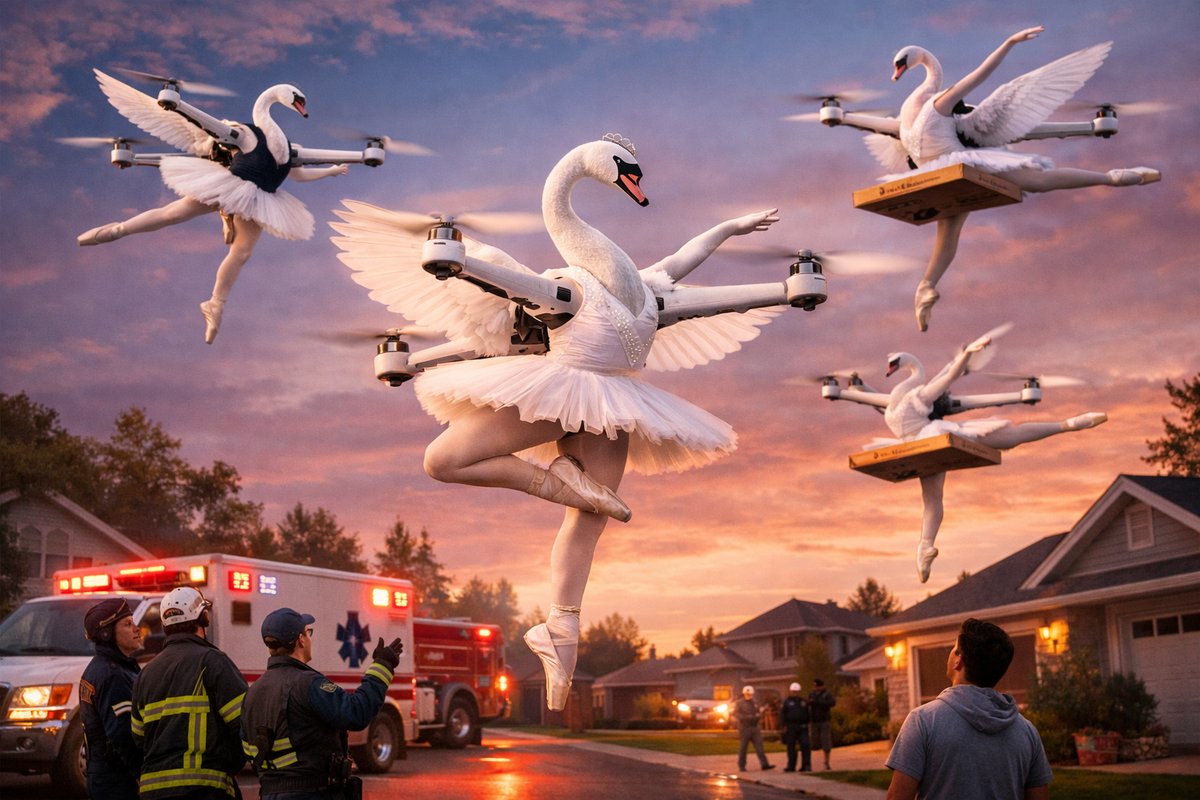

In a move equal parts visionary and vertigo-inducing, the town council passed Ordinance 42B, stipulating that all commercial drone deliveries must incorporate a thirty-second ballet sequence before landing. Advocates hailed the measure as a groundbreaking fusion of STEM and the arts, while skeptics wondered how many pepperonis would arrive cold if a drone’s rotors became entangled in a grand jeté.
It began on a quiet Tuesday morning when the baker at the corner café looked skyward just as a diminutive quadcopter unfurled mechanical wings, ascending into a graceful arabesque. Flour dusted the street below as the drone hovered in mid-air, its blinking LEDs choreographed to an imaginary orchestra. Neighbors paused their routines to witness the spectacle of drones performing a coordinated pas de deux above freshly baked croissants. Social media feeds exploded with short clips under the hashtag #DroneDance, and before long, the council’s arts commission revealed that covert auditions had already been held for “talented” delivery drones.
Within hours of the ordinance taking effect, logistics companies scrambled to retrofit their fleets. Some added lightweight tulle skirts and rechargeable LED spotlights. Others integrated gyroscopic stabilizers programmed to detect pirouette angles and ensure the final plié didn’t crush a smartphone on the porch. One enterprising pet supply store even advertised “Ballet-Ready Hamster Wheels” to test a drone’s dexterity-an accessory that prompted animal-welfare advocates to insist the wheel remain firmly on the ground.
Local pizza joints were the first to feel the pressure. One chef reported his large pepperoni being delivered via drone that paused mid-flight to assemble a miniature stage before launching into Swan Lake’s climactic act. By the time the pizza arrived, tomatoes had slid off the slices, and melted cheese registered a lukewarm temperature. The disappointed customer, however, gave a standing ovation-though the applause was muffled by the council’s edict that spontaneous performances must remain acoustic, without traditional speakers.
Emergency services soon discovered unexpected hurdles. Med-Evac drones ferrying insulin vials were now expected to stop, strike a pose, and execute a grand jeté. Firefighters raising alarms about potential house fires found themselves composing interpretive dances on command. Paramedics pleaded for exemptions, citing that life-saving shipments shouldn’t waltz between health crises. The council responded by commissioning a “Solemn Corps de Ballet” training program for first-responder drones, to be taught by retired ballet masters who once choreographed for touring companies.
Despite the operational chaos, a surprising cultural renaissance emerged. Community centers saw skyrocketing enrollments in beginner ballet classes, as backyard drone pilots sought to synchronize their bodies with buzzing machines. A local jazz trio started hosting “Drone and Jazz Night,” where drones performed classical ballet movements to improvised saxophone solos. One senior center even formed a “Crotchety Critics Club,” inviting eight octogenarians to review each drone’s performance for technical merit and emotional impact.
Not everyone embraced the new era of aerial artistry. The downtown coffee shop’s Wi-Fi bandwidth dropped sharply under the weight of live-streamed drone dance recitals. A frustrated group of remote workers staged a nocturnal sit-in, holding protest signs that read “Batteries Not Ballet” and “Keep the Drones on Task.” Tensions peaked when a delivery drone, caught up in an extended fouetté, spiraled out of control and crashed into the mayor’s office fountain mid-meeting. The mayor emerged wet, tutu-clad, holding a soggy tablet with a half-rendered Uzumaki spiral pattern stuck in its rotors.
In response to public outcry, the council convened a 24-hour “Flight and Dance Integration Symposium,” inviting town planners, ballet impresarios, drone engineers, and a local mime (who refused to comment verbally). After a marathon session of interpretive brainstorming and silhouette sketching on flip charts, they produced a staggering 78 policy recommendations-ranging from “Minimum Single Rotation Balance Test” to “Optional Tap Dance Interlude” for specialty deliveries. The final communiqué declared that any drone performing a triple pirouette must carry no more than a single envelope, and that drones used for medical emergencies were permitted a dignified bow instead of a full fouetté.
Meanwhile, the supply chain buckled under the new demand for tutu fabric and programmable thrusters. Small businesses launched pop-up shops selling miniature coin-operated barres for drone warm-ups, while local seamstresses struggled to keep up with orders for ruffled drone tutus in kaleidoscopic shades. The chamber of commerce issued guidelines for “tutu-friendly” loading docks, complete with handrails and padded floors to prevent rotor burns.
As the novelty settled into routine, the community discovered unexpected upsides. Neighbors shared rooftop vantage points, forging impromptu viewing parties complete with sparkling cider and drone-themed cakes. A children’s hospital reported that pediatric patients could no longer suffer from drone-related anxiety once they realized each courier might deliver both medication and a gentle arabesque above their window. Tourism brochures quickly rebranded the town as a global destination for “Aerial Performing Arts,” capturing the imaginations of travelers seeking both efficiency and entertainment.
In one poetic moment that captured the heart of the municipality, a grandmother who lived alone received her weekly grocery order via drone. As the drone hovered over her garden, it executed a delicate grate into relevé, paused for a dignified bow, and then lowered her shopping bag with impeccable grace. Tears welled in her eyes as she realized that in a single gesture, municipal bureaucracy, technology, and high art had conspired to transform a mundane chore into something unexpectedly tender.
Yet for every triumphant bow there remained a stumble. Trash-collection drones, once immune to the ballet requirement, now petitioned to join the performance circuit, citing artistic freedom. Citizens discovered that stray yoga mats in parks were no longer random but strategically placed for wayward drones to practice pliés. And just when the council thought it had achieved equilibrium, whispers spread of a secret plan to introduce hip-hop to aerial deliveries, complete with drone breakdance contests scheduled for the summer festival.
The saga of drones in tutus has turned municipal governance into a stage, where every ordinance feels like a curtain call and every citizen a potential critic. Whether this soaring blend of bureaucracy and ballet will endure remains uncertain, but one thing is clear: in this town, even the most ordinary service has been elevated-quite literally-to a performance of civic imagination. And somewhere above the rooftops, drones continue to pirouette, searching for their next landing spot and the applause that follows.
As city hall prepares to draft its next audacious policy-rumors suggest “Underwater Mime for Sewage Treatment”-residents wait with bated breath to see if their next package will arrive on time or in the midst of a pirouetting spectacle. After all, in a world where democracy demands drama, the sky’s the limit-just watch out for flying tutus.