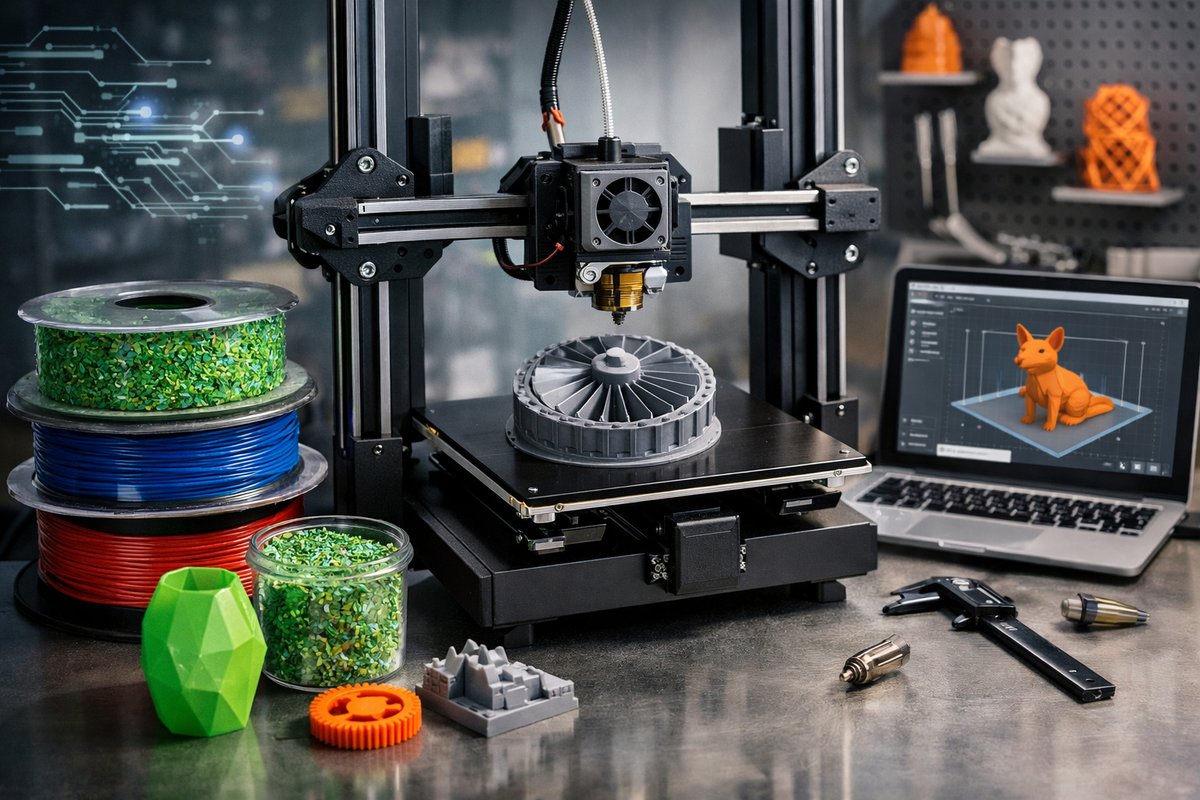

What once felt like science fiction-the ability to turn a digital sketch into a sturdy plastic prototype with the press of a button-has become a mainstream hobby and a professional tool. Yet the journey from concept to completed print still poses challenges: high material costs, finicky calibration, and unpredictable failure rates can discourage newcomers and frustrate seasoned makers. Today’s 3D printing scene, however, is witnessing a quiet revolution. Breakthroughs in economical materials, streamlined hardware, and intelligent slicing techniques are making the technology more accessible, reliable, and environmentally conscious. Whether you’re crafting intricate miniatures or engineering custom parts, these innovations turn every layer into a leap forward.
One of the biggest drivers of affordability is the emergence of recycled and bio-based filaments. Traditional thermoplastics like PLA, ABS, and PETG have long dominated the desktop scene, but variant grades infused with recycled plastic or plant-derived polymers now offer similar strength at lower environmental impact. Some filament makers collect post-industrial plastic waste-shaving scraps from packaging facilities-and reprocess it into fresh spools. Others combine cornstarch or sugarcane ethanol with PLA to create filaments that biodegrade faster after disposal. The result: dozens of cost-effective material options that maintain consistent diameter and extrusion behavior while reducing the carbon footprint of each print.
Beyond raw materials, innovations in filament production are lowering prices. Automated monitoring systems now measure diameter fluctuations in real time, rejecting any section that drifts out of tolerance. This precision reduces wasted filament and ensures reliable layer adhesion, which in turn means fewer failed prints. Some manufacturers even employ closed-loop feedback where a laser micrometer continually checks filament thickness as it cools, adjusting tension on the extruder to maintain perfect roundness. For makers, this translates into more predictable prints and less time spent troubleshooting under-extrusion or nozzle jams.
On the hardware side, modular hot ends and quick-swap extruder heads are simplifying maintenance and improving print quality. Instead of dismantling the entire assembly to clear a clog or change nozzle size, users can pop out a cartridge-style nozzle unit in seconds. This plug-and-play approach reduces downtime and eliminates the risk of misaligned heat blocks. Paired with all-metal hot ends that tolerate higher nozzle temperatures, makers can explore specialty filaments-carbon-fiber-reinforced blends, flexible elastomers, or high-temperature engineering polymers-without investing in a dedicated pro-grade machine.
Meanwhile, advances in bed adhesion strategies are making first layers more dependable. Innovations like reusable magnetic build surfaces, textured glass plates, and bio-adhesive solutions ensure that prints stick firmly without requiring complicated glue mixtures or tape. Some magnetic beds feature dual-sided sheets: one side is a fine-grit texture for PLA and PETG, while the other offers a slick finish for TPU or nylon. After cooling, the flexible plate can be peeled away like a sticker, releasing the part without prying tools. These systems not only protect delicate prints but also extend the life of the build surface.
Resin-based 3D printing has similarly benefited from cost-saving strides. Low-power LED light sources and fast-curing photopolymers now rival the speed of industrial stereolithography machines at a fraction of the price. Formulations infused with recycled plastic powder are emerging, cutting material costs by up to 30 percent. Additionally, gravity-driven vats with self-leveling silicone membranes reduce resin wastage by coating only the area directly beneath the build plate. Such design tweaks let small studios and jewelry designers access ultra-fine details without committing to large volumes of expensive resin.
Equally important is the integration of intelligent slicing software that optimizes print time and material use. Modern slicers analyze geometry and automatically introduce internal lattice structures-like gyroids or foam-inspired infills-that maximize stiffness while minimizing filament consumption. Adaptive layer height features further refine the process: thicker layers in low-detail regions speed up printing, while thinner layers preserve sharp edges and fine texture in critical zones. Some cloud-based platforms automate this entire workflow, delivering ready-to-print G-code profiles tailored to specific printers and filaments with a single click.
Complementing these software tools are predictive failure algorithms. By monitoring extrusion pressure, filament retraction patterns, and acoustic signals from stepper motors, advanced firmware can detect the early stages of a clog or layer shift. When anomalies arise, the printer can pause and alert the user or even attempt a self-cleaning routine. This real-time oversight slashes the likelihood of mid-print disasters that waste hours of machine time and material.
Open-source communities remain the beating heart of these advances. Maker networks share everything from 3D printable upgrades-like filament runout sensors and auto-bed leveling probes-to optimized print profiles for exotic materials. Crowdsourced testing ensures that new mods are vetted before hitting mainstream distribution, and documentation guides even novices through installation and calibration. Because these designs are freely licensed, manufacturers can integrate proven community innovations into commercial products, further driving down costs for end users.
Another promising frontier is decentralized filament production. Micro-extruder kits allow makers to recycle failed prints and support material into fresh filament at home or in a shared workshop. By grinding waste prints into pellets and feeding them through a small-scale extruder, users can reclaim up to 80 percent of the original material. This circular process not only defrays material expenses but also reduces landfill accumulation. Several desktop extruders now include built-in dryers, ensuring that recycled filament emerges moisture-free and ready for precision printing.
Energy efficiency has also improved. Next-generation stepper drivers run at lower current while maintaining torque, and advanced power supplies offer tighter voltage regulation. Some printers feature sleep-mode functions that power down heaters and motors when not actively printing, saving electricity during multi-day jobs. Even LED panels for resin machines have moved from high-wattage arrays to energy-sipping diode matrices that deliver uniform curing without the heat build-up that used to plague early designs.
3D printing’s future is also entwined with smarter materials testing. Machine-vision rigs and open-source tensile testers are becoming affordable enough for desktop labs. Makers can now print standardized test coupons, measure their mechanical properties, and fine-tune material blends for specific applications. Whether optimizing a flexible hinge for a wearable gadget or engineering a load-bearing bracket, these in-house validation tools accelerate iteration and deepen understanding of how processing parameters affect performance.
Educational initiatives and maker spaces are amplifying these gains by introducing classes and workshops on cost-effective 3D printing. Participants learn to calibrate machines, select the right filament for a given task, and implement post-processing techniques like sanding, vapor smoothing, or resin curing stations. Access to communal printers and material libraries encourages experimentation without forcing learners to commit large sums upfront. As more institutions adopt these programs, a new generation of designers and engineers will enter the field already fluent in lean manufacturing techniques.
Ultimately, the drive toward economical, feasible, and successful 3D printing is reshaping how we design, fabricate, and innovate. By combining recycled materials, modular hardware, smart slicing, and community-driven refinement, the barrier to entry continues to shrink. The technology’s democratization is fueling playful prototyping, rapid repair solutions, customized medical models, and even small-batch manufacturing runs. With each new filament formula and firmware update, layer by layer, 3D printing transforms the abstract into the tangible-and invites us all to rethink what’s possible in our homes, schools, and workshops.
As these trends converge, the quiet revolution of making accelerates. Whether you’re a curious hobbyist crafting a personalized gadget or a startup engineering a novel tool, the path to success lies in embracing economical innovations and sharing discoveries. After all, every great idea starts as a simple sketch. The question is no longer whether we can print it, but how cleverly we can optimize the process to bring our visions to life.