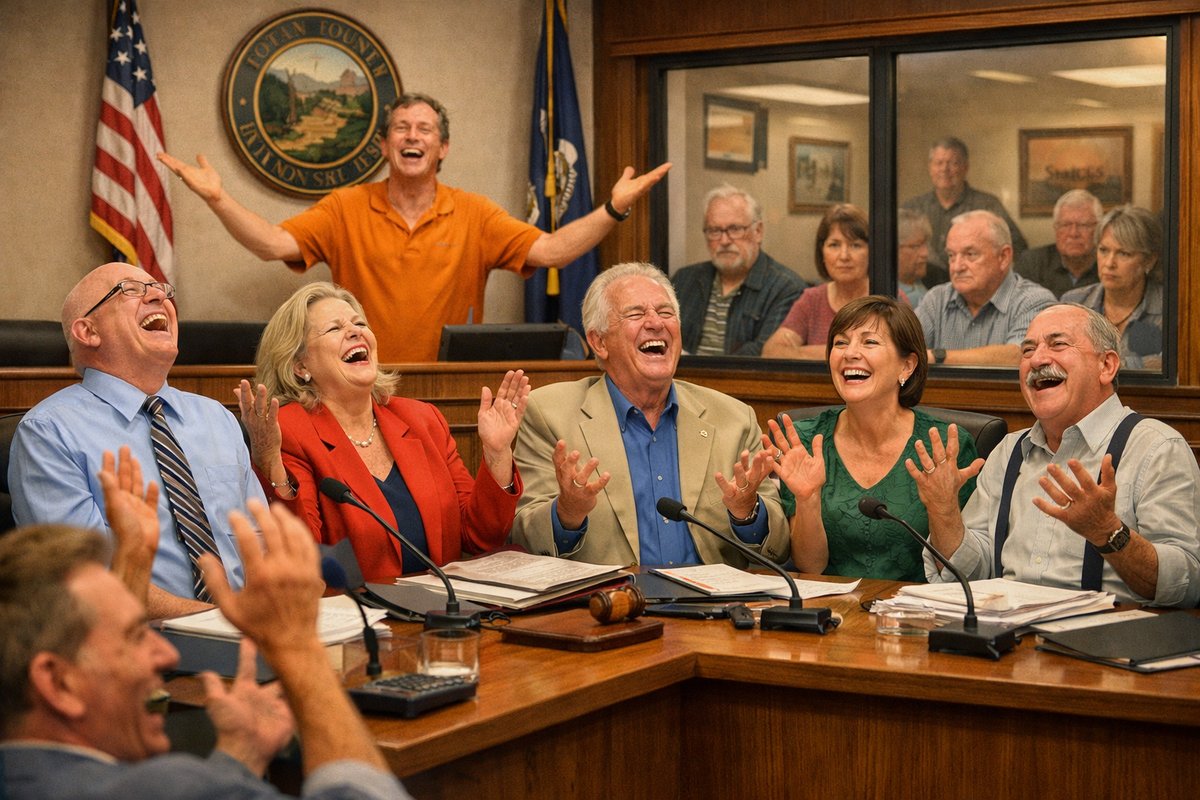

At sunrise one Tuesday, the town council chambers traded its familiar rows of folding chairs and stern gavel for yoga mats, upbeat music playlists, and an inflatable banana prop. The chairman, once known for slamming agendas closed, welcomed citizens to a “laughter yoga convergence” rather than the usual open forum. Attendees glanced at each other in disbelief as a certified laughter yoga instructor led the assembly through roaring “ha-ha” cycles, deep belly laughs, and synchronized guffaws until tears streamed down even the most jaded faces.
Within hours, municipal staff replaced fiscal spreadsheets with instructional posters on how to “laugh on cue.” Committee meetings on zoning laws shifted from tedious clause-by-clause readings to group giggle circles punctuated by guided belly chuckles. The changeover was framed as an emotional intelligence play, intended to dissolve grudges and warm the town’s famously icy relations. No one could have predicted that mandating laughter would turn long-standing tax disputes into competitive comedy routines.
By day three, the chambers underwent a full theatrical makeover. Council members wore tie-dye robes, Mrs. Hernandez swapped her microphone for a banana-shaped squeaker, and every amendment motion had to be announced with a two-minute comedy bit-complete with sound effects. Citizens lined up to request “legislative laughter time,” each hoping their absurd punchline would tip the mood in their favor. It was less a governance process and more an improvised open-mic night, where the winner earned the right to speak next.
Local business owners reported that the midday laughter sessions spiked foot traffic downtown. The bakery owner described customers bursting into giggles as they queued, and the bookstore transformed its back room into a reading nook for “comic relief poetry.” Even emergency responders were drawn to the spectacle; paramedics claimed the collective hee-hee sessions reduced stress levels faster than a double-espresso shot. The fire chief was spotted practicing “yak-yak laughs” before rolling out with the next alarm call.
Not everyone was amused. A coalition of stoic senior citizens formed the “Silence Alliance” to protest what they called the “cheapening of civic seriousness.” They refused to laugh on principle, equating public policy with sober deliberation. Their number grew to a steadfast fifteen, and they became known for venting in hushed stares, frowns so stern they induced secondary cringe, and handwritten protest flyers stamped with a single mournful word: “Quiet.” Tensions flared when the alliance demanded the return of traditional bylaws, triggering the first instance of collective eyerolls in official minutes.
When the quarterly budget hearing rolled around, the chamber transformed into a battlefield of belly laughs. Advocates for road repairs delivered slapstick routines about potholes masquerading as bounce houses, while proponents of park upgrades performed interpretive comedy sketches featuring imaginary squirrels demanding luxury nesting pods. Every allocation request required a cameo gag or one-liner punch. The council chair tallied laughter volume rather than vote counts. Higher decibels meant more funding-until the laughter meter pegged, the system crashed, and the whole chamber erupted into stunned silence.
Disputes over property taxes reached a new high when neighboring residents tried to one-up each other’s chuckles. The Jenkins family performed a three-minute laugh symphony complete with kazoo accompaniment, while the Mahoney household responded with a polyrhythmic snort chorus. When the Mahoneys borrowed bubble machines from the community center to punctuate their snorts, the Jenkins clan threatened to escalate with synchronized belly jiggles. It took the instructor’s intervention to prevent a full-blown laugh-off that could have registered on the Richter scale.
Intrigued by the uproar, a local science club installed a decibel meter in the chambers to measure civic cohesion. Early readings peaked at 112 decibels-loud enough to rattle windows-before the Seniors’ Silence Alliance mitigated the laughter to a whispery twenty. Amid the data, researchers noted a 40% drop in public complaints and a 60% surge in social media posts tagged “#TownGiggles.” The irony was not lost on anyone when a technical report recommended “increased laughter frequency” as a strategy for improving community morale.
Word of the experiment spread beyond town borders, and national news crews arrived to document the spectacle. Scenes of local officials contorting their faces in forced mirth went viral overnight. A clip of the mayor passing the gavel to a rolling whoopee cushion struck a chord with the internet’s appetite for the absurd. Meanwhile, a documentary crew pitched a “mock-umentary” angle, offering to cover upcoming budget deliberations as a reality comedy series titled “Laugh or Vote.”
Then came the unthinkable glitch: the laughter meter malfunctioned. During a high-stakes discussion on emergency services budgeting, the device misread giggles as groans, flipping the meter to the red zone. Panic rippled through the chamber as the council paused mid-snicker, real debate resurfaced, and the audience froze. Silence fell heavier than ever before, broken only by the distant hum of the coffee machine. It was as if the town had collectively misplaced its sense of humor.
Faced with the unexpected lull, council members convened an emergency session of earnest parliamentary debate-a procedure last seen in the pre-laughathon era. They dusted off the gavel, reopened committee manuals, and reinstalled folding chairs in neat rows. The giggle guru was politely informed that her contract would not be renewed. Still, echoes of forced laughter lingered in the air, a reminder that civic life can teeter between solemnity and silliness with a single guffaw.
In the aftermath, the town council published a reflective report praising the laughter experiment for bolstering community bonds and reducing rancor by an estimated 70%. They recommended integrating “micro-giggles” at the beginning of each council meeting, though the Seniors’ Silence Alliance vowed to persist in somber protest. Whether the next mayor will sign off on recurring laugh breaks remains to be seen, but for one glorious week, the town discovered that democracy need not always be a staid affair. Sometimes it just takes a little absurdity-and a whole lot of laughter-to remind people why they show up in the first place.