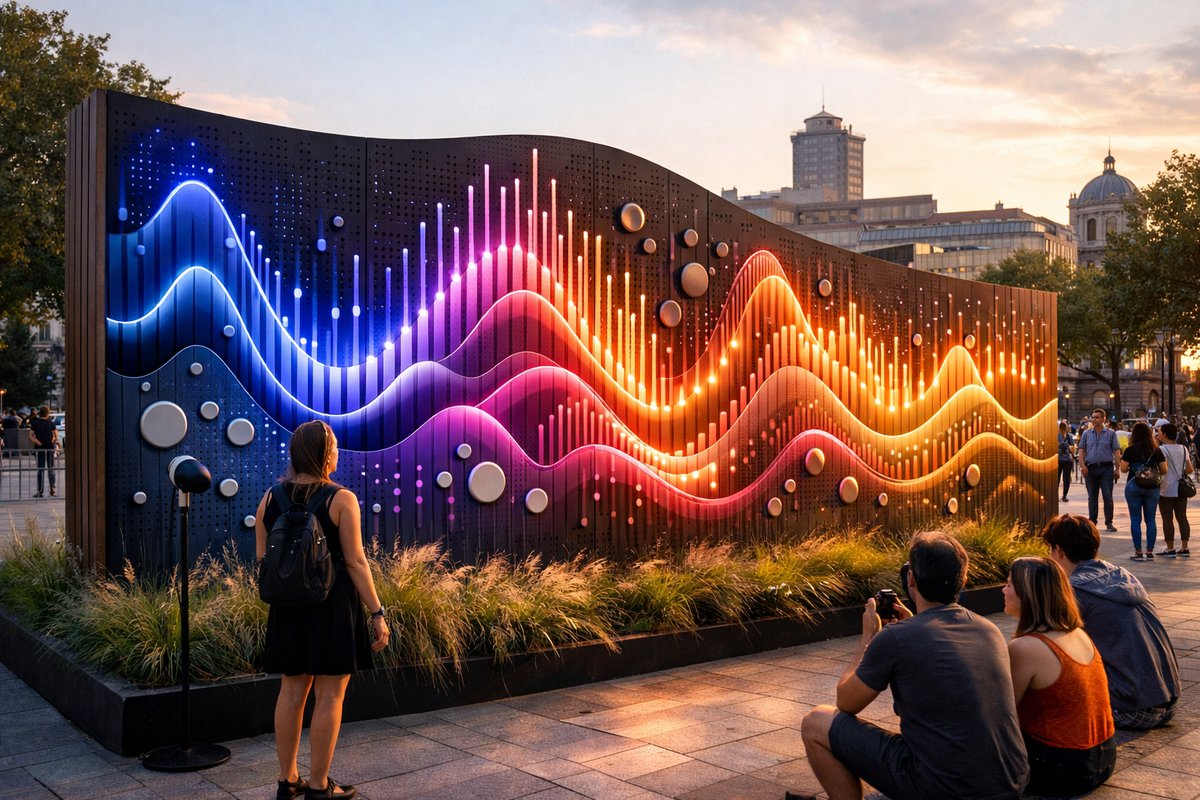

In a world where visual art often dominates public spaces, a new wave of designers is turning the cacophony of urban life into immersive, sculptural soundscapes. Imagine a wall that pulses with color and pattern in response to street chatter, vehicle hums, and bird calls-a living canvas that mirrors the city’s sonic fingerprint. By combining microphones, ambient sensors, and projection mapping, these so-called Resonant Walls invite passersby to witness the hidden rhythms of their surroundings.
At the recent Milan Design Week, one installation captivated crowds by translating day-long traffic noise into sweeping light forms across a repurposed industrial façade. Embedded sound sensors captured decibel fluctuations, feeding data into a generative design engine that rendered flowing lines and geometric blooms in real time. As rush-hour clamor peaked, the surface erupted in warm reds and oranges; during quieter evenings, soft blues and greens drifted across its panels. Visitors gathered at dusk, phones stowed, simply reveling in an ever-evolving urban symphony made visible.
Behind each Resonant Wall lies a modest yet powerful technical setup. Small condenser microphones, strategically placed around a perimeter, detect a wide range of frequencies. Those signals pass through ambient sound sensor modules, which filter and digitize the data. An Arduino-compatible microcontroller or single-board computer then processes incoming readings through custom software libraries, mapping amplitude and pitch to color values or pattern parameters. Finally, a mini LED projector or sound-activated LED strip lights up acrylic and recycled plastic surfaces, blurring the line between sculpture and digital display.
Material choices play a critical role in shaping each installation’s aesthetic and durability. Many artists favor sheets of translucent acrylic, which diffuse projected light into soft gradients and lend a ghostly glow to organic forms. Others work with repurposed polycarbonate panels salvaged from signage or packaging, embedding LED strips along their edges for a sharper, crystalline effect. Some crews even experiment with flexible textiles treated for outdoor use, transforming ordinary fabric into an illuminated tapestry that ripples under soft gusts of wind.
Sustainability underpins this movement as much as technology. Low-energy LED modules and efficient microcontrollers keep power demands minimal, allowing installations to run on solar panels or rechargeable battery packs. Biodegradable speakers and recycled sensor housings further reduce environmental impact. At a waterfront plaza in Copenhagen, a recent exhibition used driftwood frames and reclaimed marine plastics to mount sound sensors, weaving local waste streams back into the creative ecosystem.
The interactive nature of Resonant Walls invites community participation. In one Barcelona project, residents were invited to upload audio clips of neighborhood sounds-children playing, shop alarms, music drifting from cafes. The aggregated audio feed generated composite visuals that layered stories from different blocks into a collective mural. Passersby could plug in headphones to listen to raw recordings while watching flickering shapes play out across the wall, forging a multisensory bond between image and memory.
Urban planners and acoustic ecologists have taken note of how these installations reveal hidden sound patterns. By visualizing decibel hotspots and frequency clusters, city officials gain insights into noise pollution and its impact on quality of life. In Helsinki, a pilot program is exploring temporary sound-to-light displays at busy intersections to raise awareness about traffic noise levels, prompting redesigns of crosswalks and green buffer zones. In this way, art becomes both mirror and microscope, guiding urban design decisions through creative research.
Philosophically, Resonant Walls tap into a synesthetic impulse-crossing sensory boundaries to make sound visible and static space fluid. They harken back to mid-century experiments in visual music, yet harness 21st-century tools for real-time interaction. Observers find themselves oscillating between auditor and viewer, hearing in color and seeing in tone. Such experiences challenge assumptions about fixed forms and invite a more porous relationship with the built environment.
Open-source software platforms have accelerated this field’s growth. Contributors share code snippets that translate FFT analyses into color gradients, or trigger particle systems keyed to bass frequencies. Creative hardware communities swap 3D-print designs for weatherproof sensor mounts, and hobbyist forums host tutorials on synchronizing multiple projectors across large surfaces. As a result, emerging artists can prototype ambitious installations without corporate backing, fostering a vibrant ecosystem of DIY innovation.
Collaboration lies at the heart of many of these projects. Sound artists team up with architects, data scientists, and urban activists, blending technical expertise with social purpose. In one Amsterdam initiative, a design collective partnered with local housing cooperatives to map residents’ noise complaints, turning raw feedback into living murals that highlighted zones in need of better insulation or quieter infrastructure. By making data tangible and poetic, these collaborations bridge civic dialogue and aesthetic expression.
For public art programmers, Resonant Walls offer a versatile attraction. They can be deployed temporarily for festivals or integrated permanently into plazas and transit stations. Because they respond to local soundscapes, each installation feels uniquely rooted in its location-no two walls ever look the same. This dynamic quality keeps the public returning, fostering ongoing engagement rather than a one-off spectacle.
Looking ahead, designers are exploring next-generation hybrids that layer augmented reality elements or haptic feedback. Imagine donning lightweight AR glasses to see 3D soundforms hovering above a wall, or touching a panel that subtly vibrates in concert with a low hum. Others are investigating biometric inputs-heart rate or movement data-to personalize displays, creating installations that resonate with both sonic and physiological rhythms.
Whether as research tool, social mirror, or simply a dazzling city attraction, Resonant Walls mark a turning point in our relationship with public space. By translating ambient noise into vibrant, living art, they remind us that urban landscapes are not silent backdrops but symphonies waiting to be heard and seen. For curious makers and city dwellers alike, these sculptural soundscapes open a new chapter in creative expression, inviting us all to listen differently-and to see the music in everyday life.