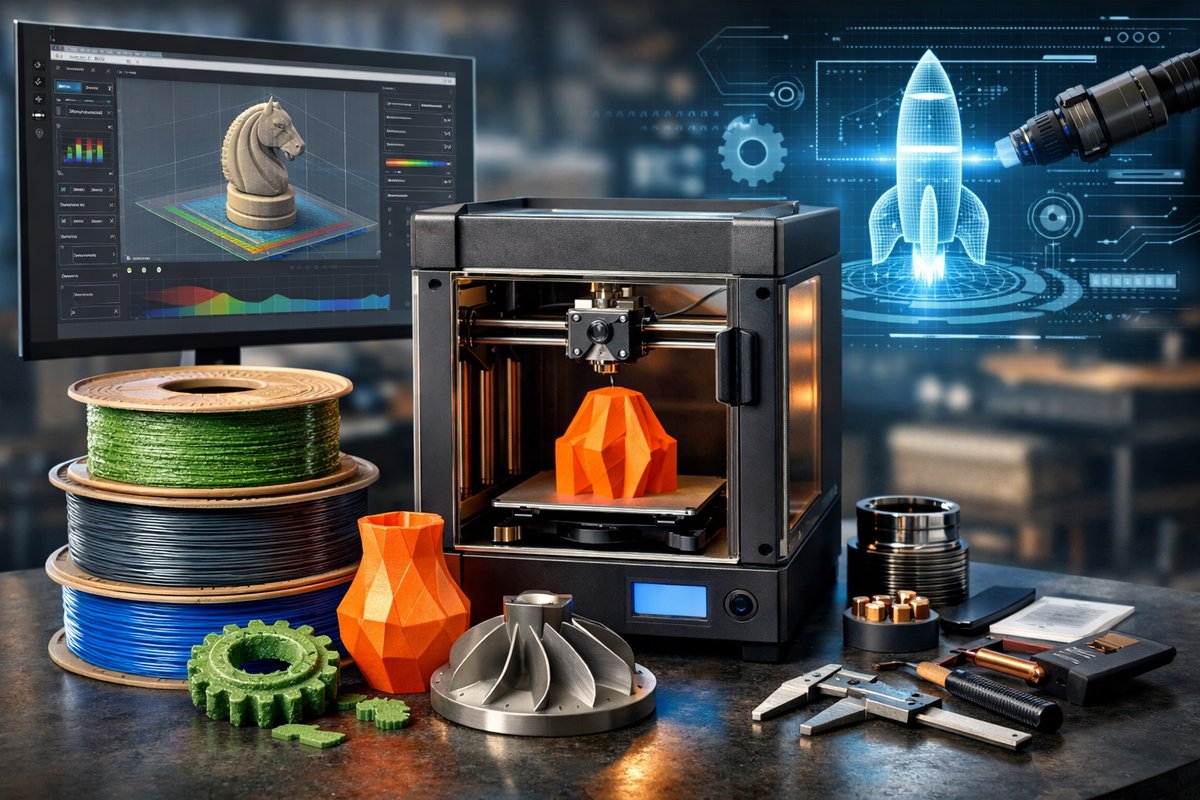

3D printing has moved far beyond early hobbyist rigs and experimental tooling. Today’s makers and professionals leverage a spectrum of technologies-from fused filament fabrication (FFF) and masked stereolithography (MSLA) to binder jetting and pellet extrusion-to drive down material costs, speed up production, and achieve consistent results. This article dives into the most impactful innovations and practical techniques that strike the balance between economy and excellence.
The Rise of Recycled and Composite Filaments
One of the biggest cost drivers in filament-based printing is raw material. High-quality PLA or ABS spools can add up quickly, especially in large-volume projects. Recycled filaments, created by remelting and extruding post-consumer plastics, deliver comparable strength and finish at a fraction of the price. Manufacturers are blending ground PET bottles with virgin PLA, producing spools that print smoothly while diverting waste from landfills.
Composite materials also enhance functionality without raising costs unreasonably. Wood-filled PLA, metal-filled PLA, and carbon-fiber-reinforced filaments let you mimic higher-end prints without buying multiple specialized machines. By adjusting nozzle temperature and print speed, you can achieve professional textures-wood grain effects, metallic sheens, or matte carbon finishes-while still using a standard FFF printer setup.
Pellet Extrusion: A Game Changer for Bulk Printing
For serious prototyping or short-run manufacturing, buying filament pellets by the kilogram is more economical than spools. Pellet extruder attachments fit onto many desktop machines, melting raw plastic pellets directly into a printable strand. This option cuts material cost per kilo by up to 70 percent compared to spooled filament. Beyond cost savings, pellets come in wider material varieties-high-performance polymers like nylon, TPU, or even polypropylene become affordable testing grounds.
High-speed Resin Printing with Masked SLA
Resin-based printers once meant slow layer curing with expensive vats of photopolymer. Masked SLA (MSLA) uses LCD panels to expose entire layers at once, massively speeding up throughput. Combined with fast-curing resins that solidify in seconds under UV, these systems deliver detailed prints in record time. Bulk resin purchases-specifically formulations designed for rapid curing-cut per-milliliter costs while maintaining crisp features and smooth surfaces.
Innovations in Post-Processing and Waste Reduction
Post-processing has historically been labor-intensive and messy. Automated wash and cure stations are now compact enough for desktop use, ensuring consistent part cleaning and full polymerization without wasted solvent or over-curing. Closed-loop solvent systems reclaim alcohol used in resin wash tanks, dramatically lowering solvent consumption. Filament scrap and failed prints can also be granulated and recycled, feeding desktop pellet extruders or community recycling bins.
Open-Source Hardware and Community-Driven Improvements
The open-source movement remains at the heart of affordable 3D printing. Projects like universal motherboard boards, tool-changer upgrades, and community-tested extruder designs mean you can add advanced features-auto-bed leveling, filament runout detection, modular hot ends-without proprietary lock-in. Online repositories share tested profiles and calibration guides, so you don’t waste material chasing optimal settings.
Smart Slicing: AI and Optimization Algorithms
Optimized toolpaths not only cut print time but reduce support material usage and surface imperfections. Emerging slicers incorporate AI-driven algorithms that analyze geometry to place supports more efficiently, adjust infill density dynamically, and vary layer thickness in regions that demand detail versus strength. These intelligent strategies can halve material consumption while boosting print success on the first try.
Modular Enclosures for Temperature Control
Stable ambient temperature is key to consistent layer adhesion-particularly when printing engineering plastics like ABS or PC. Modular enclosure kits snap onto standard frames, maintaining a warm interior and shielding delicate prints from drafts. Some feature integrated LED lighting, air filtration, and access panels for spools or tools. When combined with a small heater or heat mat, these enclosures enable large prints with minimal warping.
Dual-Material and Color-Swapping Upgrades
For makers seeking functional or aesthetic complexity, dual-extrusion setups offer new possibilities. Modern chimera or mashup hot ends mix two filaments seamlessly, enabling soluble supports or striking color transitions without manual filament swaps. This approach reduces post-processing steps-dissolvable PVA supports eliminate break-away artifacts-and turns a single-nozzle machine into a versatile multi-material workstation.
Cloud-Connected Printers and Remote Monitoring
Remote print monitoring and control have exploded in popularity. Wi-Fi-enabled boards pair with cloud slicing platforms, allowing you to send G-code to your machine from anywhere. Smart cameras watch prints in real time, triggering pause or shutdown if a failure is detected. Early detection saves hours of wasted filament and frees you from babysitting long jobs.
Hybrid Manufacturing: Combining CNC and Additive Techniques
Additive and subtractive processes are converging to unlock higher tolerances. Some desktop setups integrate tool heads that swap between extruder and miniature router, mill, or laser. The result: printed parts can undergo on-machine finishing passes, achieving smooth surfaces and precise holes without moving between machines. This hybrid workflow streamlines production and cuts out external machining costs.
Streamlined Workflow: From CAD to Print in Minutes
Time to first print has shrunk thanks to better internal communication between CAD tools, slicing software, and firmware. Many design packages now export printer-ready files with predefined printer profiles. One-click slicing and auto bed-leveling scripts mean you focus on creativity and iteration instead of fiddling with G-code parameters.
Real-World Applications Driving Efficiency
Medical modeling and dental labs lead the charge on low-waste, high-precision builds. Biocompatible resins cured in sealed chambers yield surgical guides and crowns with micrometer accuracy. In manufacturing, jigs and fixtures printed in durable composite filaments reduce assembly time and cut factory expenses. Even in architecture, large-scale polymer printing-when paired with recycled binder jets-allows builders to fabricate custom facade panels at low cost and weight.
Tips for Success Without Breaking the Bank
• Calibrate Once, Print Many: Spend time on a meticulous initial calibration. A well-tuned Z-offset and PID-tuning session can slash failed prints long-term.
• Keep Spares Handy: Nozzle clogs and bed adhesives are inevitable. Stock up on alternative nozzles, spare springs, and adhesion sheets to minimize downtime.
• Join a Local Maker Collective: Shared filament recycling, group buys, and swap meets reduce material costs and spread knowledge.
• Leverage Community Resins and DIY Wash Stations: Homemade IPA wash stations built from off-the-shelf parts save hundreds compared to commercial models.
• Embrace Batch Printing: Nest small parts in a single build to maximize plate utilization and reduce warm-up cycles.
From recycled filaments and pellet extrusion to AI-assisted slicing and hybrid tool heads, the latest advances in 3D printing target exactly what every maker and professional craves: lower costs, higher throughput, and reliable outcomes. By staying current with open-source upgrades, material innovations, and workflow automation, you can spin up complex prototypes, functional end-use parts, or artistic creations faster and more affordably than ever before. The quiet revolution of layer-by-layer manufacturing continues to empower imagination with precision-and the next breakthrough could land on your desktop tonight.